FEGAN
The surname Fegan is firmly rooted in the island of Ireland, tracing its lineage to the Gaelic linguistic tradition of the Celtic peoples. It derives from the original patronymic Ó Faodhagáin, a form meaning “descendant of Faodhagán.” The base personal name Faodhagán is itself a diminutive of Faodhagan, which is borrowed from the Gaelic word faodh meaning “wild” or “untamed.” Consequently, the surname may be understood to represent “descendant of the wild one” or “descendant of the untamed.”
Alternative etymological interpretations also appear in contemporary scholarship. One view considers the Gaelic faodhach – meaning “fruitful” or “productive” – joined with the suffix –an, which denotes “one who.” Under this construction the name could be rendered as “descendant of the productive one.” Both interpretations, however, are anchored in the same linguistic root and retain the patrilineal emphasis indicated by the prefix Ó, which denotes a male descendant. The association with the verb faodh (to hunt) also yields an alternative translation as “male descendant of the hunter.”
In the medieval period the surname was documented in several redacted forms, including O' Fegan, O' Feehan, Feehan and simply Fegan. Crystallising evidence places its earliest concentration in the province of Munster, specifically the Western County of Cork. By the Middle Ages members bearing the name had dispersed to neighbouring counties of Kilkenny and Tipperary, where parish registers and legal documents record instances such as Phillip O' Fethan, convicted of robbery in County Tipperary in 1359, and Teag MacNicholas O' Feehan, granted pardon in 1601 after pledging loyalty to the English Crown. The surname never achieved widespread commonness; census entries of the 19th century record fewer than a hundred householders in counties such as Tipperary.
Within the historical record, a considerable degree of orthographic variation is evident. The form O Faodhagain appears in deeds, wills and court rolls. Spelling alternatives such as Feagan, Feighan, Feieny, Fagan and Faegan have all been attested, reflecting the fluidity of transliteration from Gaelic to English scripts during the early modern period. When Irish families migrated to England, North America or Australasia, some chose to anglicise further, producing surnames such as Egan, Keegan, MacEgan and Feeney. These transformations often reflected phonetic approximation or an attempt to better fit the linguistic norms of the host country.
The connection between the name and the Anglo‑Norman surname Hunt or Hunter is documented in certain lines of tradition. In that view, the Gaelic Faodhagain could be viewed as a Gaelic equivalent of the English hunting surname, introduced after the Norman invasion of Ireland in 1170 by the forces of the Earl of Pembroke, known as Strongbow. By adopting the Gaelic patronymic, clan leaders may have attempted to merge their ancestral identity with the new socio‑political realities brought by the Norman conquest.
Additional legend preserves the story of a 12th‑century landholder named Patrick Fagan of County Meath who, according to chroniclers, adopted the surname Fagan under a directive from King John of England. Although the motivations behind this change remain unclear, the episode suggests that some branches of the family may have possessed estates of sufficient standing to attract royal attention. Further evidence of the surname’s mobility is found in the case of Christopher Fagan, who fled to Cork city in 1497 following his support of Perkin Warbeck’s insurgent claim to the English throne. Cork, at that period, was notable for its political leanings and thereby offered asylum to adversaries of the English Crown.
In County Mayo, early records indicate the presence of a Fegan family seat that endured for many generations. When the political turbulence of the 17th and 18th centuries prompted a mass exodus of Irish families, members of the Fegan clan migrated across the breadth of Ireland and beyond. As a result, the name can now be located not only in the core regions of Munster, Leinster and Connacht but also, through the Irish diaspora, in nations such as England, Canada, Australia and the United States. Even so, it remains relatively uncommon when compared with more prolific Irish surnames such as O'Connor or Murphy.
Practised systematically, the surname Fegan illustrates the processes of linguistic emulation and cultural continuity within Ireland. Each variant narrates a fragment of a broader tapestry of Gaelic identity, Norman influence, and the shifting socio‑political dynamics that shaped the medieval and early modern kingdom. Its recovery from parish registrations, court documents and legal charters provides essential insights for genealogical research, shedding light on the intricate relationships between name, place and heritage.
Typical given names associated with the Fegan surname
Male
- Brian
- David
- James
- John
- Michael
- Patrick
- Paul
- Sean
- Thomas
- William
Female
- Catherine
- Claire
- Eileen
- Elizabeth
- Jennifer
- Karen
- Kathleen
- Margaret
- Mary
- Patricia
- Sarah
- Sharon
Similar and related surnames
- Feagan
- Fagan
- Fagans
- Fagin
- Fagen
- Faggan
- Facon
- Facuna
- Faggian
- Faggiani
- Faggin
- Faghani
- Fagon
- Fagun
- Fakun
- Faucon
- Faucouneau
- Faughan
- Fawknee
- Feagon
- Feakin
- Feegan
- Fegans
- Feggan
- Feggans
- Feggin
- Fegin
- Feigan
- Feighan
- Feiken
- Fekini
- Ficken
- Fickin
- Figan
- Figgan
- Figgin
- Figon
- Figoni
- Focone
- Fogan
- Foggan
- Foggen
- Foggin
- Foggon
- Fokin
- Fokina
- Fykin
- Phukan
- Vacani
- Vaccon
- Vagani
- Vaghan
- Vaghani
- Vagon
- Vakani
- Vaugan
- Vaughan
- Vaughen
- Vaughin
- Vican
- Vicken
- Vickin
- Vicuna
- Vigan
- Vigano
- Viggiani
- Viggiano
- Vigon
- Vikan
- Viken
- Vogan
- Vokoun
- Voughan
Related and similar names are generated algorithmically based on the spelling, and may not necessarily share an etymology.
How to communicate the surname Fegan in...
Braille
⠋⠑⠛⠁⠝
Morse
..-..--..--.
Semaphore
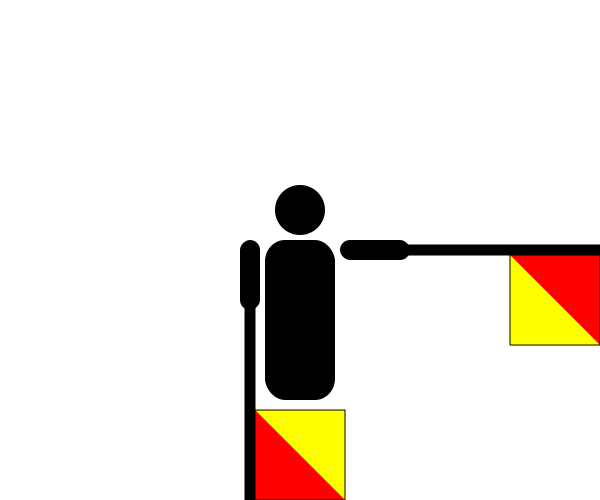


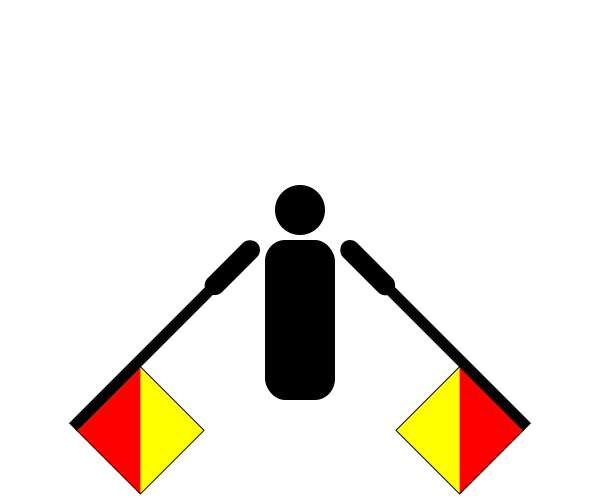
There are approximately 1,088 people named Fegan in the UK. That makes it roughly the 6,918th most common surname in Britain. Around 17 in a million people in Britain are named Fegan.
Origin: Celtic
Region of origin: British Isles
Country of origin: Ireland
Religion of origin: Christian
Language of origin: Gaelic

Famous people named Fegan
- John Fegan - Rugby union player (1872 to 1949)
- J. W. C. Fegan - Evangelist (1852 to 1925)
Names and descriptions courtesy of Wikipedia, and may contain errors. This is not intended to be an exhaustive list of every famous person with this name.