FEELEY
Feeley is a surname of Gaelic, Irish origin, derived from the Irish patronymic Ó Fithcheallaigh, which means âdescendant of Fithcheallach.â The personal byname *Fithcheallach* is interpreted as âchess-playerâ, a reference to a chess-like board game that was played in ancient Ireland. This etymology links the name to both cultural pastime and the clan’s martial tradition.
The earliest recorded instance of the name is that of Donal O Fithcheallaigh, dated to around 1500, a chronicler of the Irish annals who lived during the reign of King Henry V of England. By the sixteenth century the surname had become anglicised in several forms, including Feely, Feal(e)y, O' Fihily, O' Fihillie, O' Fielly, Fihelly, Fe(e)hely, and most importantly Feehily and Field. In a County Cork Fiant paper dated 1584, two individuals bearing the names O'Fihelly alias Field appear, illustrating the early substitution of the English surname *Field* for the Gaelic original.
The clan of Feeley originally belonged to the Corca Laoidh of south-west Cork, holding territory in Ardfield and Clonakilty. Two notable members of the sept are recorded: Maurice O'Fihily (deceased 1516), Archbishop of Tuam and editor of the works of John Scotus, and Maurice O' Fihelly (deceased 1559), Bishop of Ross. By the seventeenth century branches of the sept had become established in north Connacht and County Donegal, which remain key areas of concentration of the name to this day.
In the early nineteenth century Reverend James Feeley (1799-1875) served as Dean of Raphoe, a position that further cemented the surname’s presence within ecclesiastical circles in the Republic of Ireland. The name also migrated to the British mainland, largely through the process of anglicisation. Stated metrics such as the region British Isles and country England, together with the language English and the prevailing Christian religion, describe the broader context in which the name found some foothold. The designation of Feeley as an English surname of type `Location or Geographical Feature' reflects that many bearers in England adopted a form of the name that emphasises the place of settlement rather than lineage.
In summary, the surname Feeley encapsulates a rich linguistic heritage that blends Gaelic patronymic tradition, the cultural significance of ancient board games, and the historical processes of anglicisation that spread the name beyond Ireland to the wider British Isles. Its persistence across centuries, both in Ireland and in England, stands as a testament to the enduring legacy of this distinct family identity.
Typical given names associated with the Feeley surname
Male
- Andrew
- Christopher
- Colin
- David
- James
- John
- Mark
- Martin
- Michael
- Paul
- Robert
Female
- Carol
- Claire
- Deborah
- Elizabeth
- Frances
- Jacqueline
- Kathleen
- Laura
- Lisa
- Louise
- Margaret
- Mary
- Michelle
- Patricia
- Sarah
Similar and related surnames
- Faeley
- Faelli
- Failey
- Failie
- Faily
- Faley
- Falley
- Fally
- Faly
- Falys
- Fawley
- Fealey
- Feally
- Fealy
- Feehally
- Feehely
- Feehley
- Feel
- Feele
- Feeles
- Feelly
- Feely
- Feheley
- Fehley
- Feiley
- Feili
- Feilly
- Feily
- Fele
- Feley
- Felie
- Felis
- Feliz
- Felle
- Felley
- Felli
- Felly
- Fielly
- Fiely
- Phaley
- Pheeley
- Pheely
- Phelly
- Phely
- Vailey
- Valey
- Valley
- Vealey
- Vealy
- Veeley
- Veley
- Velly
- Vely
- Vielly
Related and similar names are generated algorithmically based on the spelling, and may not necessarily share an etymology.
How to communicate the surname Feeley in...
Braille
⠋⠑⠑⠇⠑⠽
Morse
..-....-...-.--
Semaphore
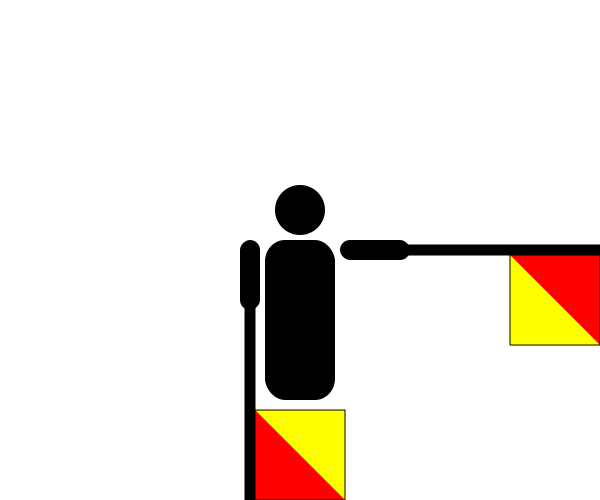


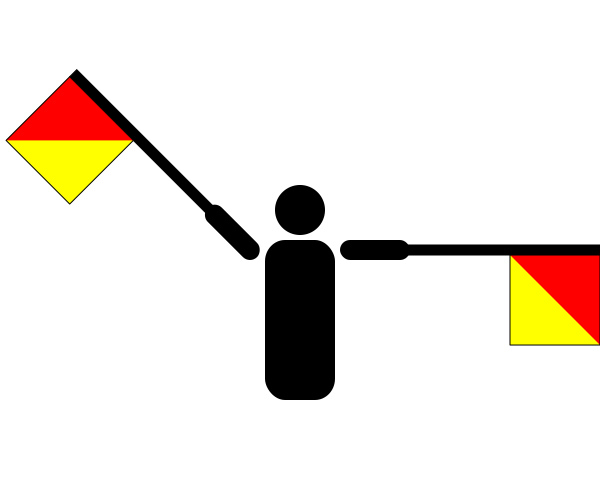
There are approximately 1,332 people named Feeley in the UK. That makes it roughly the 5,891st most common surname in Britain. Around 20 in a million people in Britain are named Feeley.
Surname type: Location or geographical feature
Origin: English
Region of origin: British Isles
Country of origin: England
Religion of origin: Christian
Language of origin: English
