FEASTER
The earliest evidence of the surname Feaster dates back to the sixteenth century, when Olyver Fester was christened at St Andrews Church in Holborn on 23 May 1560, during the reign of Queen Elizabeth I. This record confirms the name’s existence within England at a time when surnames were still often derived from a person’s occupation or habitual nickname.
According to historical analyses, Feaster originates from the Middle English word fest, meaning a feast or festival. It was likely employed as an occupational surname for an individual who organised or took part in feasts, or for one who was noted for generous hospitality. Another line of evidence points to an Old German source, the word Veizet, which denoted a good eater – a definition that could correspond to a food taster or a meal preparer in a noble household. The confluence of these linguistic roots suggests that bearers of the name were associated with the planning or enjoyment of celebratory food.
Geographically, the surname is most firmly rooted in the English east, from Lincoln through North Yorkshire. Notable parish registers record a Raph Feaster as a christening witness at St Dunstans Church, Stepney on 10 January 1622; Elizabeth Feaster of Bolton on Dearne on 23 January 1605; and John Feaster of Eston in 1727. The name is particularly well preserved in coastal towns such as Scarborough, Fylingdales, Saltburn, and Whitby, where many families with the surname have lived for centuries.
Historical speculation has linked the surname to 17th‑century engineers who supervised large drainage schemes along the East Coast, and to the Huguenot diaspora; however, no definitive documentary proof exists for either association. In any case, by the early eighteenth century the name appears to have become firmly English, independent of continental migration.
In the United States, the surname is predominantly found in the South and the Northeast, especially in Maryland, Pennsylvania, Virginia, and North Carolina. The first American record of the name dates from the Revolutionary period, with Christopher Feaster joining the North Carolina militia in 1777. Over time the surname has spread across the country, often carrying with it the legacy of its English occupational origin.
The spelling of Feaster has varied widely over the centuries, with variants such as Feister, Festor, Fester, and others recorded in parish and civil registers. These alternative forms derived from the same root words – fester meaning ‘feast maker’, faster meaning ‘fast or strong’, and fest meaning ‘feast’. As a result, genealogy researchers must consider a broad spectrum of spellings when tracing the lineage of families bearing this surname.
Similar and related surnames
Related and similar names are generated algorithmically based on the spelling, and may not necessarily share an etymology.
How to communicate the surname Feaster in...
Braille
⠋⠑⠁⠎⠞⠑⠗
Morse
..-...-...-..-.
Semaphore
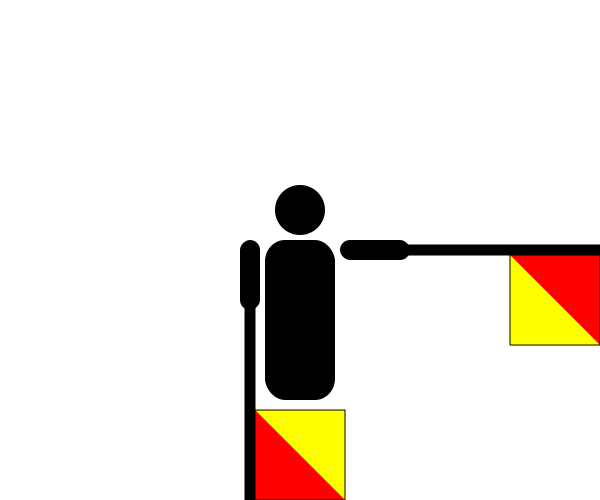


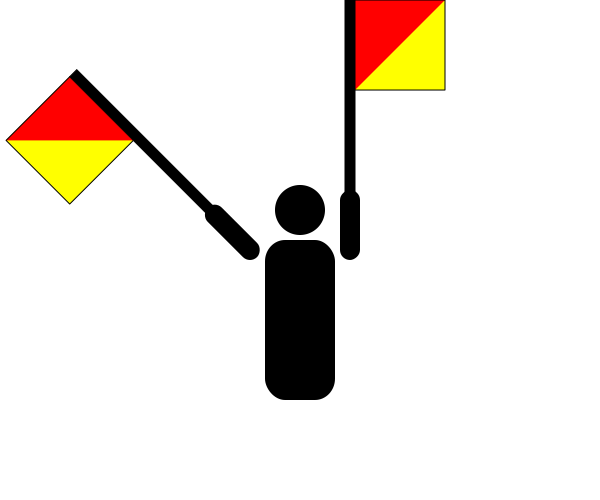
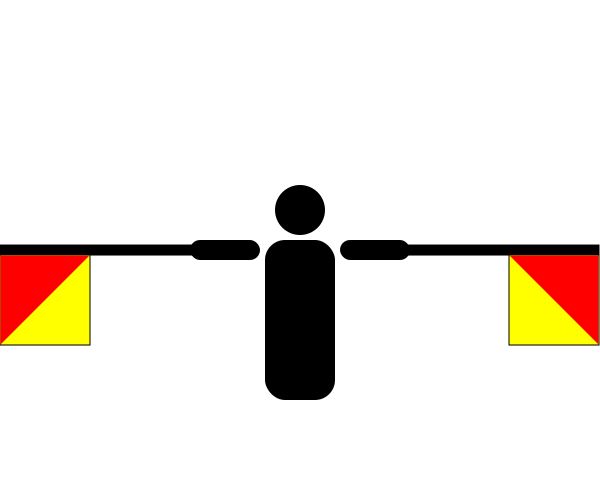
There are approximately 38 people named Feaster in the UK. That makes it one of Britain's least common surnames. Only around one in a million people in Britain are named Feaster.
Origin: English
Region of origin: British Isles
Country of origin: England
Religion of origin: Christian
Language of origin: English
