FEARN
Fearn is a surname with roots in the British Isles, particularly in England and Scotland, and it also bears a Gaelic connection. Its lineage is traced to the Old English word fearn and the Gaelic term fèarn, both of which mean “fern”. The name is thus a topographical surname, originally given to individuals who lived in proximity to fern-covered haunts or who hailed from a locality named after this plant.
Ferns occupy a symbolic place in the cultural imagination of the British countryside. They are associated with endurance, resilience and a form of natural protection, traits that may have been regarded as desirable by the early bearers of the surname. Consequently, the name Fearn could also have been bestowed upon those who exemplified such qualities, or simply marked the habitation of those dwelling among abundant ferns.
The earliest documentary evidence of the name appears in the latter half of the thirteenth century. In 1275 the Pipe Rolls of Worcestershire record a John de la Ferne, a name that demonstrates the medieval spelling that would evolve into the modern surname. Another early witness, Joceus de Ferne, is recorded in the Sussex Subsidy Rolls of 1296. These entries show that the surname was well established by the middle ages and that its bearers were dispersed across what is now southern England.
Over the centuries the name Fearn has been represented by numerous orthographic variants, including Fern, Fearne, Farn, Fairn, Feirn, Vern, Verne and Varne. The divergent spellings often reflect regional pronunciation differences, particularly the developments in south-western Middle English that introduced a voiced initial consonant in the forms with v-. The use of hyphens is common in English surnames of this type when a compound form is required, although the plain form is most commonly encountered.
An episode of historical interest is the marriage of John Fearn and Chateristin Shimpson on 11 February 1599, which took place in the parish of St. Matthew on Friday Street, London. This record illustrates the dissemination of the family name into the capital during the Renaissance period. In later centuries the name is attached to notable individuals, most prominently John Fearn (1768–1837), a philosopher, who published a significant work titled Manual of the Physiology of Mind in 1829.
Throughout its history, the surname Fearn has remained associated with the landscape of the British Isles and retains a classic British heritage. Its linguistic origins, historical documentation, and the symbolic attributes linked to the fern plant contribute to a rich genealogical narrative that transcends modern geographic boundaries while preserving its medieval roots.
Typical given names associated with the Fearn surname
Male
- Andrew
- David
- James
- John
- Mark
- Michael
- Paul
- Peter
- Richard
- Robert
- Stephen
Female
- Emma
- Helen
- Jane
- Jayne
- Julie
- Lynn
- Margaret
- Mary
- Nicola
- Patricia
- Sarah
- Susan
Similar and related surnames
- Fehn
- Fahrni
- Farnes
- Farney
- Farn
- Fairn
- Farne
- Farna
- Fairns
- Fahrny
- Feran
- Fear
- Fearne
- Fairnie
- Farnie
- Farns
- Farny
- Faun
- Fawn
- Fearan
- Fearnes
- Fearney
- Fearns
- Fearon
- Feern
- Feirn
- Feirns
- Fern
- Fernay
- Ferne
- Fernee
- Fernes
- Ferney
- Ferni
- Fernie
- Ferns
- Ferny
- Fiern
- Fierny
- Firn
- Firne
- Forn
- Forne
- Furn
- Furne
- Vaern
- Varn
- Varne
- Vern
- Verne
- Fairney
- Fauns
- Fawns
- Feare
- Fearen
- Fearin
- Fearm
- Fearnby
- Fearnly
- Fearnough
- Fearr
- Fears
- Fernau
- Fernis
- Fierney
- Firns
- Forna
- Forni
- Forno
- Furna
- Furno
- Furns
- Phairn
- Vaernes
- Varns
- Verns
- Farrin
- Farron
- Ferron
- Fruen
- Virani
Related and similar names are generated algorithmically based on the spelling, and may not necessarily share an etymology.
How to communicate the surname Fearn in...
Braille
⠋⠑⠁⠗⠝
Morse
..-...-.-.-.
Semaphore
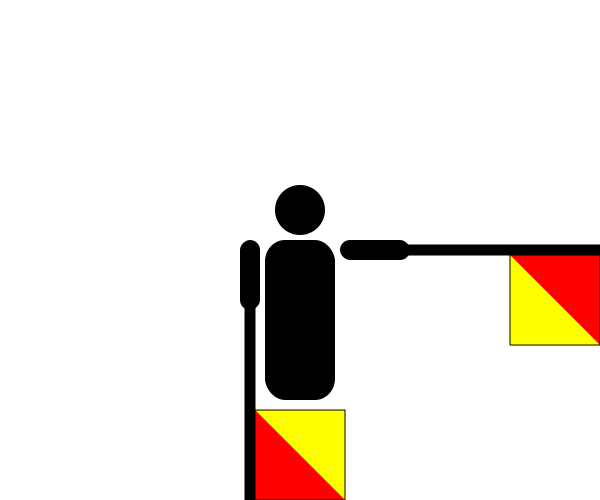


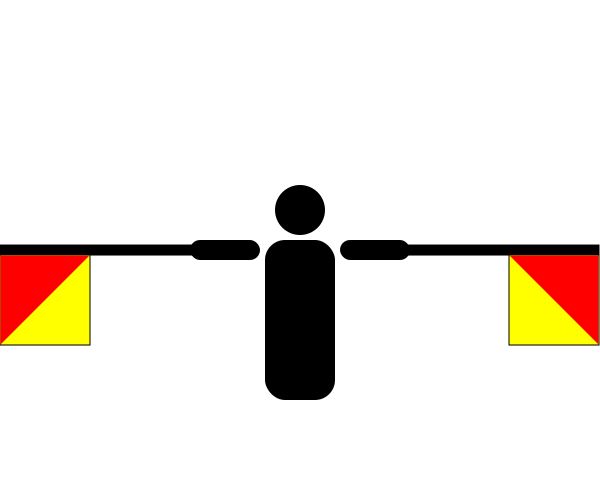
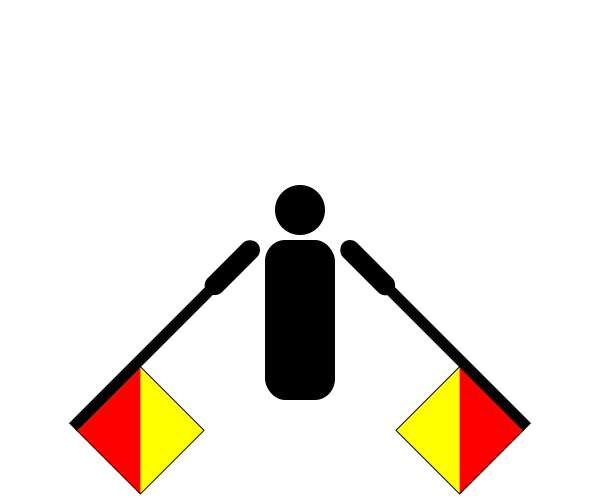
There are approximately 5,281 people named Fearn in the UK. That makes it roughly the 1,790th most common surname in Britain. Around 81 in a million people in Britain are named Fearn.
Origin: English
Region of origin: British Isles
Country of origin: England
Religion of origin: Christian
Language of origin: English

Famous people named Fearn
- Sheila Fearn - Actress
- Ronnie Fearn, Baron Fearn - Politician
- Robin Fearn - Diplomat (1934 to 2006)
Names and descriptions courtesy of Wikipedia, and may contain errors. This is not intended to be an exhaustive list of every famous person with this name.