FAY
Fay is a surname that can be traced to several distinct linguistic and cultural origins across the Atlantic Romanic Republic of France, Ireland and the broader British Isles. In its earliest recorded instances the name appears in the 12th century in Sussex, England as Ralph de Faia, a spelling that itself reflects the Old French influence of the Norman conquest.
In Ireland the surname is often seen as an Anglicised form of the Gaelic patronym Ó Fiaich, literally meaning “descendant of Fiaich.” The root name Fiaich is associated with the original Gaelic word fáidh which translates as “poet” or “prophet.” This association suggests that early bearers of the name were either poets or individuals reputed to possess prophetic insight in the ancient Irish tradition.
Another early Irish use of Fay derives from the Gaelic *fáidh* and is sometimes linked to the Christian tradition of the 12th century, when the surname appears within the context of Gaelic-speaking clerics and laypersons. The religious setting points to a convergence of poetic, prophetic and Christian connotations embodied within the name.
Across the Channel the surname has a well‑documented French lineage. In medieval France it is chiefly understood as a locational surname, taken from a place called Fay in the northern part of the country. The toponym itself comes from the Latinised form of the Old French *fai*, meaning “beech tree.” The earliest attestations of this locational usage are recorded in the 14th‑century de‑faim lists of Herefordshire and the Pipe Rolls of Surrey, where the name appears as Richard de Faye (1242) and Margaret le Fey (1332).
In the same period, secondary theories point to a nickname origin, whereby the surname was applied to a person believed to have supernatural or “fairy‑like” qualities. This derivation again stems from Old French *fae*, meaning “elf” or “fairy.” Medieval accounts sometimes associate the name with performers or actors in travelling theatre who would play the part of a fairy, thereby giving rise to a nickname that carried over into family use.
The English language also provided another layer of meaning through Old English *fei*, a word for “loyalty.” In early parish registers, entries such as the christening of Jone Phaye in 1597 and the civil marriage of Mary Fay in 1681 illustrate the Ireland‑England branch of the surname that may have originated from this loyalitise‐based nickname. The former is found in the Church of St. Botolphs without Aldergate, London, while the latter is recorded as a civil license in London.
Coat‑of‑arms records provide further historical grounding. In 1629, a grant was made to a family bearing the surnames R. Fay or R. Fay in County Kildare, Ireland, with a blazon that includes a green field, crossed silvery arms, a sword raised, and a dragon’s head decapitated from the blade. That heraldic description reflects the martial and chivalric associations common in surnames of that era.
Within the United Kingdom, the name has a noticeable concentration in the western and north‑western provinces, especially in County Fife of Scotland. Variants such as Fee and Fey appear throughout the English counties of Devon, Dorset and Cornwall, illustrating the diffusion of the surname across the British Isles. The earliest ToR entries frequently show the name in a nominative sense, sometimes as a plain personal identifier.
In the United States the surname appears as one of several Anglicised forms brought over by immigrants. According to 19th and 20th‑century census data the highest frequency remains in the New England region, especially in Massachusetts and Vermont. While globally the name is less common than other French or Irish surnames, it is still found as a minority case in France, Ireland and England today.
Various orthographic variants have developed over time. These include Faye, Fayy, Faie, Fee, Fey, Lefay, Defay in France and O'Fiaich, O'Fea, McFay, Feehan, Fegan, Fagan in Ireland. The multiplicity of forms demonstrates the way the surname adapted to various linguistic environments over the centuries.
Overall, the surname Fay serves as a testament to the intertwined histories of the French, Gaelic and Anglo‑Saxon peoples. It carries linguistic layers that reveal both a poetical or prophetic heritage in Ireland, a locational reference to beech trees in France, and symbolic associations with faith, loyalty, and the supernatural in England and Scotland. The diversity of its spelling variants and the variety of regions in which it appears underscore the fluid nature of surnames across time and geography.
Typical given names associated with the Fay surname
Male
- Anthony
- Christopher
- James
- John
- Michael
- Patrick
- Paul
- Peter
- Stephen
- Thomas
Female
- Catherine
- Clare
- Elizabeth
- Helen
- Julie
- Linda
- Lisa
- Margaret
- Mary
- Patricia
- Rebecca
- Sarah
- Susan
Similar and related surnames
Related and similar names are generated algorithmically based on the spelling, and may not necessarily share an etymology.
How to communicate the surname Fay in...
Braille
⠋⠁⠽
Morse
..-..--.--
Semaphore
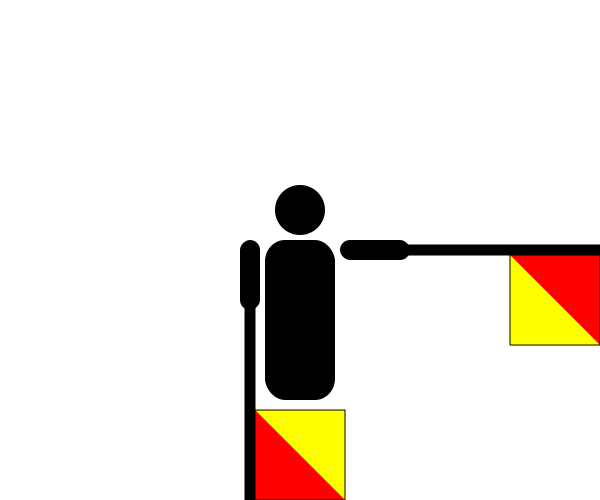

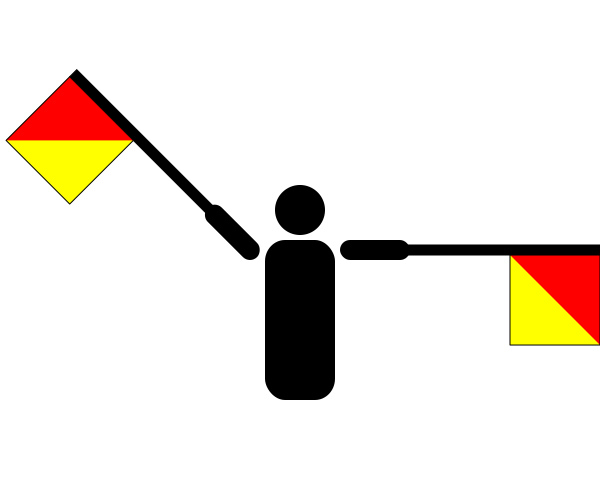
There are approximately 3,277 people named Fay in the UK. That makes it roughly the 2,770th most common surname in Britain. Around 50 in a million people in Britain are named Fay.
Origin: Celtic
Region of origin: British Isles
Country of origin: Ireland
Religion of origin: Christian
Language of origin: Gaelic

Famous people named Fay
- Gemma Fay - Scottish football player
- Sam Fay - Engineer (1856 to 1953)
- Edgar Fay - Judge (1908 to 2009)
- Ricky Fay - Cricketer
Names and descriptions courtesy of Wikipedia, and may contain errors. This is not intended to be an exhaustive list of every famous person with this name.