FAUX
The surname Faux is of French origin and appears in the historical record of the British Isles from the immediate aftermath of the Norman Conquest. The name first shows up in the Pipe Rolls of Worcestershire in 1182, where a man named Tomas Falch is recorded. Subsequent documentation in 1221 lists Walter Falc and in 1273 a William Faukes is seen in the Hundred Rolls of Norfolk. Over the following century the spelling of the surname varied, with forms such as Falk, Fauke, Fakes and Faukys appearing in the records of 1275, 1305 and 1327.
The etymology of the name is multi‑faceted. In modern French the word faux translates as “false” or “deceptive”, a meaning that is reflected in the nickname that once would have been applied to a person regarded as deceitful. Older usages point to the Old French personal name Fau(l)que(s) and to the Old German word Falco, meaning “falcon”. Another source suggests a link to the Old French term fau, the latinised word for “beech”, which would have produced a topographic surname for someone dwelling near a beech tree. These multiple derivations show that the surname developed from both descriptive nicknames and toponymic origins.
During the reign of King Henry VI a record from 1443 in the Cartulary of Oseney Abbey, Oxfordshire, shows a Roger Faux as a bearer of the name. By the early eighteenth century, the surname had spread beyond England: on 17 February 1634 a man named John Faux, aged 36, is documented as having embarked from London on the vessel Hopewell bound for the Barbadoes. This appears to be one of the earliest documented migrations of the name to the New World.
Throughout the 17th and 18th centuries the name variously appeared as Fawke, Faux, Falco, Falk, Falcons, Fake, Fawkes and Fowkes. Certain scholarly conjecture associates the French surname with the later English spelling Fawcett, although the latter may itself derive from a different locational origin in England. Such variations are typical of medieval spelling practices, where phonetic transcription led to a spectrum of surnames that are recognisably linked in modern usage.
In contemporary times the surname Faux remains relatively uncommon but can still be found predominantly in English‑speaking countries such as the United Kingdom, the United States, Canada and Australia. The name also persists in France, where it appears alongside its Greek‑derived cognates. Its spread beyond the French borders is largely attributable to the migration of Huguenots in the 16th and 17th centuries, who fled religious persecution and settled in regions of England and the Americas.
Thus, the surname Faux illustrates the complex tapestry of linguistic evolution, migration and social identity that characterises many European family names. From its earliest recorded appearances in English legal documents to its modern-day presence on courts and registries, the name retains its French heritage while reflecting the breadth of its historical development across continents and centuries.
Typical given names associated with the Faux surname
Male
- Andrew
- Benjamin
- David
- Graham
- James
- John
- Michael
- Nicholas
- Paul
- Robert
- Stephen
Female
- Charlotte
- Deborah
- Diane
- Elizabeth
- Emma
- Gemma
- Jane
- Julie
- Lesley
- Linda
- Margaret
- Patricia
- Susan
Similar and related surnames
- Fawks
- Foux
- Fus
- Fu
- Fugh
- Feuz
- Vaux
- Fuz
- Fux
- Feu
- Fou
- Fous
- Fouz
- Fau
- Facci
- Faccio
- Facks
- Facques
- Faggs
- Fakes
- Fakis
- Fauckes
- Faucks
- Faukes
- Fauks
- Fawcas
- Fawcus
- Fawkes
- Fawx
- Fax
- Feakes
- Feaks
- Fecci
- Feeks
- Feix
- Fekkes
- Fewkes
- Fewks
- Fex
- Ffooks
- Fiakes
- Fiakkas
- Fiaux
- Fickes
- Fickess
- Ficks
- Fickus
- Figas
- Figges
- Figgess
- Figgis
- Figgs
- Figus
- Fikeis
- Fix
- Foakes
- Foaks
- Focas
- Focosi
- Focsa
- Fogas
- Foggs
- Fogs
- Fokas
- Fokes
- Fokias
- Foks
- Fookes
- Fooks
- Foukes
- Fouks
- Fouques
- Fowkes
- Fowks
- Fox
- Foxe
- Fucci
- Fuccio
- Fucks
- Fue
- Fugazza
- Fuggs
- Fukes
- Fuks
- Fuksa
- Fykes
- Phocas
- Phokas
- Vacas
- Vaczi
- Vagas
- Vagasi
- Vaggas
- Vagges
- Vaggess
- Vaggs
- Vaghasia
- Vagus
- Vaickus
- Vakas
- Vakes
- Vakis
- Vaks
- Vax
- Vecsi
- Vegas
- Vegus
- Veigas
- Vex
- Vicas
- Vickes
- Vicks
- Vicos
- Viegas
- Vieux
- Vigas
- Vigues
- Vigus
- Vikas
- Vikis
- Vikse
- Vix
- Voakes
- Voeks
- Vogus
- Vokes
- Vokos
- Voks
- Voux
- Vox
- Vukas
- Vygus
Related and similar names are generated algorithmically based on the spelling, and may not necessarily share an etymology.
How to communicate the surname Faux in...
Braille
⠋⠁⠥⠭
Morse
..-..-..--..-
Semaphore
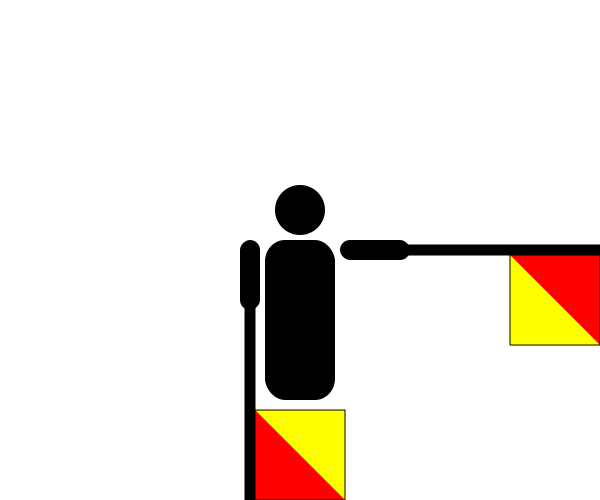


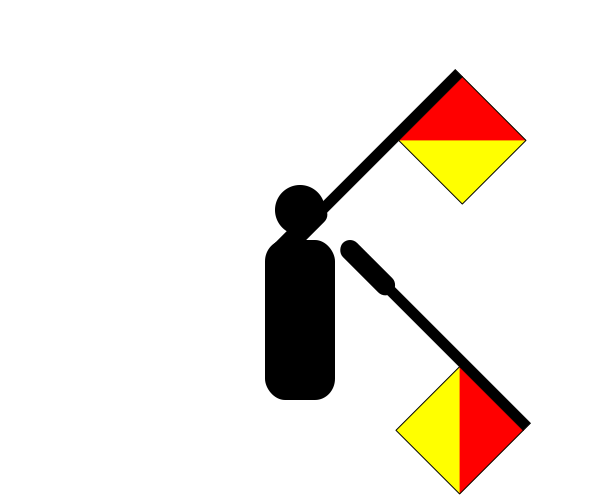
There are approximately 999 people named Faux in the UK. That makes it roughly the 7,388th most common surname in Britain. Around 15 in a million people in Britain are named Faux.
Origin: English
Region of origin: British Isles
Country of origin: England
Religion of origin: Christian
Language of origin: English
