FASS
The surname Fass is primarily of Germanic origin, derived from the Middle High German word vaz, meaning “bottle” or “flask”. As an occupational name, it would have been applied to a maker or dealer of such vessels, or as a nickname for an individual whose physical likeness or robust disposition resembled a bottle or flask.
In earlier medieval records the name appears in a wide variety of spellings, including Faas, Fass, Fasse, Fassman, Vass, Vasse, Vassman, Fasler, Vasler, Fassbender, Vassbender and Fassbindler. A number of these forms are found in surviving rolls and charters from the thirteenth and fourteenth centuries, for example: Burcardus Fasman of Frickengen (1249), Hainrich Vasseler of Freidingen (1386), and Hans Vasle of Saulgau (1405). These attestations confirm the long European presence of the name.
The etymological basis of the surname can also be traced to a pre‑seventh‑century root, the Proto‑Germanic word fas or vas, which means “round”. In early medieval usage the parent expression was employed to describe a barrel‑maker or someone who dealt in barrels, offering a secondary occupational sense for the name. It has also been suggested, though not substantiated, that the name may have acted as a short form of the Latinised Roman names Gervasious or Servatious.
Beyond its Germanic roots, the spelling variants of Fass have migrated across a number of western and eastern European countries. The surname is commonly found in Germany, Austria and the Czech Republic; it has also appeared in France, Switzerland, Luxembourg and Belgium. In North America, concentration in the United States and Canada stretches mainly through the Midwestern states of Iowa, Minnesota and Wisconsin, with sizeable populations in New England, Ohio, Pennsylvania and California. The name is also prevalent in Australia, New Zealand and South Africa, and has been recorded in parts of the Middle East, including Israel, the United Arab Emirates and Qatar.
Occasional references link the surname to Jewish origins, citing a possible derivation from the Hebrew word Afse—translated as a product “made from the sun”. This explanation is presented as a hypothesis rather than a documented fact, and no definitive link has been established.
Since the surname first appears in the nineteenth‑century records, it has often been recorded as a variation of Fassbinder, a compound indicating a barrel‑binder. The same linguistic pattern gives rise to other variant forms such as Fascher, Fassel, Faßel, Fesch, Fäsch and Vass, as well as cognates derived from the Germanic root meaning “quick” or “speedy”, for instance Fasten, Fastenbauer, Faustmann.
Today the name Fass continues to be carried by numerous family lines across Europe and the wider world. The combination of occupational origin, a rich tapestry of spelling variants and a broad geographic spread ensures that the surname retains a prominent place within the cultural and genealogical records of many nations.
Typical given names associated with the Fass surname
Male
- Michael
- Ralph
- Richard
- Stephen
- Steven
Female
- Carol
- Deborah
- Doreen
- Lisa
- Serena
Similar and related surnames
- Faas
- Faass
- Faasse
- Face
- Faes
- Faice
- Fais
- Faisi
- Faiss
- Fas
- Fasa
- Fasae
- Fasce
- Fasci
- Fasco
- Fase
- Fasey
- Fash
- Fashe
- Fasi
- Faso
- Fassa
- Fasse
- Fassey
- Fassi
- Fassih
- Fassio
- Fassis
- Fassl
- Fasso
- Fassy
- Fast
- Fays
- Faze
- Feace
- Feassy
- Feese
- Feess
- Fehse
- Feise
- Fess
- Fessi
- Fessy
- Fice
- Vase
- Vass
- Vassa
- Vasse
- Vassi
- Vassie
- Vasso
- Vaysse
- Vaz
- Vess
- Vice
- Vos
- Voss
- Voyce
- Vyse
Related and similar names are generated algorithmically based on the spelling, and may not necessarily share an etymology.
How to communicate the surname Fass in...
Braille
⠋⠁⠎⠎
Morse
..-..-......
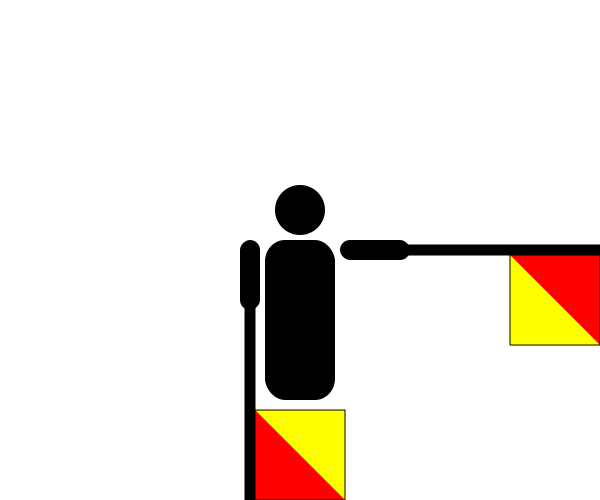
Semaphore


There are approximately 75 people named Fass in the UK. That makes it one of Britain's least common surnames. Only around one in a million people in Britain are named Fass.
Origin: English
Region of origin: British Isles
Country of origin: England
Religion of origin: Christian
Language of origin: English
