FARAGHER
Faragher is a surname that traces its roots to the Gaelic traditions of the British Isles, particularly Ireland, Scotland and the Isle of Man. It belongs to the group of surnames that are classified as Celtic and are typically derived from patronymic origins, meaning they indicate descent from a particular ancestor.
In Ireland the name is most commonly found in the counties of Mayo and Galway, with a forms such as Fraher in County Cork. It originates from the Gaelic patronymic Ó Fearadhaigh, which signifies “descendant of Fearadhach.” The personal name Fearadhach is composed of the elements fear (“man”) and dach, meaning “good.” Consequently, the surname can be interpreted to mean “descendant of the good man.” This construction is typical of many Irish surnames that employ the prefix Ó to denote lineage.
Alternative derivations point to the Old Gaelic personal name Fearchar, meaning “beloved person.” The name has been recorded in several spelling variants across the centuries, including Farahar, Farguar, Faraker, Faragher, Farragher, Farguhar and Forker. Its earliest documented spelling is Andro Farchare, noted as the burgess of Are in Ayreshire, Scotland, dated 1450. This early reference places the name within the Scottish context, where it was linked to the Laird of Macintosh who arrived from Braemar in the late thirteenth century.
The Manx connection is equally significant. The surname first appears on the Isle of Man, derived from the Gaelic O Fearghail and describing a person of valor. Variants found in Manx records include Fearcher, Fearchair and Fearchar. Modern habitations of the name involve its presence in Australia, New Zealand, the United States—particularly the Midwestern states—and Canada, where emigrants from the Isle of Man settled during the nineteenth and twentieth centuries.
Several other surname forms are related. The shortened forms Farrell, Farrel, Farrelly, Farell, Farel, Farry and Farryl can be traced back to the original Gaelic Ó Fearghail when the name was anglicised over time. The diversity of spellings reflects regional pronunciations and the transliteration of Gaelic sounds into English orthography.
Notable bearers of the surname illustrate its continued relevance. For instance, in the nineteenth century, Ann Faragher, daughter of James Faragher and Biddy Moran, was baptised on 13 May 1864 at Castlebar in County Mayo, a record that confirms the name’s persistence in that area.
Overall, the Faragher surname represents a rich tapestry of Gaelic heritage, ecclesiastical tradition, and the migratory movements that have shaped the identities of Irish, Scottish and Manx peoples across the world. The name persists as a marker of lineage, carrying forward its original meaning – that of a man who was good, beloved or of valor – into contemporary contexts.
Typical given names associated with the Faragher surname
Male
- Andrew
- Colin
- Darren
- David
- John
- Mark
- Michael
- Peter
- Richard
- Robert
- Stephen
- Thomas
Female
- Amanda
- Claire
- Emma
- Gemma
- Gill
- Helen
- Julie
- Katherine
- Lisa
- Margaret
- Marion
- Patricia
- Sarah
- Susan
Similar and related surnames
Related and similar names are generated algorithmically based on the spelling, and may not necessarily share an etymology.
How to communicate the surname Faragher in...
Braille
⠋⠁⠗⠁⠛⠓⠑⠗
Morse
..-..-.-..---.......-.
Semaphore
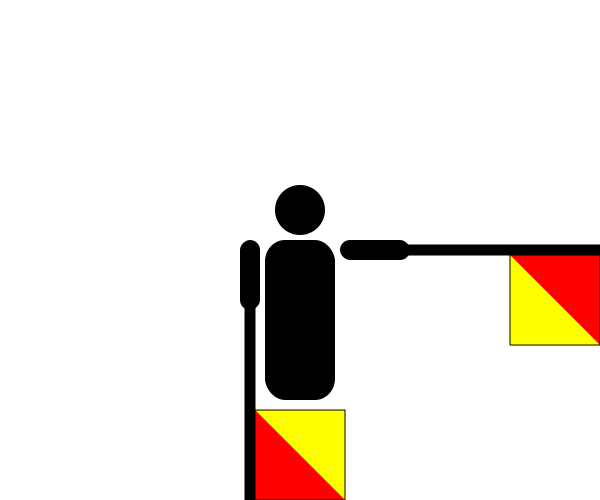

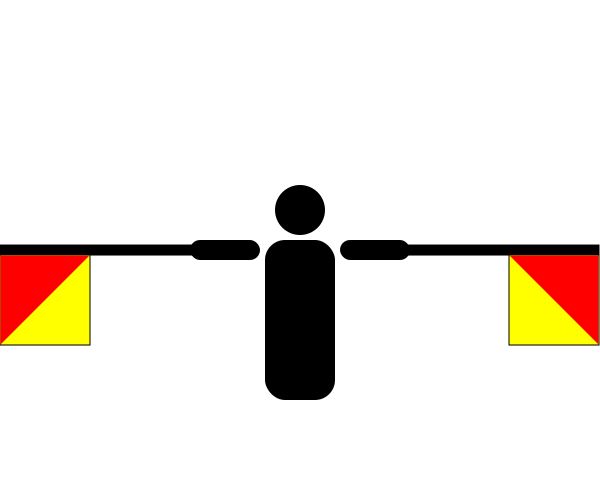


There are approximately 533 people named Faragher in the UK. That makes it one of Britain's least common surnames. Only around eight in a million people in Britain are named Faragher.
Surname type: Occupational name
Origin: Celtic
Region of origin: British Isles
Country of origin: Ireland
Religion of origin: Christian
Language of origin: Gaelic
