FALVEY
Falvey is an Irish surname that has been recorded in various forms in the British Isles and elsewhere, reflecting a complex genealogical history that spans several centuries and linguistic traditions.
Its earliest documented derivation in Irish is the Gaelic patronymic Ó Fallamhain, meaning descendant of Fallamhan. The personal name Fallamhan is understood to be derived from the Gaelic word fallamh, which translates as leader or ruler. Consequently, the Falvey name is associated with families that historically held positions of authority within their communities.
The Falvey surname is most frequently linked to the Munster region, particularly County Kerry, where extant records indicate a concentration of Falvey families who were recognised as local leaders. Other counties such as Clare and Cork also contain historic references to the surname.
Historical records demonstrate that the name adopted an anglicised form in the fifteenth and sixteenth centuries, appearing as Falvie, Falvey, Falvoye and Felvey in Irish documents. Simultaneously, French sources record variants such as Fauve, Fauvet, Falvy, Falvet, Fauvin and Fauvette.
English scholar William H. Barry, in his Dictionnaire etymologique de Noms de France, notes that the surname was among ancient French surnames and was believed to refer to the colour of a horse, specifically fawn. The dictionary, however, gives no explanation for the connection between the name and the colour, and suggests that alternative meanings could involve a maker or wearer of fawn-coloured clothes, or that the colour may have had symbolic significance in Roman aristocratic or senatorial circles.
The name is documented in England from the seventeenth century and is regarded in many cases as a Huguenot refugee name. A notable early record is that of Anna Falvie, who married Richard Price at St. Martin’s-in-the-Fields, Westminster, on 14 June 1658. This suggests that the Falvey family, or its close cognates, were established in England during the period of Huguenot migration prompted by religious persecution between 1580 and 1740.
In addition to its Gaelic and French origins, the surname also bears a Norman influence. According to heraldic tradition, the Falvey line can be traced back to the Norman invader William de Falaise, who, in 1169, was granted lands at Ballimagery in County Kerry by King Henry II. His descendants were later recorded as MacFhailbhe, a form that evolved into the modern Falvey.
The Norman connection associates the Falvey surname with commerce and farming, although over subsequent centuries a number of Falveys made their mark in the military, politics and the arts. The modern pronunciation is usually FAH-vay, and the surname has been orthographically interchanged with Fallvey in recent times.
Contemporary demographic data show that Falvey families remain an active presence in the Republic of Ireland, particularly in areas such as County Clare, where the name is still quite common. The diaspora of the nineteenth century carried the surname to North America, with significant populations emerging in Massachusetts, New York, California, Connecticut and Pennsylvania.
In addition to the primary Gaelic and Norman forms, the Falvey surname has a wide array of variants. These include, but are not limited to, Fauvel, Favel, Favelle, Favela, Favell, Favello, Favelo, Favelas, Favellas, Favall, Favalli, Favalos, Falvai and Falvei. The breadth of these spelling variants reflects the historical migration and linguistic adaptation of the Falvey line across Europe and the Atlantic.
The Falvey coat of arms, where a falcon appears on a green shield alongside silver stars and a golden lion, further illustrates the heraldic importance placed upon the family in various historic records, even though conventional heraldic authorities do not formally recognise the surname in the tradition of naturalised arms.
From its earliest mention in the Old Irish patronymic to its current global distribution, the Falvey surname embodies a rich confluence of Gaelic, Norman, and French elements. The name remains a symbol of heritage for descendants who continue to celebrate their Irish roots, often through symbols such as the shamrock, while acknowledging the varied linguistic and cultural pathways that shaped the surname’s long history.
Typical given names associated with the Falvey surname
Male
- Andrew
- Christopher
- Daniel
- Dennis
- James
- John
- Kevin
- Martin
- Michael
- Patrick
- Paul
- Peter
- Thomas
Female
- Ann
- Barbara
- Caroline
- Catherine
- Elizabeth
- Hannah
- Karen
- Margaret
- Mary
- Nicola
- Sandra
- Sarah
- Susan
- Zoe
Similar and related surnames
Related and similar names are generated algorithmically based on the spelling, and may not necessarily share an etymology.
How to communicate the surname Falvey in...
Braille
⠋⠁⠇⠧⠑⠽
Morse
..-..-.-.....-.-.--
Semaphore
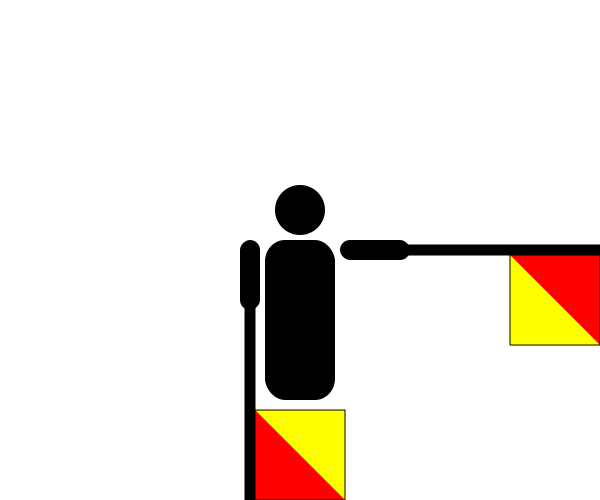


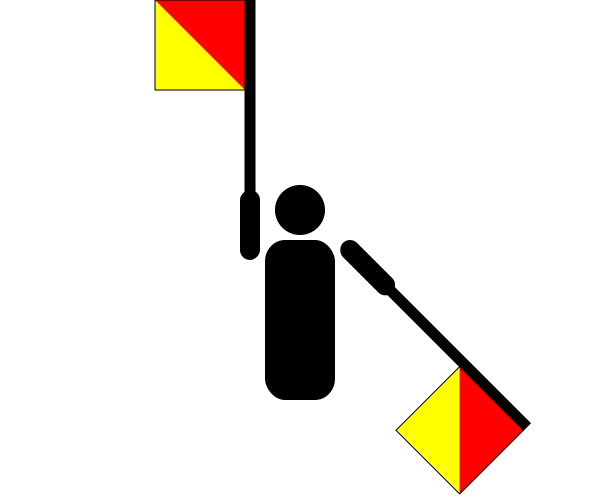

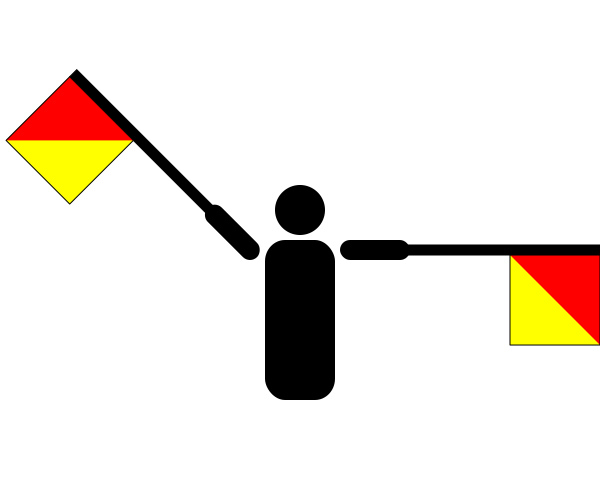
There are approximately 545 people named Falvey in the UK. That makes it one of Britain's least common surnames. Only around eight in a million people in Britain are named Falvey.
Origin: Celtic
Region of origin: British Isles
Country of origin: Ireland
Religion of origin: Christian
Language of origin: Gaelic
