FALK
Falk is a surname with a rich linguistic and cultural heritage, originating in Germanic and Yiddish traditions while also appearing within Hebrew-speaking Jewish communities. The name derives from the Middle High German word valke and the Yiddish word falk, both of which translate directly into English as falcon. In its earliest attestations, the surname functioned either as a metonymic occupational label for a falconer, or as a nickname for an individual whose attributes—swift and keen‑sighted—reminded observers of a falcon.
Historical documentary evidence places the surname in several European regions by the early thirteenth century. A recording of Geoffrey Faukes in 1221 amongst the Transcripts of Charters relating to the Gilbertine Houses during the reign of King Henry The Frenchman confirms an early use of a variant spelling centered on the Germanic root. In the following decades, William Faukus is listed in the Cartularium Monasterii de Rameseia, Huntingdonshire, in 1251; John Faukys appears in the Subsidy Rolls of Essex, 1327; and Robert Faukes is documented in the Subsidy Rolls of Sussex, 1327. These instances illustrate the surname’s persistence across different English counties in the Middle Ages.
The name continued into the Early Modern period with a diversity of spellings: Faulkes, Fawlks, Fawkes, Fakes, Faulks, and others. Parish records from the seventeenth century record individuals such as Mary Faulkes, who married John Spufford on 8 July 1629 at St. James, Clerkenwell, London; Sara Foulkes, christened 1 June 1634 at St. Giles, Cripplegate, London; and Gabrill Faulks, christened 31 January 1708 at St. Botolph without Aldergate, London. These documents show that the surname circulated widely within London and its surrounding suburbs.
In the wider British context, the name is most famously associated with Guy Fawkes, the Protestant plotter who, following a conversion to Roman Catholicism, was implicated in the failed attempt to blow up the Houses of Parliament in 1605. Born in York in 1570, his house still stands, now repurposed as a hotel near the Minister. Guy Fawkes’ notoriety popularised a particular spelling of the name in England, although the root remains the same Germanic element referring to a falcon.
Beyond the United Kingdom, the surname Falk is common in continental Europe. In Germany, it ranks as the 87th most common surname and can be found in a variety of spellings, such as Falke, Falken, Falcken, and Falkner, the last of which explicitly denotes the occupation of a falconer. In Scandinavia—especially Sweden and Denmark—the name persists, often derived from the Old Norse falki or the Old English fælcen, both also meaning falcon. In countries with significant diaspora populations, such as the United States, the surname has spread through migration and remains in use among descendants of German and Jewish settlers.
The Jewish connection to the surname is twofold. It functions both as a literal occupational title—used by Ashkenazi Jews engaged in falconry—and as an ornamental name selected during periods when Jews were required to adopt fixed surnames for census and registration purposes. The Jewish use of the Yiddish word falk as a surname reflects a broader practice of choosing names that convey desirable qualities, in this case the power, speed, and keen vision emblematic of a falcon.
Given its varied origin stories, the surname Falk illustrates a common medieval phenomenon in which a single lexical element could give rise to multiple family names across linguistic boundaries. Whether as a nickname, an occupational reference, or an ornamental choice, the name anchors its bearers in a symbol of elevated status and martial prowess.
In contemporary usage, the surname Falk remains widespread in German‑speaking regions, Scandinavian countries, and among communities of Ashkenazi Jewish descent. Its presence in English‑speaking nations is largely a product of migration, with spelling variations being moulded by the phonetic conventions of new linguistic environments. Despite variations in orthography, the underlying association with the falcon endures, signifying a lineage characterised by agility and perceptiveness that has survived through centuries of social and cultural change.
Typical given names associated with the Falk surname
Male
- Alexander
- Benjamin
- Darren
- David
- Jason
- John
- Nicholas
- Peter
- Richard
- Robert
- Stephen
- Winfried
Female
- Angela
- Debra
- Elizabeth
- Emma
- Irene
- Katherine
- Miriam
- Patricia
- Penelope
- Sally
- Sara
- Sarah
- Stacey
Similar and related surnames
Related and similar names are generated algorithmically based on the spelling, and may not necessarily share an etymology.
How to communicate the surname Falk in...
Braille
⠋⠁⠇⠅
Morse
..-..-.-..-.-
Semaphore
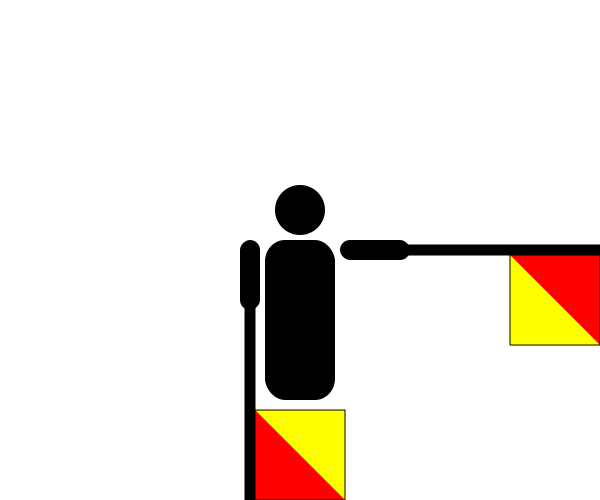


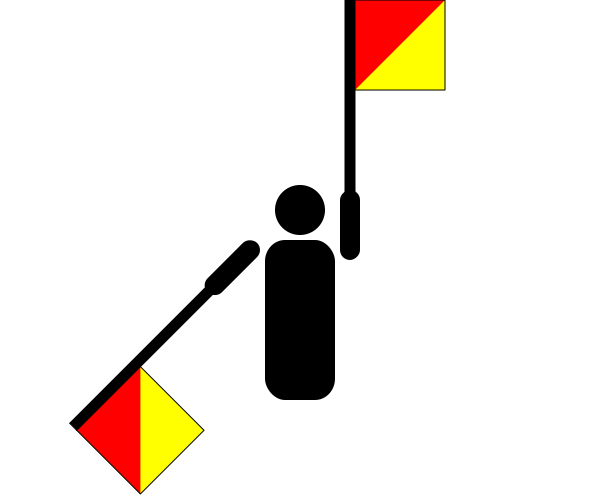
There are approximately 476 people named Falk in the UK. That makes it one of Britain's least common surnames. Only around seven in a million people in Britain are named Falk.
Religion of origin: Jewish
Language of origin: Hebrew

Famous people named Falk
- Peter Falk - American actor (1927 to 2011)
Names and descriptions courtesy of Wikipedia, and may contain errors. This is not intended to be an exhaustive list of every famous person with this name.