FAIRES
Faires is predominantly considered a surname of English origin, yet the appellation also appears within French successional records, suggesting parallel lineages in both the British Isles and continental Europe. The name is recorded in the Domesday Book of 1086 under the variant Edeua Faira, situating it firmly within early English society.
The etymological roots of Faires derive chiefly from the Middle English word fair, which meant “beautiful” or “fair-complexioned”. The prefix is also found in the Old Germanic Faeger and the Old French fayre, both bearing the same visual connotation. Consequently, the surname was historically applied as a nickname for someone with a fair appearance, for an individual regarded as attractive, or for a person noted for being fair-minded and just.
Early documentary evidence documents a variety of spellings and uses: in 1191 the Suffolk Court Rolls record a Robert Faier; the Duchy of Cornwall Accounts of 1297 contain a reference to Henry le Vayre; a 1573 entry lists Dorothy Fayre of Stepney; 1616 London records the name Elizabeth Faire; and a 1799 London register cites Abraham Fair. In 1696, Robert Faires married Anne Flaws at St Dunstan's in Stepney, London, offering the earliest known instance of the spelling Faires that persists to modern times.
The modern name retains a number of related orthographic variants, including Faire, Fayre, Faer, Fayer, Fyers, Phair, and Phayre. The variant Phayre is historically significant, as it is associated with Sir Arthur Phayre, Chief Commissioner in British Burma, who bore a distinctive coat of arms featuring a gules cross moline argent surmounted by a bend azure, within a border of the same hue; the crest depicts a dove holding a laurel branch.
Within the United Kingdom, the surname is found across England, Scotland, Wales, and Ireland in a range of forms: Fair, Fay, Fayer in England, Fayr, Faer, and Far in Scotland, and Fayre and Faier in Wales. In Irish records, a frequent spelling is Fares. The variation Fair-Faires may appear in some families, and other derivatives such as Fairer, Faerer, Farrer, and Ffairer demonstrate the adaptability of the base name over several centuries.
Historical accounts, particularly in continental Europe, suggest that the name was occasionally linked to an occupational role: an entertainer or jester, derived from the Latin fario meaning “happy” or “blissful”. This association with humour and merriment is reflected in the colloquial descriptions of the name as denoting those who were “happy and lucky”. While modern scholarship does not categorically confirm such occupational usage for every bearer, the explanatory tradition persists in various genealogical narratives.
In the United States, demographic records indicate a concentration of the surname in the Appalachian region. In 2010, Faires ranked 312th most common in North Carolina with 12,630 bearers, 507th in South Carolina with 6,120, and 375th in Virginia with 10,576. The predominance of the name in these states aligns with historical migration patterns of Scots-Irish immigrants who settled in Appalachia during the late eighteenth and early nineteenth centuries, bringing the surname across the Atlantic.
Economically, individuals bearing the surname have engaged in a wide range of professions throughout history, including farming, manufacturing, commerce, banking, and shipping. The geographic dispersal of the name, coupled with occupational diversity, reflects a capacity for adaptation across socio-economic contexts.
Variations of the name are also present in France and Germany, where the surnames Fleury and Faeser are considered orthographic cousins. Nonetheless, all such derivatives maintain a core linguistic lineage traceable to the original English, Scottish, Welsh, or Irish form of Faires.
Through its multifaceted origins, historical recurrence, and geographic breadth, the surname Faires exemplifies the rich tapestry of English and French onomastic development, merging visual descriptors with cultural meaning over the span of several centuries.
Typical given names associated with the Faires surname
Male
- Alexander
- Ashley
- Christian
- Dominic
- Gareth
- Ian
- Jack
- James
- Paul
- Peter
- Robin
- Stephen
- Steven
Female
- Anna
- Carol
- Christine
- Diana
- Eileen
- Ellen
- Gemma
- Jane
- Joanna
- Linda
- Maureen
- Niki
- Sara
- Susan
Similar and related surnames
- Faire
- Fair
- Fairey
- Fahr
- Fairess
- Faiers
- Faries
- Fairie
- Fairies
- Fairns
- Fairris
- Fairs
- Faras
- Farbes
- Fare
- Fares
- Farese
- Faress
- Farges
- Farie
- Faris
- Farkes
- Farmes
- Farnes
- Farras
- Farre
- Farres
- Farries
- Farrs
- Fars
- Farse
- Farys
- Faure
- Fayre
- Fayres
- Feare
- Feares
- Fearis
- Fears
- Feers
- Feres
- Feries
- Ferres
- Ferries
- Fiers
- Fierz
- Fire
- Fires
- Firs
- Fores
- Forez
- Forres
- Fors
- Furs
- Fyers
- Phairs
- Phares
- Phires
- Vaire
- Vares
- Veares
- Viers
- Vires
- Faers
- Fairles
- Fairooz
- Fairy
- Farek
- Farey
- Farge
- Farias
- Fariz
- Faroe
- Farr
- Farress
- Farris
- Farrows
- Faus
- Faws
- Fearce
- Fehrs
- Feir
- Fere
- Fier
- Fierce
- Fior
- Firris
- Firus
- Fore
- Fowers
- Fure
- Pharez
- Vair
- Vare
- Vars
- Veres
- Viars
- Vire
- Vores
- Ferris
- Forse
- Furze
- Phare
Related and similar names are generated algorithmically based on the spelling, and may not necessarily share an etymology.
How to communicate the surname Faires in...
Braille
⠋⠁⠊⠗⠑⠎
Morse
..-..-...-.....
Semaphore
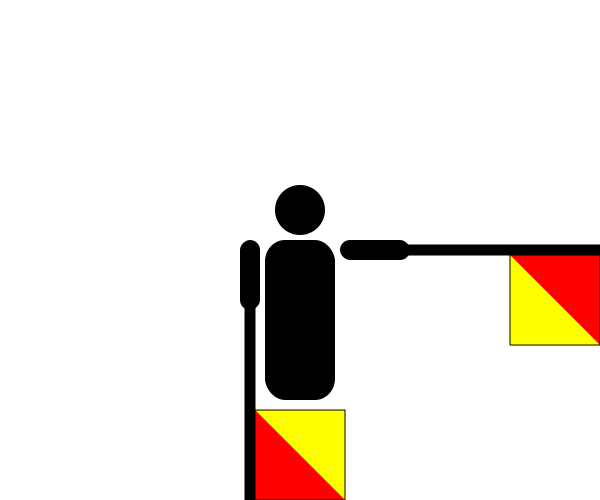

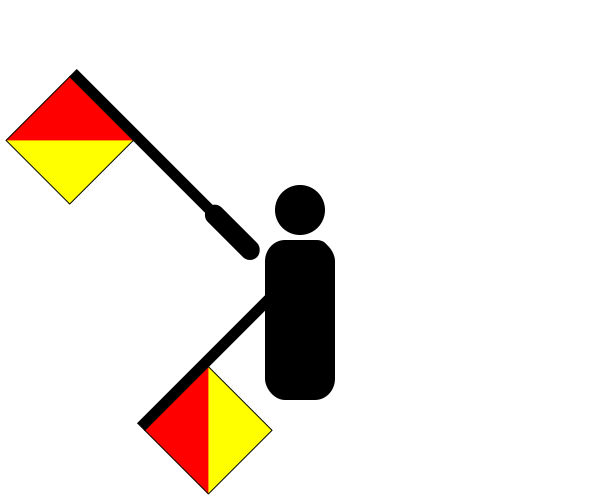
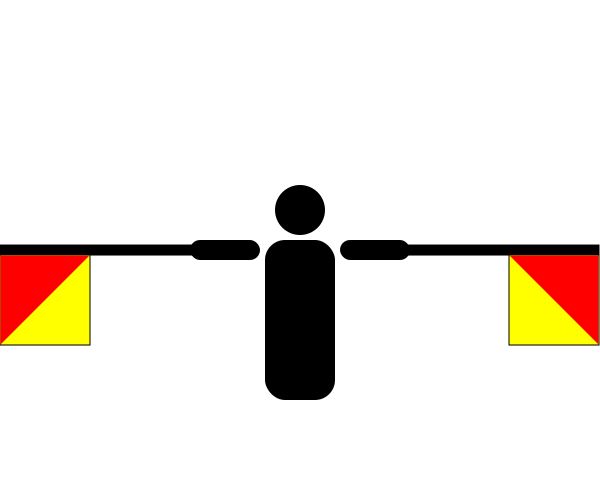


There are approximately 162 people named Faires in the UK. That makes it one of Britain's least common surnames. Only around two in a million people in Britain are named Faires.
Origin: English
Region of origin: British Isles
Country of origin: England
Religion of origin: Christian
Language of origin: English
