FAIRBAIRN
Fairbairn is a surname that has its roots in the British Isles, specifically Scotland and the adjoining parts of England. The name is traditionally linked to the Gaelic language and to the ancient Celtic peoples who inhabited the region, and it has long been associated with the Christian faith of that era.
The earliest form of the name appears in the Subsidy Rolls of Yorkshire dated to 1297, where an individual named Augustin Fayrbarn is recorded. This early spelling indicates that the surname was already established in the late thirteenth century. The name reappears in the 1379 Yorkshire Poll Tax Returns in the form of Robert Fayrebarne, confirming its continued use in the North of England during the Middle Ages.
From an etymological standpoint, Fairbairn derives from two Old English elements. The first element, *fæger*, meaning fair, beautiful or lovely, and the second element, *bearn*, meaning child, combine to give the literal meaning of “fair child” or “beautiful child.” This descriptive origin suggests that the name was originally a nickname or a baptismal name, affording the bearer an affectionate or endearing designation in the early medieval period.
There are alternative theories regarding the second element of the name. Some scholars argue that it may have been associated with *beorn*, a word for warrior, thereby producing an interpretation of “beautiful warrior.” This construction would align the name with the martial culture of the Scottish borderlands and the frequent conflation of personal traits with social roles in that place and time.
Because of the phonetic nature of medieval spelling, the surname has survived in several variants. These include Fairborn, Fairborne, Fairburn, Fairbairns and Fairbanks. In the border areas between Scotland and England, the patronymic form Fairbairns has been particularly persistent. Variants such as Fairebanke and Fairbanke were also documented in the Middle Ages, while more contemporary forms appear to influence the creation of names such as Fairchild in England.
In the early twentieth century, notable bearers of the name contributed to industry and public service. Sir Peter Fairbairn, who lived from 1799 to 1861, was an engineer and inventor recognised for inventing improved flax‑spinning machinery. He introduced modifications to the roving‑frame and the screw and rotary gills, and he established a foundry for war materials. He served as mayor of Leeds in 1857 and again from 1858 to 1859, reflecting the stature that the surname commanded in local society.
Another distinguished figure was Sir William Fairbairn, a Scottish civil engineer renowned for his work on the design of the Stockton‑River Tyne bridges and for his studies of iron as a structural material. His contributions to engineering have made the surname associated with technical progress and pioneering spirit in Scotland and abroad.
A coat of arms has been granted to a Fairbairn family. The blazon describes a red shield featuring an eagle with wings enamelled gold, surrounded by an ermine bordure. The crest portrays a black griffin passant. Heraldic tradition affirms that the coat of arms is rooted in a legitimate family line, giving a visual representation of the surname’s heritage.
The surname is most frequently encountered today in Scotland and in countries where Scottish emigrants settled, notably the United States, Canada, Australia, and New Zealand. While the name remains relatively uncommon compared with some other Scottish surnames, it continues to signify a lineage that stretches back to the Celtic‑Gaelic world and to the early medieval societies of the British Isles.
Additional public representatives of the surname appear in modern sports; for example, Australian rower Robert Fairbairn has represented his country at an international level, demonstrating the global span of the family name.
Although local dialects and migration have produced subtle variations in spelling and pronunciation, the core etymology of Fairbairn remains anchored in its Scottish origins and in the descriptive meaning of a “fair child.” The name’s endurance over seven centuries attests to its significance within the cultural and genealogical history of the British Isles.
Typical given names associated with the Fairbairn surname
Male
- Alan
- Andrew
- David
- Ian
- James
- John
- Michael
- Paul
- Robert
- William
Female
- Elizabeth
- Helen
- Jane
- Jean
- Karen
- Linda
- Margaret
- Mary
- Rebecca
- Sarah
- Susan
Similar and related surnames
Related and similar names are generated algorithmically based on the spelling, and may not necessarily share an etymology.
How to communicate the surname Fairbairn in...
Braille
⠋⠁⠊⠗⠃⠁⠊⠗⠝
Morse
..-..-...-.-....-...-.-.
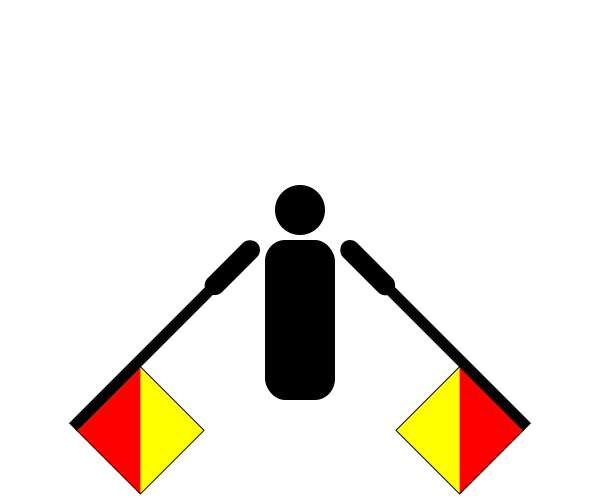
Semaphore
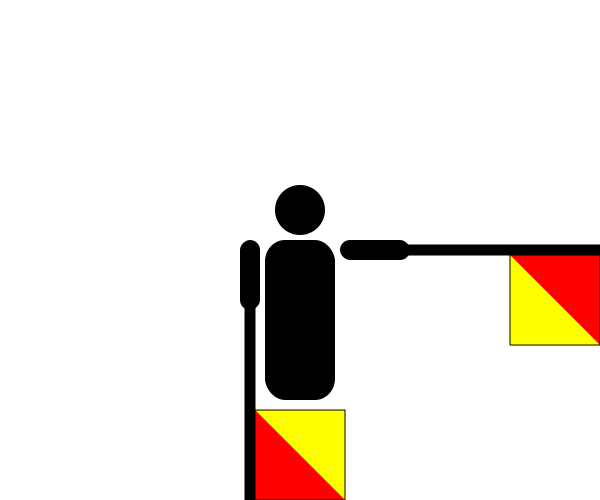

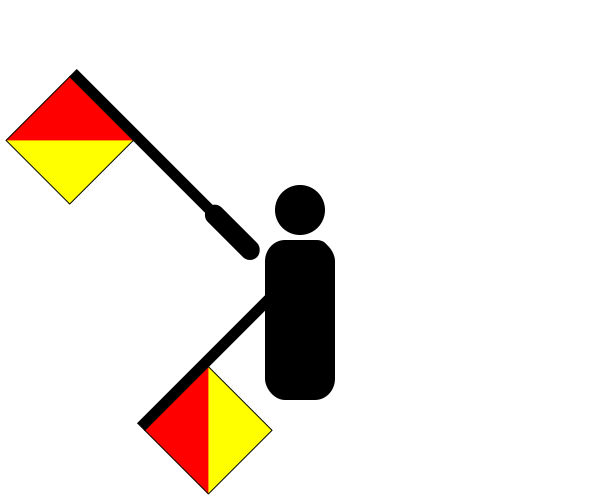
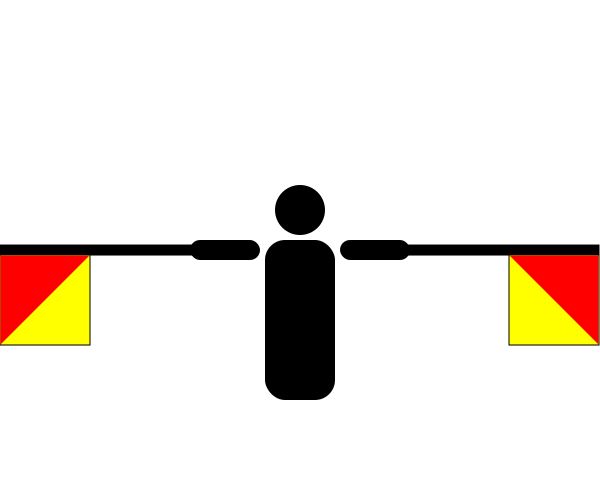
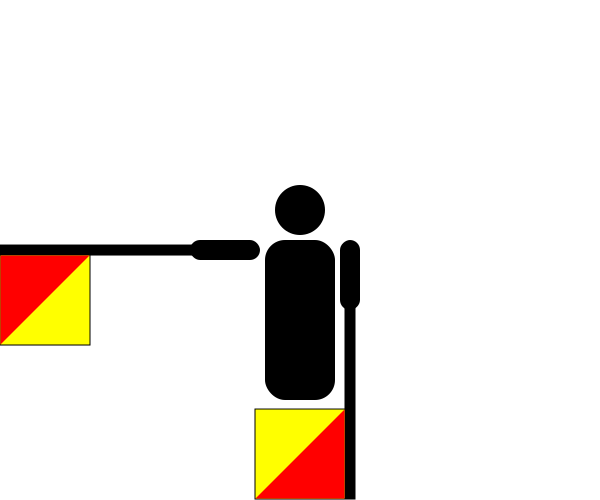
There are approximately 4,136 people named Fairbairn in the UK. That makes it roughly the 2,256th most common surname in Britain. Around 64 in a million people in Britain are named Fairbairn.
Origin: Celtic
Region of origin: British Isles
Country of origin: Scotland
Religion of origin: Christian
Language of origin: Gaelic

Famous people named Fairbairn
- William E. Fairbairn - General (1885 to 1960)
- Carolyn Fairbairn - Businesswoman
- Ronald Fairbairn - Scottish psychiatrist & psychoanalyst (1889 to 1964)
- Nicholas Fairbairn - Politician (1933 to 1995)
- William Fairbairn - Scottish civil engineer, structural engineer and shipbuilder (1789 to 1874)
- Sydney Fairbairn - Cricket player (1892 to 1943)
- John Fairbairn - South African politician (1794 to 1864)
- Patrick Fairbairn - Minister (1805 to 1874)
- Alan Fairbairn - Cricketer (1923 to 2005)
- Ivo Fairbairn-Crawford - Athlete (1884 to 1959)
- Gordon Fairbairn - Cricketer (1892 to 1973)
- David Fairbairn - Australian politician (1917 to 1994)
- Richard Robert Fairbairn - Politician (1867 to 1941)
- Thomas Fairbairn - Art collector (1823 to 1891)
- James Fairbairn - Australian politician (1897 to 1940)
- Robert Fairbairn - Scottish first-class cricketer and banker (1910 to 1988)
- Robert Edis Fairbairn - Canadian minister (1879 to 1953)
- Irene Fairbairn - Chief Commissioner of Guides Australia (1899 to 1974)
Names and descriptions courtesy of Wikipedia, and may contain errors. This is not intended to be an exhaustive list of every famous person with this name.