EWELL
Ewell is a surname of English origin, deriving principally from Old English elements describing natural features. The core of the name comes from the Old English word æwell or aewill, meaning a spring or source of a river. As a locational surname it was generally assigned to individuals dwelling near or working at such a natural spring.
In addition to its English roots, the surname has been linked with a Norse component. The surname Ewell can be considered a variant of Yule, which originates from the Old Norse word jól and denotes the Christmas season. Thus, the name may, in some instances, imply a connection to seasonal celebrations.
Several English place-names provided the geographical base for the surname. The town of Ewell in Surrey appears in the Cartularium Saxonicum of 675 as Euuelle; the parish of Temple Ewell in Kent is recorded as Aewille in 772; and other nearby localities, such as Ewell Manor and Ewell Minnis, are associated with the same root word. All these placenames stem from the pre‑7th century term for a spring.
Recorded evidence of the surname in a clerical and civil context first surfaces in the mid‑16th century. In London Church Registers, Joane Yole married William Strangas on 13 January 1543 at St. Leonards, East Cheap; Elizabeth Ewell was christened at St. Martin in the Fields, Westminster on 29 September 1560; and Francisca Yewell married Arthurus Keyting at St. Martin‑in‑the‑Fields on 3 January 1600. The earliest dated witness to the name is the testimony of Wyllym and Anne Ewell, dated 9 April 1543 at Kingston Upon Thames, Surrey.
Earlier archival references date the name back to the early 12th century. William de Ewelle is mentioned in the Pipe Rolls of Surrey in 1130, indicating an established family bearing the name at that time. This early appearance supports a topographic interpretation linking the family to a stream or spring.
The surname appears in a number of variant spellings. Common English variants include Ewells, Ewel, and Ewels. A number of alternative forms such as Yowell, Yowles, Yule, Yewle, and Yewell have also been attested. Although some sources suggest French (de Uel) or German (Euel) derivations, the preponderance of evidence places the core of the name in English linguistic history.
While the surname remains predominantly found in England, it has migrated beyond its country of origin. The first documented American bearer is a Joseph Ewell born in Virginia in 1663, placing the name in the colonial period of Virginia and North Carolina. In later decades, many former slaves adopted the surname; by the 1830s and 1840s it became established in the southeastern United States, a trend that continues to the present day. According to the 2019 Census, Louisiana records 9,667 bearers, followed by Georgia with 8,527, Alabama with 7,068, and Mississippi with 6,210. Across the entire United States, Ewell ranks among the top 4,209 surnames.
Overall, the surname Ewell embodies a deep historical lineage tied to natural springs and specific English locales. Its linguistic roots in Old English, occasionally intersecting with Old Norse, and the evidence of its early appearance in medieval records underscore its longstanding presence throughout English society. The subsequent migration of the name to the Americas, its adaptation into various spellings, and its present demographic distribution illustrate how a name that began as a descriptive locational identifier evolved into a family identifier recognised worldwide.
Typical given names associated with the Ewell surname
Male
- Andrew
- Arnold
- Kevin
- Melvyn
- Paul
Female
- Hilary
Similar and related surnames
Related and similar names are generated algorithmically based on the spelling, and may not necessarily share an etymology.
How to communicate the surname Ewell in...
Braille
⠑⠺⠑⠇⠇
Morse
..--..-...-..
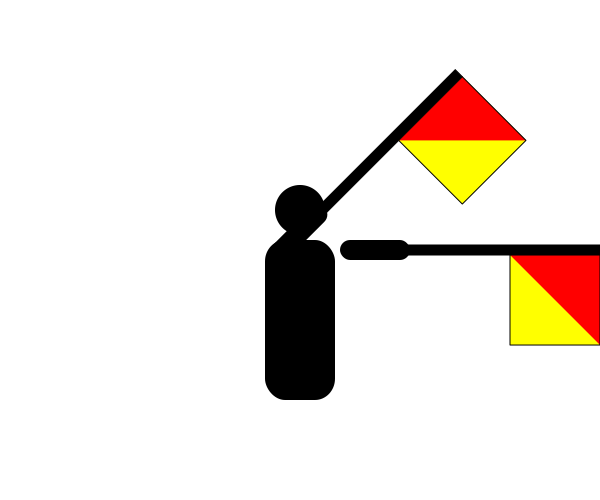
Semaphore


There are approximately 57 people named Ewell in the UK. That makes it one of Britain's least common surnames. Only around one in a million people in Britain are named Ewell.
Origin: English
Region of origin: British Isles
Country of origin: England
Religion of origin: Christian
Language of origin: English
