EWAN
The surname Ewan is firmly established within the Celtic traditions of the British Isles, having originated in Scotland and derived from the Gaelic personal name Eoghan. The root name itself is interpreted as meaning “born of the yew tree” or, in some contexts, “youth.” The yew tree, a symbol of longevity and resilience in ancient Celtic culture, thus lends the surname connotations of strength and endurance.
In its earliest use the name was patronymic, identifying the descendants of a man bearing the given name Eoghan. As a result, the surname has been historically linked to notable medieval figures. For instance, a record dated circa 1165 mentions Douenaldus Ewain of Dunpeldre, found in “The Register of Saint Marie de Neubotle” during the reign of King William the Lion. The name also appears in medieval English documents such as the Domesday Book of 1086, where variations like Ewen and Ewin are recorded in Herefordshire.
Throughout the Middle Ages, the surname evolved into several orthographic variants, notably Ewen, Ewin, Ewans, Ewings, Ewing, and Yewen. In Ireland, the patronymic prefix Mac could be appended to produce MacEwen or MacEwan, meaning “son of Ewen,” while in Wales the form Bowen derives from the prefix ab and the given name Owen. These variations reflect regional accents, dialectal shifts and differing levels of literacy across the Celtic lands.
Geographically, the surname originally concentrated in the West Highlands, particularly Argyllshire and surrounding Gaelic districts such as Perthshire, Ross, Cromarty and Inverness. From the 12th to the 17th centuries, documentary evidence shows the name appearing increasingly throughout Scotland and the English south‑east, for example in the 1609 christening of Elizabeth Ewen at St. Michael’s Wood Street and the 1678 marriage of Christian Ewan and Mary Cans in London. By the early modern period the surname had also crossed the English Channel and become established in England.
In the modern era, the Ewan surname continues to be most common within Scotland and the United Kingdom, where it remains closely associated with areas possessing strong Celtic heritages. Nevertheless, immigration has spread the name across the Anglophone world, including the United States, Canada, Australia and New Zealand. Despite this diaspora, the cultural resonance of the name persists, embodying the youthful vitality and aged endurance encapsulated in its Gaelic origins.
In sum, the surname Ewan represents a lineage rooted in ancient Gaelic culture, underpinned by the symbolic twin themes of youth and the enduring yew tree. Its varieties across the British Isles and beyond reflect centuries of linguistic evolution, migration and the rich interweaving of Scottish, Irish and Welsh histories.
Typical given names associated with the Ewan surname
Male
- Alan
- Andrew
- Christopher
- David
- Gordon
- James
- John
- Mark
- Martin
- Michael
- Paul
- Robert
- William
Female
- Alison
- Annalisa
- Anne
- Elizabeth
- Esme
- Helen
- Janet
- Julia
- Julie
- Margaret
- Mary
- Ruth
- Susan
Similar and related surnames
Related and similar names are generated algorithmically based on the spelling, and may not necessarily share an etymology.
How to communicate the surname Ewan in...
Braille
⠑⠺⠁⠝
Morse
..--.--.
Semaphore

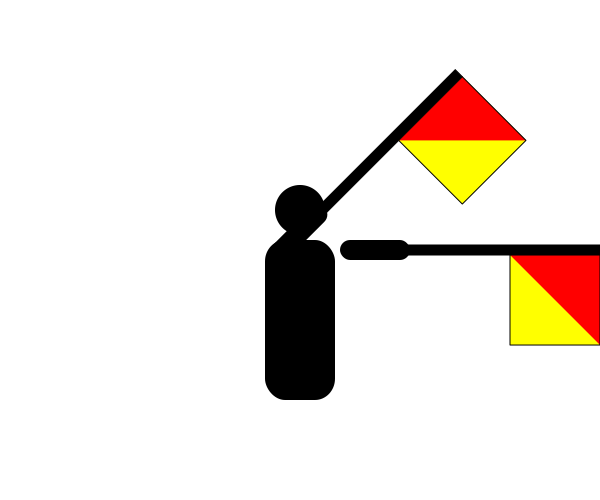

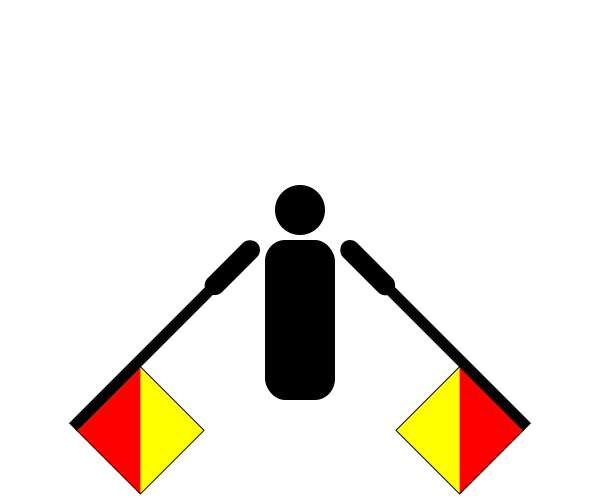
There are approximately 1,082 people named Ewan in the UK. That makes it roughly the 6,942nd most common surname in Britain. Around 17 in a million people in Britain are named Ewan.
Surname type: From given name or forename
Origin: Celtic
Region of origin: British Isles
Country of origin: Scotland
Religion of origin: Christian
Language of origin: Gaelic

Famous people named Ewan
- Gregor Ewan - Wheelchair curler
Names and descriptions courtesy of Wikipedia, and may contain errors. This is not intended to be an exhaustive list of every famous person with this name.