EVERT
Evert is a surname of Germanic provenance, found predominantly in the Netherlands, Germany and German‑speaking communities of Belgium. The name is traditionally recognised as a patronymic identifier, signalling descent from an ancestor who bore the personal name Eberhard.
The personal name Eberhard is composed of the elements eber, meaning “wild boar”, and hard, meaning “brave” or “strong”. Consequently, the literal import of the name is “strong boar” or “brave as a boar”. Over time this personal name evolved into the surname Evert as a means of recognising the progeny of a man called Eberhard.
In addition to its patronymic origin, some references identify Evert as an occupational surname derived from the Middle German word for “groom”, the animal‑keeper responsible for the care of horses and other beasts. The dual derivations are recorded in separate linguistic traditions, each offering a plausible explanation for the prevalence of the surname in pastoral societies.
The first documented instance of the name occurs in the early thirteenth century with entries such as Simon Eborard of Norfolk in 1275 and Johannes Everard of Yorkshire in 1379. Earlier references date back to 1066, when individuals of Norman and Breton origin bearing forms such as Everard were recorded in the English legal rolls. The name appears on the Bedford curia regis rolls in 1204 in the entry for Richard Everard, showing a continuous presence in medieval England.
Throughout the sixteenth and seventeenth centuries parish registers in London document a range of morphological variants. For example, Robert Evert appears at St Giles Cripplegate in 1562, Peter Everit at St Stephen Walbrook in 1567, and Edward Everet at St Andrews Holborn in 1666. George Everett is recorded at St Mary at Hill on 1 May 1700. These entries illustrate the fluidity of spelling in the pre‑standardised period.
The surname has developed numerous spelling variations, many of which are attested in different national contexts. Variants include Everard, Everett, Evras, Everest, Ebi, Ebe, Eberline and Eberle. In Dutch contexts the spelling is commonly Everts, while the forms Eberts and Ebberts appear among Dutch East Indian settlers. English adaptations include Ebert, Evered and Ebbert; Irish versions are rendered as Evitt or Mac Caffrey, and French adaptations include Évert and Ebber. In German it is found as Eberhard, Everhard, Ewerhardt and Ebhard; in Swedish and Finnish the spelling is more frequently Everdahl.
Geographically, after its early consolidation in the Low Countries, the surname spread throughout continental Europe. In the Netherlands it is recorded from 12 December 1647, when Everd Heinkes was christened in Hoorn, West Friesland. Migration has carried the name to Scandinavia, the British Isles and the United States. In North America the surname is most prevalent in the states of Michigan, Pennsylvania and Wisconsin, reflecting patterns of Dutch and German settlement. Small communities in Australia, Canada and other parts of the world also carry the name.
Modern bearers of the surname often report characteristics that mirror the name’s etymology, describing themselves as determined, assertive and reliable – attributes traditionally associated with the notions of resolve and endurance found in the Germanic roots of the name.
In contemporary society the name Evert remains a testament to both linguistic evolution and cultural persistence. Its endurance across centuries and continents illustrates how surnames serve as living artefacts of ancestry, occupation and societal change.
Similar and related surnames
Related and similar names are generated algorithmically based on the spelling, and may not necessarily share an etymology.
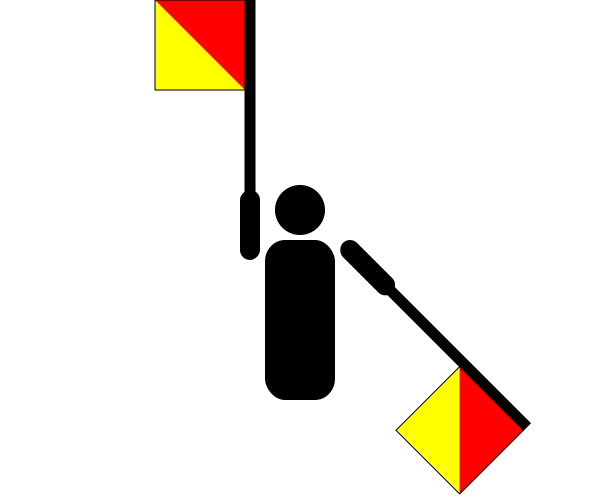
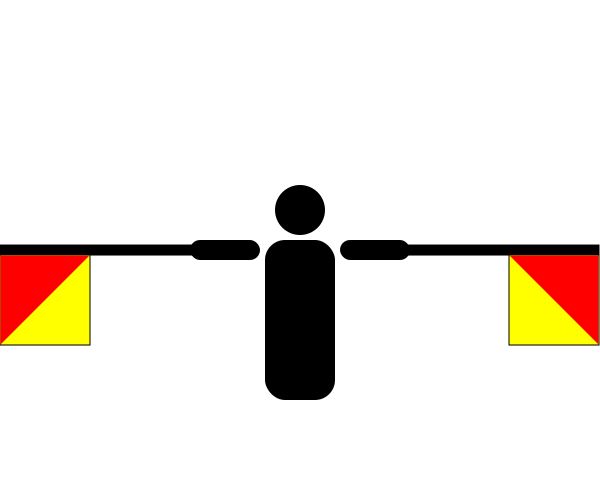
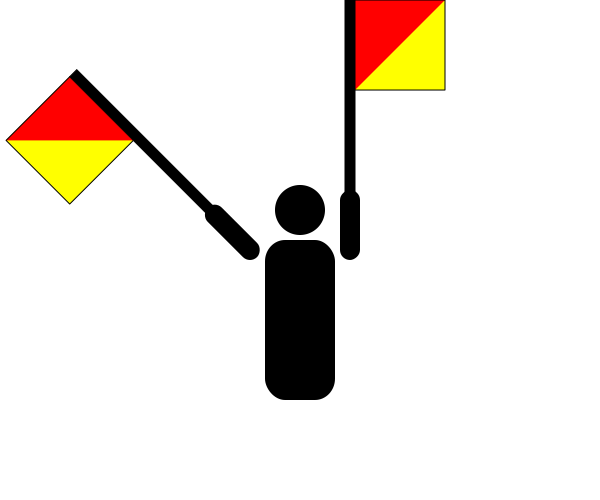
How to communicate the surname Evert in...
Braille
⠑⠧⠑⠗⠞
Morse
....-..-.-
Semaphore

Sorry, we don't have any statistics on this name. That's probably because it's very uncommon in Britain.
