ETTER
Etter is a surname of German provenance, whose earliest linguistic roots can be traced to the Middle High German word eter, denoting an adder or snake. The appellation was most likely a nickname, applied to a person who exhibited snake‑like attributes such as cunning or slyness, or who resided near a locale associated with serpents.
In the late seventeenth century an example of the name’s evolution is recorded at the French Huguenot Church of Le Temple in Soho, London: on 2 July 1693, during the reign of William of Orange, Jean Jacques Ytier was christened. Ytier, son of Jacques Ytier and Margueritte Suisse, bore a surname variously spelt as Itter, Eitor, Yter, Etter and even Heater. This diverse orthography illustrates the process of Anglicisation that many Huguenot refugees underwent between 1580 and 1770, when over fifty thousand Protestant exiles settled in England and Ireland. Earlier, in 1588, Katherin Etur was christened at St. Katherine by the Tower, London, during the reign of Queen Elizabeth I, showing that the name had already been established in English records.
Other etymological explanations for Etter point to Germanic personal names. One theory holds that the surname descends from the ancient Saxon Id-hari, meaning “work army”, a personal name used prior to the tenth century. Yet another line of inquiry relates it to the Old High German word etari, translating as “district” or “local”, or to the welfare‑based surname Attinger, from which Etter may be derived. In each case the suffix -er signals either a locative or patronymic connection, implying a familial link to a specific occupation or region.
In German‑speaking countries the surname is predominantly found in Austria, Germany, and Switzerland, with the greatest concentration in Bavaria in Germany. Its presence in the United States expanded through German immigration during the mid‑nineteenth century, and today it is most prevalent in the states of Pennsylvania, Ohio, Indiana, and Kentucky, reflecting the settlement patterns of German and Swiss ancestors. Within the United Kingdom the name occurs chiefly in England and Scotland, and is comparatively uncommon in Wales and Northern Ireland.
The diversity of spelling variants further reflects the surname’s geographical spread. Some of the variants that are historically attested include Eder, Eber, Ebert, Ederer, eter, eiter, Ettere, Ehtter, and Edley. Many of these forms appear in records from Silesia, the Rhineland, and Bavaria, and some have been Anglicised in the United States, where Etter is the most common spelling.
In summary, the surname Etter possesses a multifaceted heritage. Its origins lie in German linguistic roots, with possible connections to descriptive nicknames, occupational terms, and ancient personal names. The migration of Huguenot refugees and later German immigrants carried the name across the Atlantic, where it has become entrenched particularly in the United States while remaining present in Britain and continental Europe. The array of variants recorded in historical documents underscores the surname’s adaptability and its long-standing presence within diverse cultural contexts.
Similar and related surnames
Related and similar names are generated algorithmically based on the spelling, and may not necessarily share an etymology.
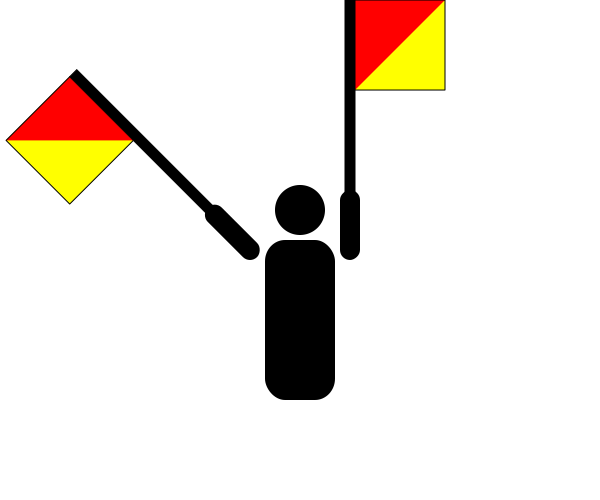
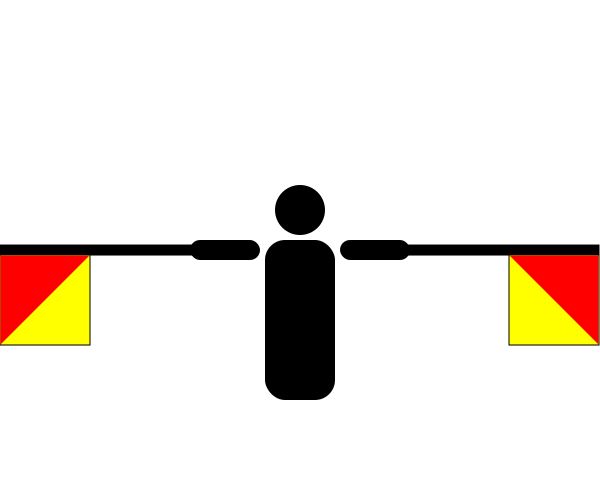
How to communicate the surname Etter in...
Braille
⠑⠞⠞⠑⠗
Morse
.--..-.
Semaphore

There are approximately 48 people named Etter in the UK. That makes it one of Britain's least common surnames. Only around one in a million people in Britain are named Etter.
Origin: English
Region of origin: British Isles
Country of origin: England
Religion of origin: Christian
Language of origin: English
