ERB
Erb is a surname of German origin, derived from the Middle High German word erbe, which means “heir” or “inheritance.” As an occupational name it was originally given to individuals who were heirs of estates or who administered the possessions of deceased relatives. The term also applied to stewards and managers of large properties, and thus the surname frequently denoted a person of responsibility within a landed household.
In addition to its Germanic roots, Erb has been adopted as a patronymic in other European regions. In France the name appears in various forms such as Erb(e), Erbain, Yve, Yvon and Iva(i)n, reflecting the Germanic compound names that began with the element iv, “yew,” a wood traditionally used for bows. Italian variations include Ivi and Ivone. These forms, together with the Germanic erbe, illustrate how nicknames relating to inheritance or prominence were common sources of surnames in the Middle Ages.
Historical records document early bearers of the name across Central Europe. Hans Erbe married Agnes Streubel at St. Michael in Zeitz, Sachsen, on 27 May 1571, a deed registered during the reign of Maximilian XI. In England, a Phebe Erbe united with Thomas Kyddall at St. Vedast in the Foster Lane district of London on 19 July 1574. A side‑by‑side example occurs in France where Philbert Erbee wedded Margueritt Huart at St. Marcel, Ardennes, on 20 August 1736. The Erbe family of Strasbourg was granted a coat of arms depicting two black wings in lure, charged with a silver crescent upon a gold shield, an emblem that survives in heraldic records.
In the 16th and 17th centuries, members of the family migrated from the Alsace‑Moselle region of France to neighbouring German states and ultimately to the emerging colonies in North America. The surname entered the British Isles through emigration, particularly to England, where it was recorded among Christian families who spoke English and settled in local communities. In the United States, the name found a strong foothold with German settlers in Pennsylvania, where a sizeable Pennsylvania‑Dutch population adopted the surname. Distribution maps from recent decades show high concentrations in the states of Pennsylvania, Ohio and Indiana, with smaller clusters in the Great Lakes region, Appalachia and Ontario, Canada.
The name is notably represented in various professional fields. Those bearing the surname have achieved distinction in business, law, medicine, engineering, the military, and politics, including service as senators, representatives and governors. In many cases, the Erb family has accumulated wealth and influence while maintaining close kinship ties that can be traced back to German origins.
Variants of the surname arise from regional dialects and linguistic shifts. In northern Germany the form Arb is retained, whereas in Schleswig‑Holstein a spelling such as Erger is found. The Swiss German speaking areas sometimes use Erphe. Other common variations include Erbe, Erben, Erber, Erbucher, Ehrle, Hehrle and Herle. For English speakers, the name has been adapted as Irbe, Erby, Erbacher and, in some cases, Herb or Herbs. A Jewish presence exists, with the surname occasionally appearing as an Ashkenazi variant of German Erb.
Today, Erb remains a globally distributed surname, yet the strongest genealogical links persist in the United States and Canada, where many residents can trace their lineage back to the German emigrants who settled in the eighteenth and nineteenth centuries.
Typical given names associated with the Erb surname
Male
- Stefan
Female
- Zsofia
Similar and related surnames
Related and similar names are generated algorithmically based on the spelling, and may not necessarily share an etymology.
How to communicate the surname Erb in...
Braille
⠑⠗⠃
Morse
..-.-...
Semaphore

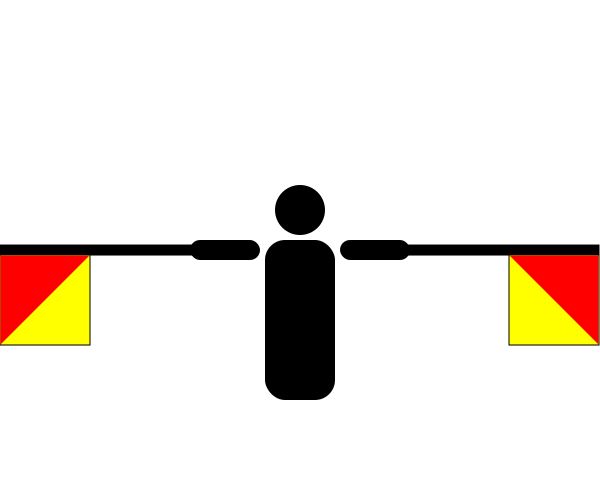
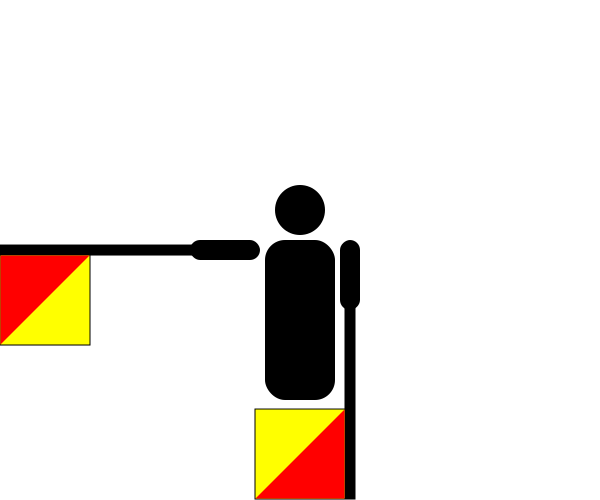
There are approximately 101 people named Erb in the UK. That makes it one of Britain's least common surnames. Only around two in a million people in Britain are named Erb.
Origin: English
Region of origin: British Isles
Country of origin: England
Religion of origin: Christian
Language of origin: English
