ERASMUS
The surname Erasmus has its origins in ancient Greece and stems from the Greek personal name Erasmios, which signifies someone who is beloved or desired. As a patronymic name, it originally served to identify the descendants or followers of a man bearing that given name.
Historical records mention a 6th‑century Christian saint named Erasmios, who was later revered as the patron of seamen and turners. The etymological link to the Greek word erasmos, meaning beloved, is further supported by the numerous medieval spellings that have survived—such as Rasmus, Asmus, and Eras—which testify to the name’s widespread use among Christian communities across Europe.
The surname gained renewed prominence in the Middle Ages through the profound influence of the Renaissance scholar Desiderius Erasmus. His critical writings on theology, education, and the arts helped disseminate the name beyond its original geographic confines, and it remains associated with the humanist movement that shaped European intellectual history.
In contemporary contexts the surname is most common in the Netherlands, where it ranks among the most frequent family names. According to the Dutch Bureau of Statistics, approximately 32,000 individuals bore the surname in 2019. South Africa also hosts a significant population of people with this name, reflecting the legacy of Dutch colonial migration. Outside these regions the name is considerably rarer; in the United Kingdom it is uncommon, while the United States Census of 2010 recorded roughly 3,500 bearers.
Over centuries the surname has appeared under a wide array of orthographic variations—including Erasmus, Erasmi, Eras, and Rasmus—illustrating how the original Greek root was adapted into Germanic, Latin, and other linguistic traditions throughout Europe.
Historical documentation provides evidence of the name’s use across a variety of contexts. Augustus Erasmi of Berlin is documented in 1420, and Conrad Erasmus of Prague appears in 1427. In England, the marriage of Johan Asmus to Jane Elizabeth Taylor in 1839, followed by the birth of six children, indicates that the surname, in some form, found its way into English society by the early nineteenth century.
The enduring presence of the surname Erasmus in modern populations serves as a reminder of its ancient Greek roots and of the lasting legacy of the humanist scholar who amplified its reach. Whether marking family lineage or evoking cultural memory, the name persists as a testament to the intertwining of language, history, and individual identity.
Typical given names associated with the Erasmus surname
Male
- Christopher
- Daniel
- David
- Eben
- Gabriel
- Gavin
- Ian
- James
- Johannes
- John
- Martin
- Michael
- Nicolaas
- Peter
- Pieter
Female
- Amanda
- Gemma
- Hannah
- Lynn
- Margaret
- Maxine
- Ruth
- Sharon
- Sian
- Susan
- Tracey
- Tracy
Similar and related surnames
Related and similar names are generated algorithmically based on the spelling, and may not necessarily share an etymology.
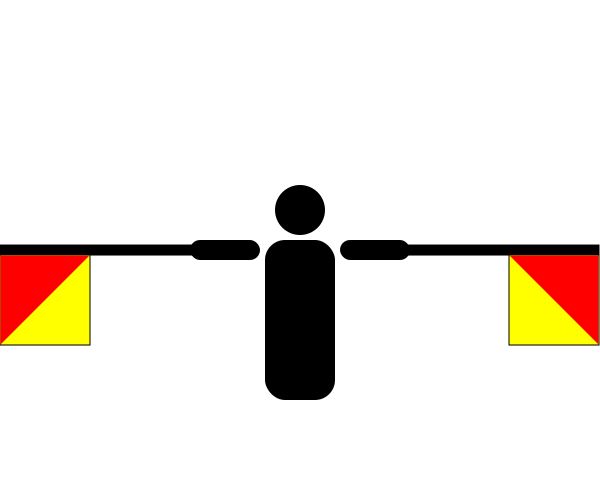
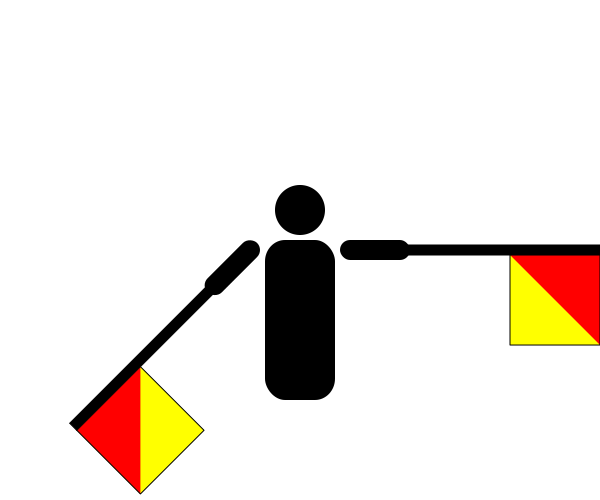
How to communicate the surname Erasmus in...
Braille
⠑⠗⠁⠎⠍⠥⠎
Morse
..-..-...--..-...
Semaphore




There are approximately 809 people named Erasmus in the UK. That makes it roughly the 8,693rd most common surname in Britain. Around 12 in a million people in Britain are named Erasmus.
