ENSLEY
Ensley is a surname of English origin that is fundamentally locational in nature. It derives from place names recorded in Anglo‑Saxon sources and has been preserved in the family names of Britain and, later, the broader English‑speaking world.
According to toponymic etymology, the name is composed of the Old English element een, meaning “one” or “single”, and leah, meaning a wood, a clearing or a meadow. When combined, the name can be interpreted as “the solitary clearing” or “one who lives near a single clearing in the woods”. This semantic construction reflects the common practice in early medieval England of naming people after the landscape features in which they resided.
The variation in place names that give rise to the surname includes Ansley in Warwickshire, Annesley in Nottinghamshire, and former villages once situated in Northumberland and Devonshire. The Domesday Book of 1086 records the Warwickshire location as Hanslei, where the Old English word ansetl meaning hermitage is combined with leah. The Nottinghamshire name appears as Aneslei, and here an, again meaning a or one, contributes to the meaning “the solitary glade”. Early Scottish records cite individuals such as Thomas de Aneslei in Glasgow in 1221 and Johan de Anesleye of Roxburghshire in 1296, indicating a presence in the Lowlands that closely follows the English toponymic tradition.
Surviving ecclesiastical registers provide concrete evidence of early surname spellings. For instance, Thomas Hensley is recorded in North Molton, Devon, on 16 August 1557; Anthony Aynsley married at Moulsoe, Buckinghamshire, on 29 July 1632; Mary Insley was christened at St Ann’s Blackfriars in London on 5 December 1658; and William Ensley married Agnes Lancaster at St Pauls, Exeter, on 28 February 1828. The very first documented form of the surname is William de Anslee, a canon at Glasgow in 1220, as noted in the Register of the Monastery of Passelet during the reign of Alexander I of Scotland.
The surname has produced a number of orthographic variants over the centuries, including Ainslie, Ainsley, Annesley, Aynsley, Insley, Endsley, Endsey, Ensey, Innsley, Enslie, Enncly, and Ensleigh. Such variations are commonly attributed to differences in regional dialect, the absence of standardised spelling in the medieval period, and the transcription errors that can arise when names are copied from handwritten documents onto printed records.
In contemporary times, the name is most frequently encountered outside of Britain, particularly in the United States where it is predominately found in the Southern states such as North Carolina and South Carolina. According to the 2000 Census, the surname is ranked as the 11,877th most common in America. Smaller concentrations can be found in Canada, Australia, and England itself, reflecting the wider dispersion of English surnames across former colonies and the global diaspora.
In sum, the surname Ensley remains a vivid example of a place‑derived family name that has survived through the centuries because of its clear linguistic roots, its documentation in early records, and the continuous adoption of its several spelling variants across diverse English‑speaking societies. Its history offers insight into both Anglo‑Saxon place naming conventions and the genealogical pathways that carry these names into the modern era.
Similar and related surnames
Related and similar names are generated algorithmically based on the spelling, and may not necessarily share an etymology.
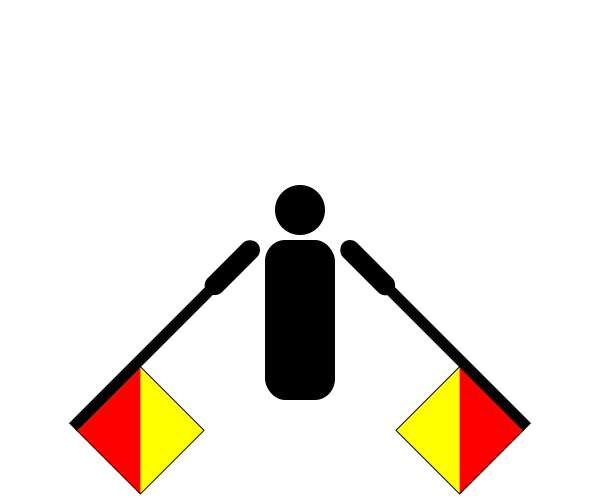
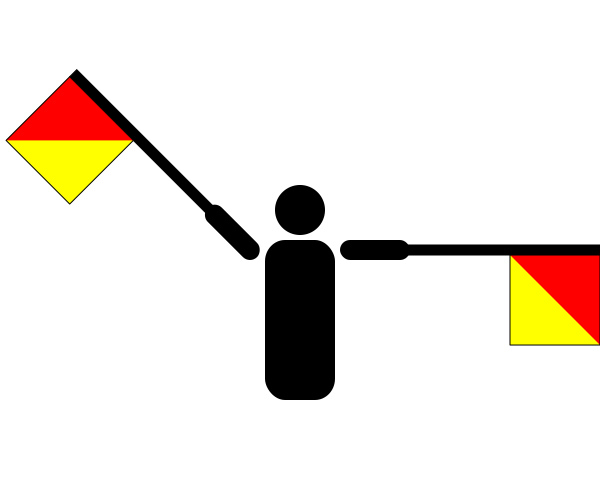
How to communicate the surname Ensley in...
Braille
⠑⠝⠎⠇⠑⠽
Morse
.-.....-...-.--
Semaphore



Sorry, we don't have any statistics on this name. That's probably because it's very uncommon in Britain.
