ENRIGHT
Enright is an Irish surname of Gaelic origin, first recorded in the fifteenth‑century annals of the British Isles. The name is generally understood to be a patronymic form derived from the Gaelic Ó Cionnaith, meaning ‘descendant of Cionnaith’. The personal name Cionnaith itself is believed to stem from the word cionn, which translates as ‘head’ or ‘chief’, thereby rendering the surname with the interpretation ‘descendant of the chief’ or ‘descendant of the head.
The surname has evolved through a number of orthographic variants. Early forms such as Erraught, Enraughty and the archaic MacEnryckty appear in eighteenth‑century parish registers of Limerick, a county in Munster which still hosts a high concentration of bearers of the name. The form MacIonnrachtaigh provides a further variant, with the prefix Mac meaning ‘son of’. The Irish personal byname Ionnrachtach has two suggested meanings: one as ‘upright, lawful’ from ionracas, or the other as an adjectival form of ionradh, meaning ‘attack’, implying ‘the Attacker’ or ‘Plunderer’.
Irish annals record individuals bearing the personal name Inreachtach, from which the familial surname MacIonnrachtaigh is taken. In the sixteenth century the name, rendered as MacErachta in the Fiants of County Longford, was also seen as MacEnryckty and Kinraght in County Limerick. The earliest surviving documentary spelling is that of Father Maurice Mackenrahty, chaplain to the Earl of Desmond, dated 1585. He was executed in Clonmel, County Tipperary, during the reign of Queen Elizabeth I.
According to further historical evidence, the surname is also linked to the Gaelic O’Indreachtain, ‘descendant of Indreachtan’. The element innraic is understood to mean ‘to ride or drive’, so the original bearer may have been described as ‘little rider’. Over the centuries the spelling settled on the now common Enright, especially within Kerry and Limerick where it remained prolific.
The name Enright is an example of an early Irish surname devised to distinguish between people sharing a common given name, often indicating an attribute or occupation. Here it may hint at a progenitor noted for riding proficiency or physical strength, suggested by the term Indreacht meaning ‘the exertion of physical strength’ recorded in the western territories of Ireland.
The great upheavals of the mid‑nineteenth century, notably the Great Famine, prompted mass emigration of families bearing the surname. Census records show significant numbers of Enrights fled to the United States, Canada, Britain and Australia. Within the United States the name remains common in urban centres such as Chicago, New York and Boston, while in Australia it is particularly frequent in New South Wales.
Despite its dispersion, the surname continues to be most prevalent within its country of origin, Ireland. Within the country it is concentrated in the western counties, especially Kerry and Limerick, where parish and civil records chronicle its long presence. Modern registries and telephone directories confirm that the Enright name remains robustly represented in these regions.
Alternative spellings that have been documented include Enrite, Enryght, Henright, Enwright, Inright and Innright. These variants reflect regional dialectical influences and historical periods of Romanisation and anglicisation of Gaelic names. The related surnames O’Henright and O’Inneirghe carry a similar patronymic structure, though they denote different lineages.
Historical documents such as the father‑and‑son relationship noted in the 1742 christening of Mary Enraughty, an infant, and the 1768 christening of Catherine, daughter of Michael Enright, provide tangible evidence of the name’s occupancy in parish registers of County Limerick. These records illustrate the steady continuity of the surname through successive generations.
Given the variety of possible meanings attached to the name’s Gaelic ancestors – ranging from ‘chief’ to ‘lawful’, ‘attacker’ to ‘little rider’ – scholars regard the surname Enright as emblematic of the linguistic complexity inherent in Irish patronymic surnames. Each variant offers a distinct narrative thread into the history and social status of its bearers.
Thus, the Enright surname stands as a testament to Ireland’s linguistic heritage, its historical movements and the enduring patterns of naming that link modern individuals back to their ancestral roots. The name’s persistence across centuries and continents highlights both its resilience and the broader diaspora of the Irish people.
Typical given names associated with the Enright surname
Male
- Christopher
- David
- James
- John
- Kevin
- Mark
- Michael
- Patrick
- Paul
- Sean
- Thomas
Female
- Ann
- Catherine
- Helen
- Jacqueline
- Julie
- Karen
- Margaret
- Mary
- Michelle
- Patricia
- Samantha
- Susan
Similar and related surnames
Related and similar names are generated algorithmically based on the spelling, and may not necessarily share an etymology.
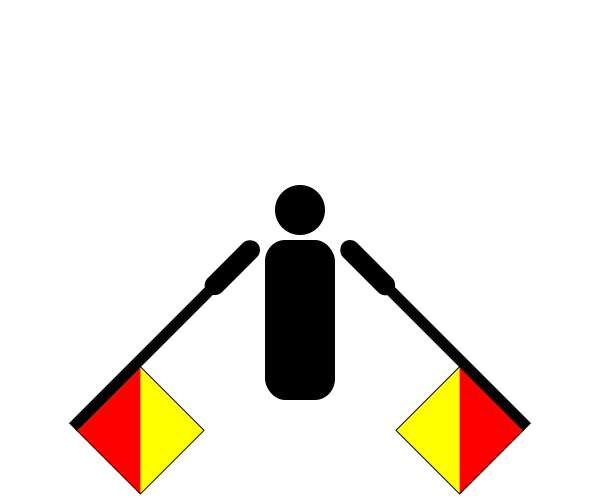
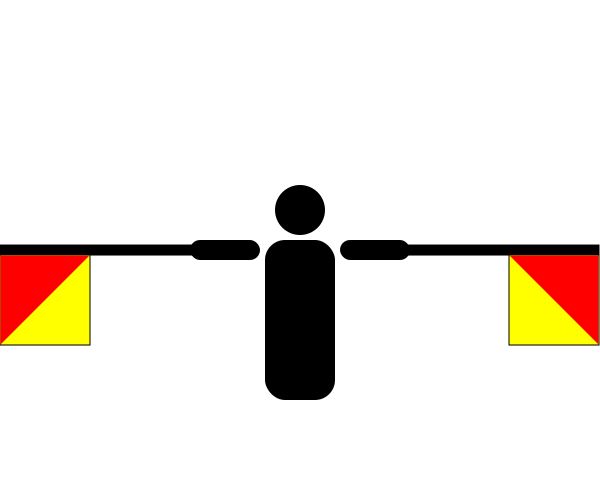
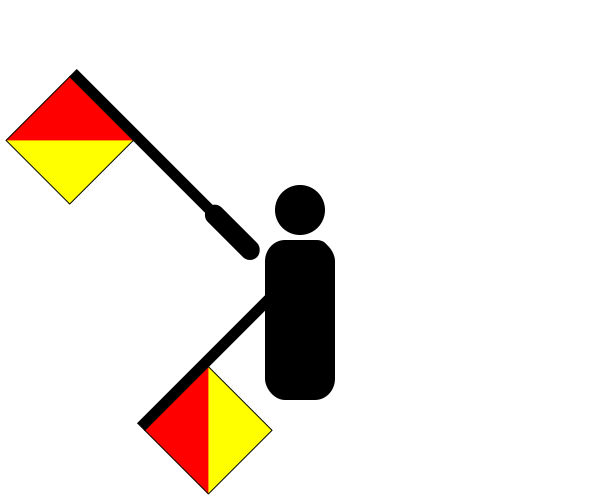
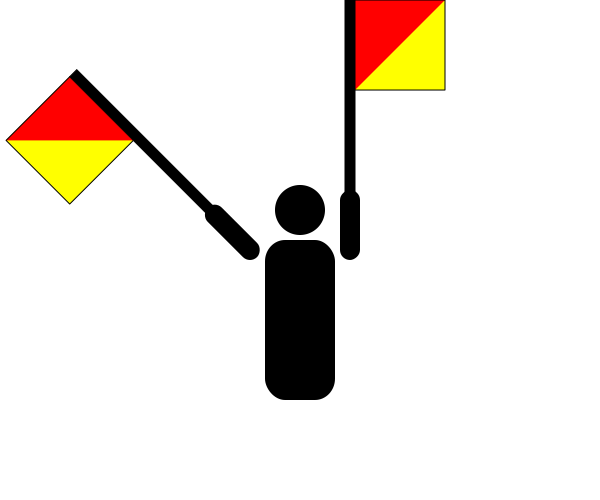
How to communicate the surname Enright in...
Braille
⠑⠝⠗⠊⠛⠓⠞
Morse
.-..-...--.....-
Semaphore



Did you know?
According to a survey carried out by Democracy Club, politicians and candidates with the surname Enright are most likely to say that their favourite biscuit is a Shortbread.
There are approximately 1,908 people named Enright in the UK. That makes it roughly the 4,374th most common surname in Britain. Around 29 in a million people in Britain are named Enright.
Origin: Celtic
Region of origin: British Isles
Country of origin: Ireland
Religion of origin: Christian
Language of origin: Gaelic

Famous people named Enright
- Philip King Enright - Admiral (1894 to 1960)
Names and descriptions courtesy of Wikipedia, and may contain errors. This is not intended to be an exhaustive list of every famous person with this name.