ENDERS
Enders is a surname of dual origin, deriving both from German and Greek roots. The name is patronymic, originally indicating descent from a person named Andreas, the Greek form of Andrew, and later from the Old Germanic personal name Ender, Endor or Endros. The evolution of the name demonstrates the linguistic interplay between languages and cultures across medieval Europe.
In the Greek tradition, Andreas means “manly” and was widely adopted as a baptismal name in the 12c and 13c. The spelling changed over centuries, appearing in documents as Andro (1399), Andrus (1510), Anders (1610) and ultimately Enders. The first recorded instance of the personal name Andreas is found in the 1086 Domesday Book, and it was first noted in Scotland in 1242. The surname itself began to appear in English records in the late 17c, with examples such as Richard Ender, son of James and Judith Ender, christened at St Dunstans Church, Stepney, on July 20th 1679. Further evidence of the name’s spread appears in 1833 when John Enders married Louise Adele Elizabeth Hoffman at St Ann's Soho, Westminster.
From the Germanic perspective, the root ender means “in the corner” or “at the end”, suggesting that the original bearer lived at a corner or the end of a village or road. The addition of the suffix –er designates “son of”, thereby forming the patronymic Enders. This construction was common in medieval German naming practices and propagated across German-speaking regions. Early American records from the 1700s, particularly in Pennsylvania, document individuals bearing the name, many of whom were glass makers. The surname retained its prevalence in Austria, Belgium, and Holland, and continues to be distributed across Europe and North America.
Today Enders remains a relatively frequent surname. In Britain it ranks as the 4,400th most common name, especially in the East of England and Norfolk. In Germany it is the 413th most common surname, strongest in Bavaria, Baden‑Wurttemberg, Saxony and Lower Saxony. The name is also present in Canada, Australia and the United States, where it occupies various positions in surname frequency lists, such as 8,523rd in the United States, 8,834th in Canada and 15,617th in Australia. These statistics demonstrate the enduring presence of the name across continents.
Several spelling variations exist, reflecting regional dialects and historical orthographic changes. Common variants include Endress, Endrich, Enderle, Enderly, Endrick, Endricke, Endersz, Endres, Endresen, Endreson, Endriss, Endzel, Enderlin, Endrun and Endey. These forms are all derivable from the same root and share the characteristic –ers suffix seen in the original surname.
In sum, the surname Enders encapsulates a rich linguistic heritage that spans Greek and Germanic origins, medieval patronymic traditions, and transnational migration. It continues to link descendants across Europe, America and beyond, preserving a connection to its historical roots for future generations.
Similar and related surnames
Related and similar names are generated algorithmically based on the spelling, and may not necessarily share an etymology.
How to communicate the surname Enders in...
Braille
⠑⠝⠙⠑⠗⠎
Morse
.-.-....-....
Semaphore

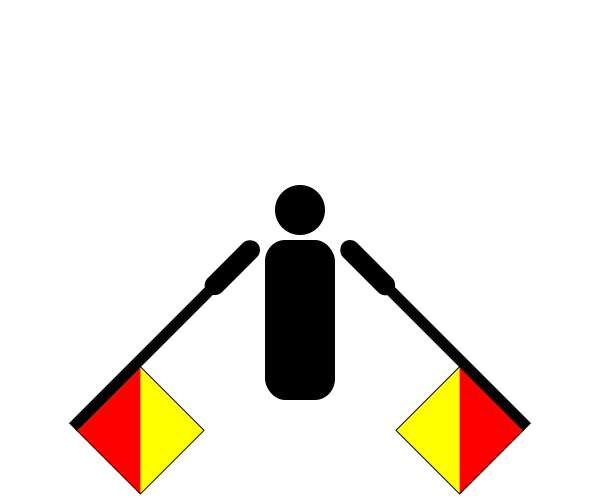

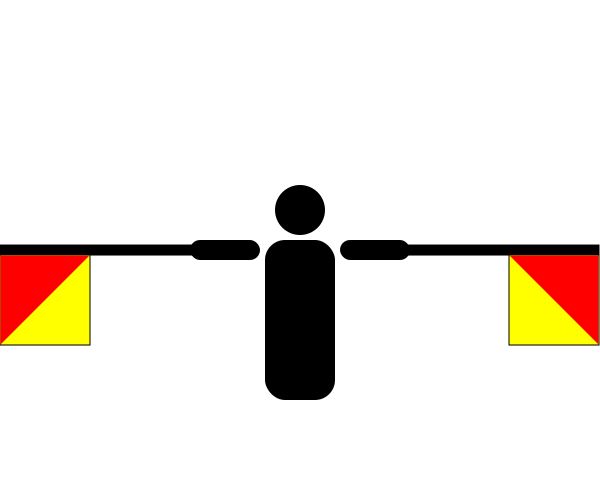

There are approximately 58 people named Enders in the UK. That makes it one of Britain's least common surnames. Only around one in a million people in Britain are named Enders.
