ELY
The Ely name is fundamentally of English provenance, though it also occurs as an anglicised variant of the Hebrew personal name Eliyahu. In the oldest English records the surname is traced to the Old English word eg, meaning a low‑lying area or island, or to oel meaning “eel” combined with ge, a term designating a district or region. Consequently the name may have arisen as a topographic label for a person dwelling near an island or marsh, or as a locational identifier for someone from the town of Ely in Cambridgeshire. The place itself was so named because the adjacent fens were rich in eels; the Old English root has this enduring connotation in the toponym.
The earliest documentary example of the surname appears in the Inquisition Rolls of Cambridgeshire, where Huna de Ely is recorded in 1086 during the reign of King William I. This medieval testimony confirms that the name had already entered the lexicon of the English population by the late 11th century, when surnames were introduced in Britain to facilitate taxation and administrative control.
Further early evidence is provided by the Subsidy Rolls of Cambridge of 1327, which list a John Elye, and by the Danelaw Rolls of Nottingham of 1154, in which a William Heli appears. Additional documentary references include the 1150 Rolls of Lincoln, showing the name Hely de Amandevilla, and a 1213 Somerset record of Phillipus filius Helie. These entries illustrate the geographical spread of the surname across the East and South of England from the first half of the medieval period.
In the 16th century, parish registers provide further evidence. On April 8, 1562, the marriage of Anne Elye to Anthony Shipsett was recorded at St. Olave’s, Old Jewry, London, and on April 12, 1562, the union of Henry Ely with Christian Cults was entered into the book of Allhallows, London Wall. These entries demonstrate the continued existence of the surname in the capital during the Tudor period.
The surname’s association with the Hebrew name Eliyahu is most likely a later adaptation. The Old French personal name Elie, itself derived from the biblical Elijah, was introduced by the Normans after the 1066 invasion and reinforced in the post‑Crusader period when knights returned from the Holy Land and chose biblical given names for their children. Thus, families of Hebrew origin could adopt the English spelling Ely without alteration, lending the name a dual cultural heritage.
Variations of the spelling have been documented throughout history. The most frequent forms are Eley, Ely, Ealey, Eeley, Heley and Hely. The range of spellings was largely dictated by regional accents, the lack of standardised orthography in medieval England and the phonetic approach of clerks recording names at parish and court. Related surnames that may share a common origin include Elly, Ellyson and Elson, reflecting a pattern of patronymic or occupational derivation in the same geographical area.
In heraldry the name Ely is most commonly represented by the blazon: a barry of ten pale silver and blue, over all a red bend. This shield is attested in several heraldic collections from the early modern period and is associated with families who held estates in or near Cambridgeshire. The use of this coat of arms during the Tudor and Stuart eras highlights the social standing and lineage of certain branches of the Ely family.
Contemporary distribution records indicate that the surname remains sporadic in England, with concentrations in the East of the country, particularly in Cambridgeshire, Essex and the lesser‑known locality of Eely in Northamptonshire. While it is uncommon in its country of origin, it has a noticeably larger presence in the United States where it appears most frequently in California, followed by Texas and Florida. Australian and other Anglophone colonies also show isolated pockets of the name, largely a consequence of emigration from the British Isles over the last two centuries.
Given the multiplicity of origins, a definitive conclusion regarding the precise etymology of an individual family’s Ely surname can only be reached through meticulous genealogical investigation of archival material, including parish registers, tax rolls, and heraldic records. Such a study would establish whether a particular case stems from a locational origin in Cambridgeshire, a topographic reference to a marshland dwelling, or a cultural adoption of the Hebrew name Eliyahu.
Typical given names associated with the Ely surname
Male
- Christopher
- David
- John
- Jonathan
- Matthew
- Michael
- Paul
- Peter
- Richard
- Robert
Female
- Caroline
- Claire
- Elizabeth
- Julia
- Linda
- Margaret
- Nicola
- Rebecca
- Samantha
- Sarah
- Sharon
- Susan
- Vanessa
Similar and related surnames
Related and similar names are generated algorithmically based on the spelling, and may not necessarily share an etymology.
How to communicate the surname Ely in...
Braille
⠑⠇⠽
Morse
..-..-.--
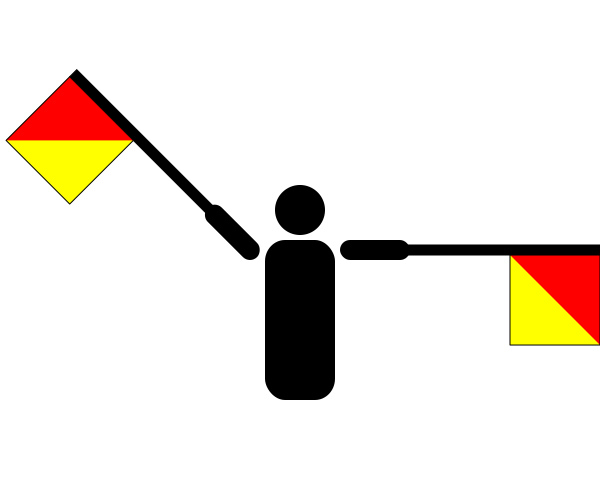
Semaphore


There are approximately 2,494 people named Ely in the UK. That makes it roughly the 3,521st most common surname in Britain. Around 38 in a million people in Britain are named Ely.
Surname type: Location or geographical feature
Origin: English
Region of origin: British Isles
Country of origin: England
Religion of origin: Christian
Language of origin: English
