ELLER
The surname Eller is primarily of German origin, a fact that is well documented in linguistic and genealogical studies. It is derived from the Middle High German word eller or ellern, meaning alder tree. Consequently, the name fell into the category of topographic surnames, given to individuals who lived near alder trees or in an area where such trees were common. In some cases it may also have reflected an occupational connection, for example a person who harvested or traded alder wood.
Although rooted in Germany, the name is also attested in the British Isles, particularly in Northern England and Yorkshire. Early English records include Prior de Ellerton of York in the Hundred Rolls of 1273, John de Ellerker of York in 1315, and later entries such as Isabell Ellor of Brompton-by-Sawdon (1576) and John Eller of Osmotherley in 1623. These documents indicate an early presence of the name in England, possibly introduced by Anglo‑Saxon settlers after the fifth century, or perhaps re‑introduced in the fifteenth century when German engineers were involved in the draining of the Vale of York. The surname appears in several forms, including Ellar, Ellor and Eller, and is related to locational surnames such as Ellerby, Ellerker, Ellershaw, Ellerton and Ellerey. The common element in these variations is the reference to “low lying ground,” a meaning that may derive from the old river name Elera used in parts of the Rhine Valley.
In Germany the surname remains most common in the regions of Nordrhein-Westfalen and Bayern. In the United States it is frequently encountered in Pennsylvania, North Carolina and Virginia, a distribution that reflects historic German immigration to those areas. Smaller concentrations exist in Brazil, Denmark, Sweden and other European countries, some of which show variant spellings such as Eler, Ellur, Ellere and occasionally Heller or Ellery under anglicisation. In Scandinavia a related surname, Ellers, has been recorded, presumably a regional variant.
Variations of the name are produced not only by spelling differences but also by the addition of prefixes or suffixes that indicate territorial association or social status. Examples from German contexts include Ellerhoff and Ellermann; the use of the particle von, as in Von Eller, would historically signify nobility. Such adaptations illustrate how the surname could evolve as families migrated and were assimilated into different linguistic and cultural environments.
Overall, the surname Eller offers a concise illustration of how topographic and occupational descriptors in medieval Germany gave rise to family names that have persisted across centuries and continents. The name’s survival in both German and English records, alongside its multiple orthographic forms, continues to provide genealogists and historians with tangible clues to the lives and movements of its bearers.
Typical given names associated with the Eller surname
Male
- Alexander
- Daniel
- David
- Garry
- Heinz
- James
- Joseph
- Justin
- Malcolm
- Michael
- Philip
- Ralf
- Richard
Female
- Alison
- Beverley
- Jacqueline
- Kirsten
- Marion
- Nancy
- Natalie
- Nicole
- Patricia
- Pauline
- Rebecca
- Susan
- Vivien
- Yvonne
Similar and related surnames
Related and similar names are generated algorithmically based on the spelling, and may not necessarily share an etymology.
How to communicate the surname Eller in...
Braille
⠑⠇⠇⠑⠗
Morse
..-...-....-.
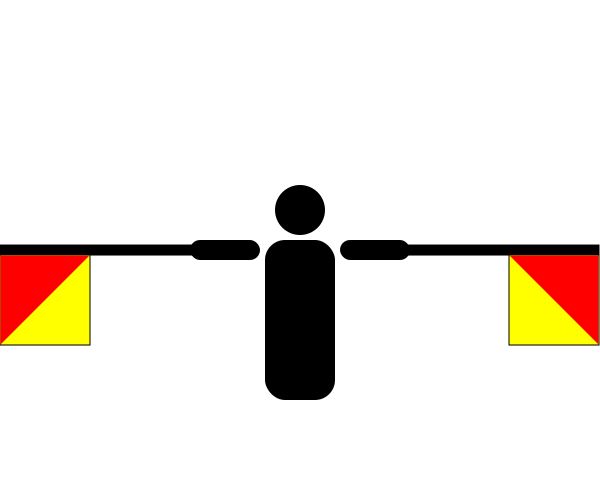
Semaphore


There are approximately 146 people named Eller in the UK. That makes it one of Britain's least common surnames. Only around two in a million people in Britain are named Eller.
Surname type: Occupational name
Origin: English
Region of origin: British Isles
Country of origin: England
Religion of origin: Christian
Language of origin: English
