ELKS
Elks is a surname of strictly English origin. It stems from the Old English word elch or elk, a term that referred to a large, deer‑like animal that was once widespread across England and Europe.
The name is traditionally regarded as a descriptive nickname. It would have been applied to an individual who possessed traits reminiscent of the elk – notably height, strength or a dignified bearing. Such nicknames were common in Early Middle English society, where physical attributes or personal characteristics often served as a basis for surname formation.
Another accepted explanation connects the surname to an occupational role. Documentation suggests that an Elks ancestor may have been involved in training or managing elk, a practice that would have required considerable skill and would have set that person apart within the community. The term itself, derived from Old English, would thus have functioned both as a description and a job title.
There are also less widespread theories. One relates the name to a medieval verb hulc, itself an early derivation of the Anglo‑Saxon helkein meaning “to tow.” Under this view, an Elks individual might have worked towing ships by rowing or by means of ropes pulled from the shore. Another theory mentions a possible patronymic link to the Hebrew female name Elke, though the evidence for this is scant and the surname is generally considered to be of English rather than Hebrew origin.
The earliest definitive record of the spellings that make up the modern family name is that of Robert Elks, who appears as a witness at St. Ann's, Blackfriars, London, on 24 January 1583. This date places the surname firmly within the reign of Queen Elizabeth I, at a time when English society was already embracing hereditary surnames.
In terms of geographic distribution, the name is most commonly found in England. It has particular concentrations in the London area – possibly reflecting the water‑related occupations mentioned above – and in North‑West England, with some occurrences noted as early as 1227 in Northumberland. Across the Atlantic, the surname is largely rare, but it is occasionally recorded in states such as Kentucky, Virginia, North Carolina, California and Ohio, probably as a result of immigration from England or Northern Ireland during the 18th and 19th centuries.
Several variations of the surname occur in historical records, including Elk, Elkes, Elke, Elx, Elck and possessive forms such as Elke’s. These variants have arisen through spelling standardisation, cultural assimilation and linguistic evolution over the centuries.
Whilst the surname Elks remains relatively uncommon in contemporary records, it endures as a testament to the long history of human relationships with wildlife and the occupational traditions of early English communities. Bearers of the name today may therefore trace their ancestry back to ancestors who were physically imposing, skilled in animal management, or involved in maritime towing operations, thereby retaining a name that once described both a person and their trade.
Typical given names associated with the Elks surname
Male
- David
- Gordon
- James
- John
- Jonathan
- Kenneth
- Martin
- Michael
- Paul
- Philip
- Robert
- Stephen
- Stuart
Female
- Barbara
- Eileen
- Elisabeth
- Hazel
- Jane
- Linda
- Lorraine
- Margaret
- Nicola
- Rebecca
- Sarah
- Susan
- Tracey
- Vena
Similar and related surnames
Related and similar names are generated algorithmically based on the spelling, and may not necessarily share an etymology.
How to communicate the surname Elks in...
Braille
⠑⠇⠅⠎
Morse
..-..-.-...
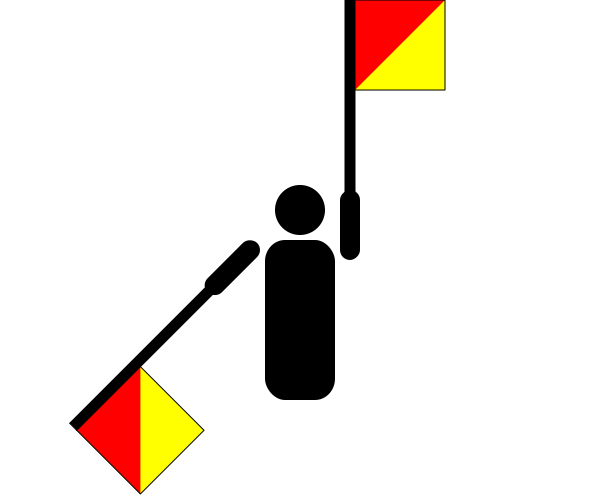
Semaphore



There are approximately 551 people named Elks in the UK. That makes it one of Britain's least common surnames. Only around eight in a million people in Britain are named Elks.
Origin: English
Region of origin: British Isles
Country of origin: England
Religion of origin: Christian
Language of origin: English