ELDERS
Elders is a surname of English and Scottish origin that dates back to the Middle Ages. The name is derived from the Old English word ealdra, meaning “older” or “senior.” This etymology reflects a practice in medieval society where individuals who were eldest in a family or held a position of respect were identified by such descriptors, which later became hereditary surnames.
The earliest recorded forms of the name appear as Elder and Elders in medieval English documents. In the early 12th century, the Curia Regis rolls contain the entry “Hugo le Heldere” for Hertfordshire, and by the late 14th century, the Priory Rolls of Yorkshire record “Ricardus le Elder.” These instances demonstrate that the surname was in use across different regions of England within a span of just over a century.
In Yorkshire, a common practice was to distinguish generations using the descriptors Senior and Junior, with the former often becoming the family surname in its own right. The form Elders is a patronymic or short form of Elderson and is more widely recorded across England than the single word Senior. The 1273 Lincoln Hundred Rolls provide an example: “Robert Junior,” indicating that both halves of the modern “Elders” system were in use during this period.
The surname’s association with leadership or authority is evident in its biblical connotations. In the Hebrew and early Christian texts, the term “elder” denoted a person who held spiritual or communal authority. Consequently, families bearing the name might have had ancestors who served as village elders or were recognised as church leaders. This religious dimension is a recognised component of the name’s historical meaning.
Spelling variants can be found across different parts of the English-speaking world, including Elder, Eldred, Eldridge, and occasionally Eldres. However, the most common modern form remains Elders. The spelling variation often reflects regional linguistic differences or transcription errors in ancient records.
From the 17th to the 19th century, many bearers of the surname emigrated from the British Isles to other English-speaking countries such as the United States, Australia, New Zealand, and Canada. In these diaspora communities the name remained relatively stable, continuing to indicate ancestral ties to the original English or Scottish locales.
While the surname is not among the most frequent in the United Kingdom today, it persists in pockets across England and Scotland, and it can also be found in the Netherlands, where the prefix “Van” occasionally appears, giving forms such as Van Elders or Van der Elders.
Overall, the Elders surname encapsulates a heritage of seniority, respect, and community leadership that has been recognised and recorded in various medieval English documents. By tracing its evolution from a simple descriptive nickname to a hereditary family name, one gains insight into the social structures and linguistic practices of early English society.
Typical given names associated with the Elders surname
Male
- Andrew
- Brian
- David
- Graham
- Henk
- John
- Jonathan
- Joseph
- Martin
- Michael
- Paul
- Richard
Female
- Angela
- Christine
- Elizabeth
- Helen
- Ilse
- Irene
- Jean
- Margaret
- Mary
- Melissa
- Rachael
- Sarah
- Vera
- Zabeena
Similar and related surnames
Related and similar names are generated algorithmically based on the spelling, and may not necessarily share an etymology.
How to communicate the surname Elders in...
Braille
⠑⠇⠙⠑⠗⠎
Morse
..-..-....-....
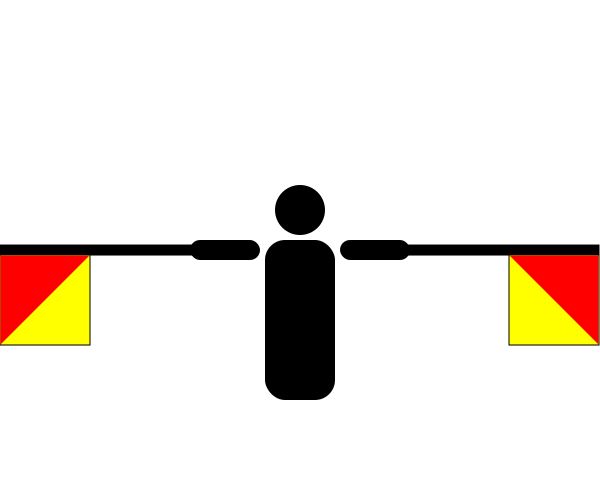
Semaphore



There are approximately 277 people named Elders in the UK. That makes it one of Britain's least common surnames. Only around four in a million people in Britain are named Elders.
Origin: English
Region of origin: British Isles
Country of origin: England
Religion of origin: Christian
Language of origin: English
