EGER
Eger is a surname encountered in several linguistic and cultural contexts, most notably within Germanic, Anglo‑Saxon and Ashkenazi Jewish traditions. Each tradition attributes a distinct etymology and historical usage to the name.
In the German context the name may have arisen from the word Eger, meaning hedgehog, possibly as a nickname for an individual whose appearance or character evoked that of the animal. It is also regarded as a habitational surname for people from the city of Eger, present‑day Cheb, in the Czech Republic. Furthermore, the Yiddish word eyger, meaning island, has been recognised as a source for the name among Jewish communities, suggesting a locational association with an island or island‑habitants.
The Anglo‑Saxon derivation stems from the Old English personal name Eadgar (ead ‘prosperity, fortune’ + gar ‘spear’). The name entered English usage as a surname in the early 13th century, with early recordings such as Walter Elgar (1234), Thomas Algor (1260) and Robert Elger (1271). Subsequent variations in spelling include Eager, Eagger, Egar, Egarr and Agar, reflecting the fluid orthography of the medieval period.
In another Germanic strand the surname is linked to the word egger, which translates as ploughman. It has also been associated with estates where the ploughman lived, indicating an occupational origin. A prominent figure bearing this name, Akiva Eger, is noted for beginning his life as a farmhand alongside his father and later advancing to a leading position within the Jewish community.
Contemporary frequency data show that the name remains most common in Central Europe. In Germany the surname is found throughout the country, with significant numbers in Berlin, Bavaria and Saxony. Switzerland records it chiefly in German speaking cantons such as Zurich and Basel Stadt. In Hungary it is especially frequent in Central Transdanubia and Northern Hungary, while in the Czech Republic it is prevalent in the eastern regions and in Prague. Immigration has carried the name to the United States, Canada, Australia and other countries.
Variations of the surname arise from regional pronunciation and orthographic practices. Common forms are Egger, Eiger, Eggers, Egli, Egler, Egle and Heger, among others. In Dutch contexts the spelling may appear as Eegher or Eeger, and the United States often records it as Eiger or Aeager. Spelling differences can even occur within single families or generations.
Prominent individuals bearing the surname include the noted scholar Akiva Eger, whose journey from a farmhand to a respected religious authority exemplifies the diverse occupations adopted by those with this name.
The surname Eger illustrates how a single family name can encapsulate varied etymological roots, from animal nicknames and occupational descriptors to locational markers and aspirational personal names. Its persistence across centuries and across Europe reflects both the mobility of families and the enduring nature of traditional naming practices.
Similar and related surnames
Related and similar names are generated algorithmically based on the spelling, and may not necessarily share an etymology.
How to communicate the surname Eger in...
Braille
⠑⠛⠑⠗
Morse
.--...-.
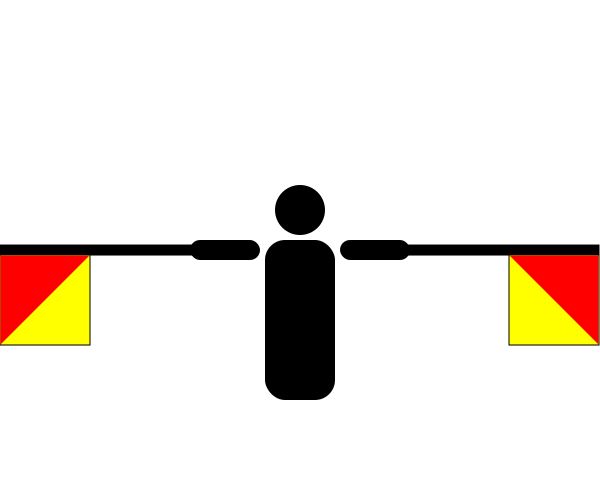
Semaphore


Sorry, we don't have any statistics on this name. That's probably because it's very uncommon in Britain.