EDGER
Edger is an English surname of antiquated origin, with documentary evidence that places its earliest usage in the medieval period. It devotes from the Old English noun ecg, meaning “edge”, and the Middle English word edger, denoting a person situated at the periphery of a settlement or a boundary line.
The locational sense of the name is evident in how it was applied to those who lived on or near the outer limits of a village or town. In this respect, it functions in a manner analogous to surnames such as Hill or Forester, providing a direct reference to geographical position.
In addition to its purely locational interpretation, the surname may have honorary occupational connotations. Because ecg also conveyed the idea of a sharp metallic edge – for instance, a sword’s cut – an edger could have been someone engaged in the sharpening of blades or the manufacture of edged tools. The dual meaning of the root term facilitated both senses within the same lexical field.
A third derivation stems from the Old English personal name Eadgar (modern Edgar), composed of the elements ead “prosperity” and gar “spear”. This name was borne by a notable Anglo‑Saxon king, grandson of Alfred the Great, and survived the Norman Conquest, preserving its usage in recorded deeds. The Domesday Book of 1086 lists the name in the spellings Edgar and Etgar, while the Suffolk registry of 1095 records it as Aedgar, and a later 1182 entry cites Adger. The personal name also appears in early Scottish chronicles with King Eadgar ruling from 1097 to 1100.
The surname was established in Scotland by the early fourteenth century, illustrated by a 1306 witness record of Richard Edgar of Wedderbie, who attended the second marriage of King Robert Bruce. In England, the name appears in parish registers; for example, on 14 August 1605 a marriage between James Edgar and Joane Watson is recorded at St. Giles’ Cripplegate.
A notable heraldic record for the name is a coat of arms granted to a family of the surname, featuring a gold cross formee amid four gold martlets on a blue escutcheon. Although heraldic designs were specific to individual families, this description illustrates the historical prominence of certain bearers of the name.
The earliest documented spelling of the family name is Thomas Edgar in 1250, preserved in the Book of Fees of Surrey during the reign of King Henry III (1216‑1272). Subsequent records confirm the continuity of the surname in the English legal and ecclesiastical archives into later centuries.
Variations in spelling are common, owing to regional pronunciation differences and the orthographic fluidity of the medieval period. Recorded variants include Edge, Edgerly, Edgeley, Edgerton, Edgeston, Egger, and Edgars. These forms are geographically dispersed and have, over time, propagated into the wider diaspora of English‑speaking peoples.
In the present day, the surname Edger is not particularly widespread within the United Kingdom, yet it persists amongst communities with British ancestry in the United States, Canada, Australia, and New Zealand. Due to its antiquity and the varied origins it encompasses, the name has sustained a modest but enduring presence in contemporary society.
Typical given names associated with the Edger surname
Male
- Andrew
- Bryan
- George
- James
- John
- Jonathan
- Joseph
- Peter
- Robert
- Stephen
- William
Female
- Ann
- Delma
- Edna
- Elizabeth
- Joyce
- Louise
- Patricia
- Ruth
- Sarah
- Susan
Similar and related surnames
Related and similar names are generated algorithmically based on the spelling, and may not necessarily share an etymology.
How to communicate the surname Edger in...
Braille
⠑⠙⠛⠑⠗
Morse
.-..--...-.
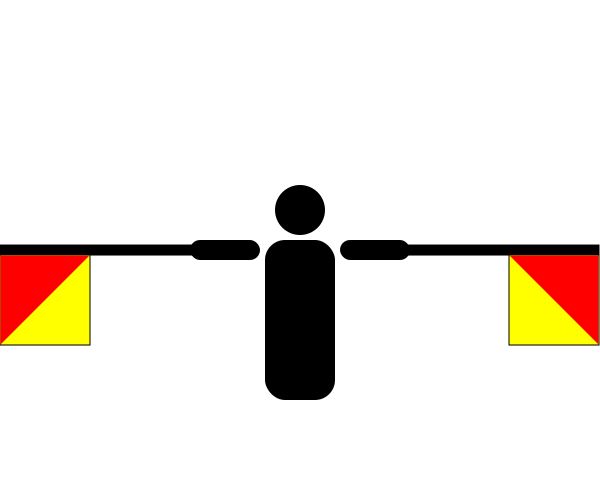
Semaphore


There are approximately 119 people named Edger in the UK. That makes it one of Britain's least common surnames. Only around two in a million people in Britain are named Edger.
