EBLE
Eble is a surname of German origin that has been recorded since the early sixteenth century. The name is classified as patronymic, indicating that it was originally used to identify the descendants of a particular ancestor named Eberhard or a similar Germanic personal name.
The etymology of Eble can be traced to the Middle High German personal names Eberhard and Everard. The first element, eber, translates as “wild boar”, while the second element, hard, conveys the meanings of bravery, hardy or strong. In Old German these components combined to produce a meaning that can be rendered strong boar – a metaphorical reference to courage and resilience.
Historical records document the first instance of the surname in the year 1525 when a marriage record of Jacob Ebels appears in Lengefelt, Chemnitz, in the German state of Sachsen. Later documentation from the early seventeenth century includes the marriage of Sebolt Eble and Barbara Werber on 2 February 1609 in Ettenheim, Freiburg, Baden, and the baptism of their son Andreas on 14 March 1613 in the same parish.
There are several orthographic variants of the surname that have appeared in surviving records. Common alternatives include Ebel, Ebles, Ebelle, Ebell, Evel and Eveles. These variants are often tied to specific regional uses: the form Ebel is most frequently found in German‑speaking areas such as Austria, Bavaria and Baden‑Württemberg, while Ebles and Ebelle have appeared more often in French‑speaking territories and in parts of the Netherlands.
Geographically, the surname has traditionally been concentrated in the south‑west of Germany – particularly in Bavaria, Baden‑Württemberg and Hesse – but has also been documented in Switzerland, Alsace in France, and Austria. In recent centuries, migration has spread the name beyond Europe, with occurrences most notable in the United States, especially in Texas, New York, and California, where the community of Eble, Texas, was named after early settlers bearing the surname.
A heraldic achievement associated with the Paris branch of the Eble family is recorded in Rietstap's Armorial General. The quartered shield bears a gold cross overall; the first quarter displays corn in gold on a blue field; the second and third quarters show swords in saltire on a red field; the fourth quarter contains a gold lion rampant on a blue field. In heraldic symbolism, gold represents generosity and elevation; blue stands for loyalty and truth; and red denotes military fortitude and magnanimity.
In contemporary usage, Eble remains a relatively uncommon surname worldwide. Nevertheless, it continues to be carried by individuals in the areas historically associated with the name, and it retains an aura of the strength and noble character implied by its original components.
Although the precise origins of the surname remain partly obscured by time, the documented evidence underscores its Germanic roots, its patronymic nature, and its spread across Europe and into North America. The name Eble thus embodies a lineage that is both historically grounded and culturally significant.
Similar and related surnames
Related and similar names are generated algorithmically based on the spelling, and may not necessarily share an etymology.
How to communicate the surname Eble in...
Braille
⠑⠃⠇⠑
Morse
.-....-...
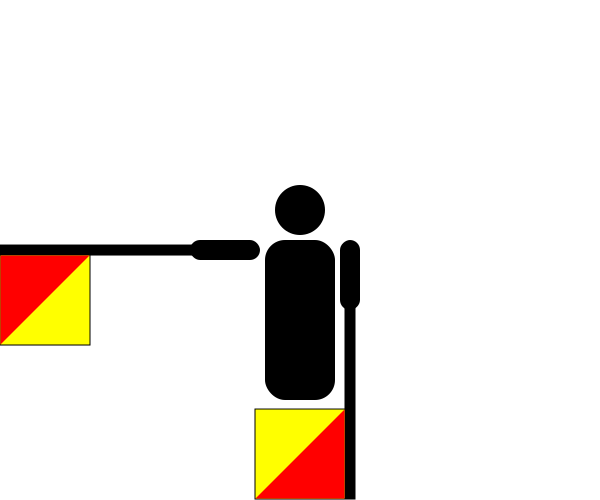
Semaphore


Sorry, we don't have any statistics on this name. That's probably because it's very uncommon in Britain.