EASTERLING
Easterling is a surname of Anglo‑Saxon origin, with a history that stretches across the British Isles and into continental Europe. It is traditionally associated with England, particularly the eastern counties, and is carried by individuals who trace their ancestry to the medieval era.
The name derives from the Middle English word easterling, literally meaning “someone from the east.” The prefix easter is related to the Old English stem ēast, meaning east, while the suffix -ing denotes a person belonging to or associated with a place. Historically, the term was employed to describe merchants from the eastern parts of Germany, the Netherlands and Scandinavia who travelled to England for trade during the Middle Ages, and it was also used to denote a resident of East Anglia or any eastern settlement.
Three principal etymologies are recognised. First, it may be a topographic name for a person who lived east of a principal settlement, emphasising the literal geographic orientation. Second, it is possibly a habitational name derived from a cluster of villages in Essex whose Old English name eowestre meant sheepfold; the surname would then refer to those dwelling in those particular locales. Third, it could be a nickname for someone connected with the festival of Easter, either through birth or baptism during the season, based on the Old English term eastre for the pagan festival that later gave rise to the Christian observance.
Records of the surname first appear in the 16th century. Notable early entries include the christening of Simon Easter at St. Martin Pomeroy in London on 5 April 1640, John Easter, son of Henry, at St. Olave, Southwark on 5 October 1645, and Mary Easter, daughter of Jacob and Frances, at St. Dunstan, Stepney on 9 September 1649. An exceptional bearer was Alexander Hay, Lord Easter Kennet, a Scottish judge and clerk to the Privy Council who died in 1594. The earliest documented spelling of the family name is that of Anna Easter, who was married to Rogerus Cauve on 20 June 1569 in the church register of Hollingbourne, Kent during the reign of Queen Elizabeth I.
During the medieval period the name was usually written in variants such as Easterly, Easterlin and Eastling. Its early distribution was predominantly in northern England, though it later spread across the English‑speaking world, especially to America. Presently the surname is uncommon, with significant concentrations in the United States and in England, and occasional records in Germany, reflecting historical migration and trade links.
Although the modern bearers of the surname no longer carry a strong geographical connotation, the name remains a historically rich ethnonymic term that reflects the movement of peoples, the trading networks of the Hanseatic League, and the cultural significance of the East in medieval Europe.
Typical given names associated with the Easterling surname
Male
- Adrian
- Benjiman
- David
- Dennis
- Dj
- James
- Jason
- John
- Kenneth
- Mark
- Martin
- Nigel
- Ryan
- Simon
- William
Female
- Christine
- Clare
- Dorothy
- Heidi
- Jean
- Kathleen
- Katrina
- Lilian
- Linzi
- Lorriane
- Paula
- Sheena
- Tammera
- Tara
Similar and related surnames
Related and similar names are generated algorithmically based on the spelling, and may not necessarily share an etymology.
How to communicate the surname Easterling in...
Braille
⠑⠁⠎⠞⠑⠗⠇⠊⠝⠛
Morse
..-...-..-..-....-.--.
Semaphore


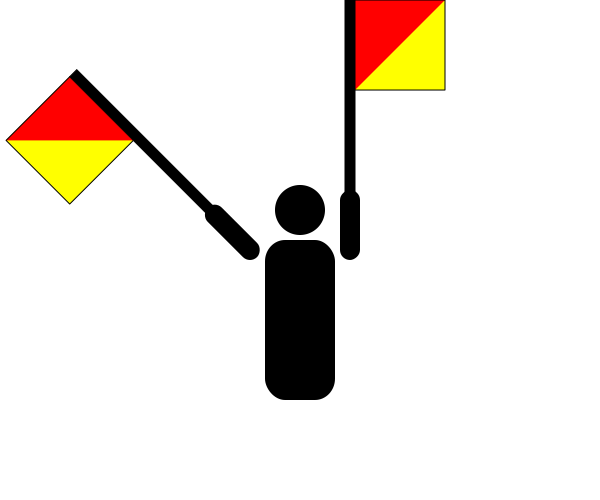
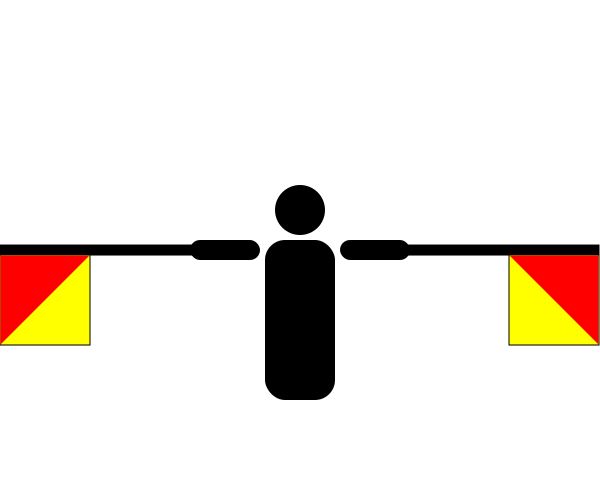

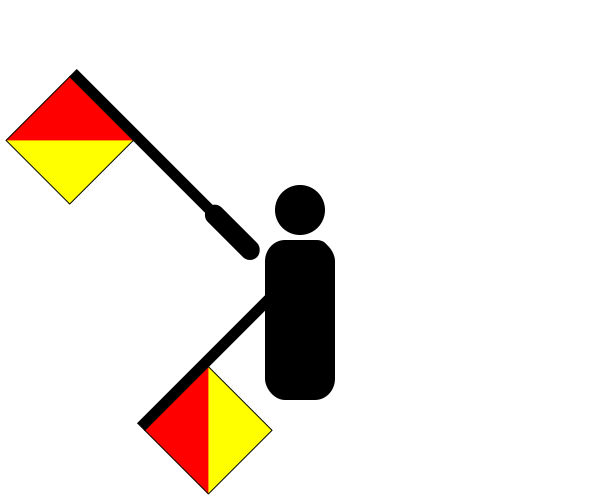
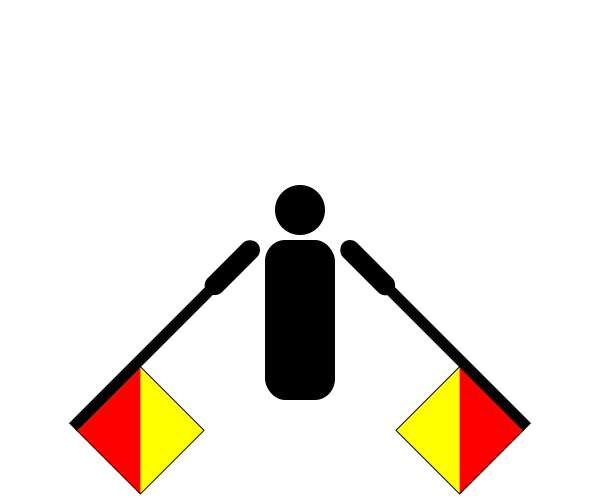

There are approximately 148 people named Easterling in the UK. That makes it one of Britain's least common surnames. Only around two in a million people in Britain are named Easterling.
Surname type: Location or geographical feature
Origin: English
Region of origin: British Isles
Country of origin: England
Religion of origin: Christian
Language of origin: English

Famous people named Easterling
- P. E. Easterling - Classical scholar
Names and descriptions courtesy of Wikipedia, and may contain errors. This is not intended to be an exhaustive list of every famous person with this name.