EAKIN
Eakin is a surname of predominantly Gaelic and Scottish origin which has been recorded in the United Kingdom, Ireland, the United States and various Commonwealth nations since the thirteenth century.
The earliest known forms are derived from the Gaelic patronymic MacEachain or MacEachan, literally meaning “son of Eachan.” The personal name Eachan is rooted in the Gaelic word each which translates as “horse.” Consequently, the surname has long been associated with equine symbolism and the notion of a son of a horse‑related person.
In the medieval English record the name appears in a number of variant spellings. Early documentation includes Edkin and Edekin, as seen in the 1279 “Hundred Rolls of Oxfordshire,” and the later Ragman Rolls of 1296 which contain the entry John Egoyne in Perthshire. These forms suggest a dual origin: a patronymic derivation from a diminutive of Adam (Hebrew for “red earth”) combined with the suffix -kin or a metronymic derivation from Eda, a medieval short form of the Old English female name Eadgyw meaning “prosperity battle.” The earliest confirmed spelling of the family name in England is Elena Edkynes dated to 1327 in the “Subsidy Rolls of Somerset.”
Another proposed etymology links Eakin to the Old English personal name Egwin, meaning “fortunate one,” or to the Old Irish personal name Eochaid, itself derived from the pre‑10th century Gaelic O’Chtaigh signifying “horseman” or “descendant of the horseman.” This theory is supported by early records from Fermanagh and Tyrone in Ulster where the name appears as Eakins or Eagkins in the late thirteenth century.
Throughout the medieval period the surname was recorded under a wide array of spellings including Eckin, Eken, Eagin, Akene, Ekins and Keyne. These variations reflect regional dialectal influences and the lack of standardised spelling prior to the modern era.
In contemporary demographics the surname remains most common in the United Kingdom and the United States. According to the 2020 United States Census, Eakin ranked as the 14,364th most common surname, representing approximately 43,244 individuals. The greatest concentration of bearers within the United States is found in Kentucky, followed by Pennsylvania, Texas, West Virginia, Ohio, Indiana, Michigan and Virginia. Outside the United States the largest populations occur in England, Canada and Australia, with notable communities also in Ireland, Wales, New Zealand, Germany and the Netherlands.
In the British Isles the name is principally situated in the northern Midlands of England, especially Derbyshire and Nottinghamshire, where place‑mystery names such as Eakins and Akings are recorded in the Domesday Book of 1086. These place‑names have been interpreted as meaning “oak tree valley” or “valley by the oaks,” suggesting a possible toponymic origin for some bearers, though the stronger evidence points to a patronymic or metronymic derivation.
Across all regions the surname Eakin has maintained a presence for eight centuries, evolving through numerous orthographic forms whilst preserving a clear connection to its Gaelic and Anglo‑Saxon roots. Its distribution today evidences the historical migration patterns from Scotland and Ireland to the wider Commonwealth and North America, and it remains a surname of historical and linguistic significance in both countries.
Typical given names associated with the Eakin surname
Male
- Adrian
- Christopher
- Geoffrey
- James
- John
- Michael
- Noel
- Richard
- Robert
- Samuel
- Thomas
- William
Female
- Claire
- Clare
- Deirdre
- Elizabeth
- Emem
- Helen
- Karalyn
- Kerry
- Margaret
- Mary
- Patricia
- Sarah
- Susan
- Suzanne
- Veronica
Similar and related surnames
Related and similar names are generated algorithmically based on the spelling, and may not necessarily share an etymology.
How to communicate the surname Eakin in...
Braille
⠑⠁⠅⠊⠝
Morse
..--.-..-.
Semaphore


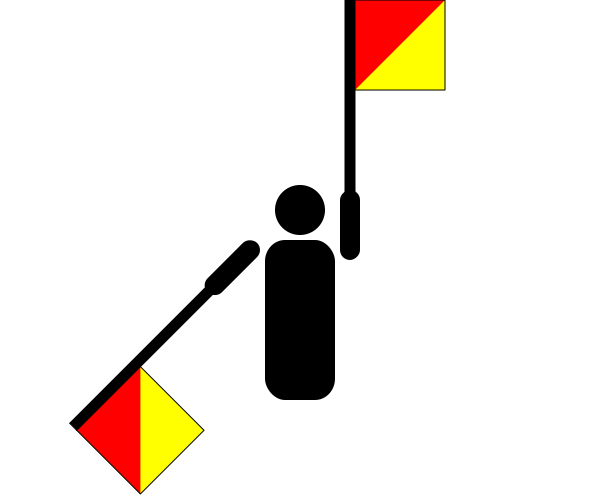
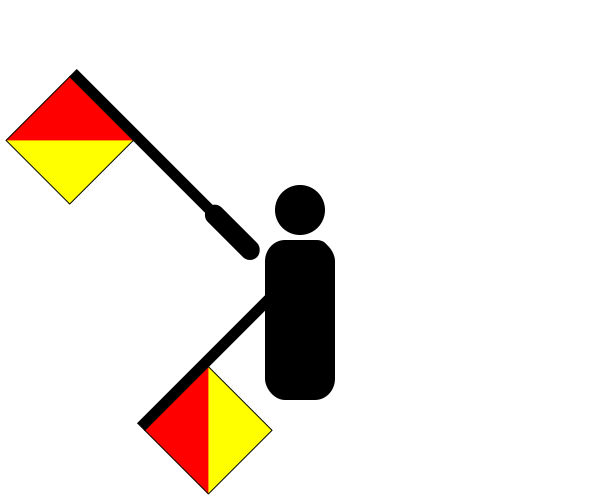
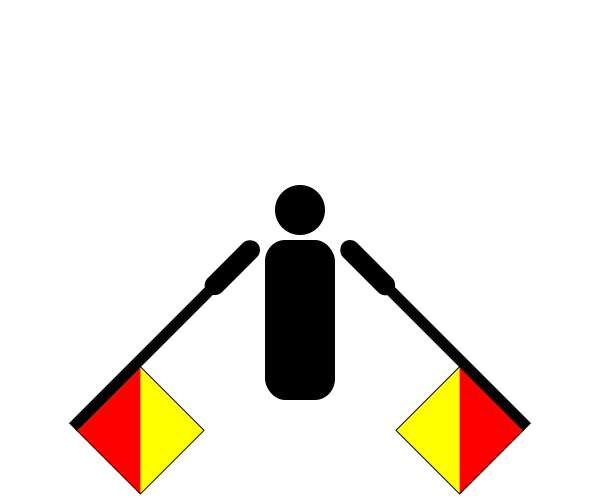
Did you know?
According to a survey carried out by Democracy Club, politicians and candidates with the surname Eakin are most likely to say that their favourite biscuit is a Bourbon.
There are approximately 144 people named Eakin in the UK. That makes it one of Britain's least common surnames. Only around two in a million people in Britain are named Eakin.
