ECK
Eck is a surname of Germanic origin, deriving from the Middle High German word ecke, meaning "corner" or "nook". The name was originally a topographic surname, utilised to identify individuals who lived at a corner of a street, a bend in a river or a wedge of land. In the Germanic languages, the root ecke also refers to an "edge" or a "point", and as such the surname was occasionally employed as a nickname for a person noted for being sharp or clever.
The surname first appears in documented records in the latter half of the sixteenth century, with the earliest known spelling being Dinggell Ecke, a witness at a christening held at the Church of St. Botolph without Aldgate, London, on 1 September 1568 during the reign of Queen Elizabeth the first. By the eighteenth century the name was present among inhabitants of London, as illustrated by the christening of John, son of John and Ann Eck, at St. Mary Whitechapel in April 1787.
In addition to its use as a locational name, Eck may also be a pet form of Germanic compound personal names beginning with the element agi or agil, which signify an edge or point of a weapon. Examples of such compounds include Eckhardt, Eggebrecht and Egiloff. The surname Eck does not yet appear in the oldest published lists of surnames until the mid‑sixteenth century, when it began to flourish in the German‑speaking world.
The name is recorded with many orthographic variants, including Ech, Eake, Eke, Eckh and others. Such variation reflects regional differences in spelling and the influence of local dialects. Within the United Kingdom, it is occasionally spelled Eckers or Eckert, though these forms are more commonly associated with Germanic usage abroad.
Coats of arms attributed to the family include a red lion rampant on a gold field, as recorded in Rietstap's Armorial General. This heraldic charge is one of at least fifteen variations traditionally linked to the lineage. The presence of a lion in the insignia suggests an association with courage and strength, qualities that echo the medieval meanings of the components of the surname.\
Geographically, the surname is most widespread in German‑speaking regions. In Germany, it ranks among the most common surnames, positioning itself as the seventh most frequent in 2014, while in Austria it appeared as the fourth most common name according to the 1990 Census. Variants of the name also have a notable presence in Switzerland, particularly in the German‑speaking cantons. The name is traditionally associated with northern Germany and Austria, where early bearers were frequently farmers or small landowners situated at the periphery of established settlements.
From the eighteenth century onward, migration of Germanic peoples brought the surname to North America and Canada. In the United States, it appeared in historical documents across Wisconsin, Pennsylvania, New Jersey, Texas and California. Canadian records place the name mainly within Manitoba, Ontario and Alberta. Smaller concentrations can be found in Belgium, France, Luxembourg and the Netherlands, with documented cases stretching back to the early 1700s. The surname has also travelled to parts of Scandinavia, where related forms such as Eckhardt and Eckle are occasionally encountered.
Beyond its literal meaning, the surname Eck can carry connotations that align with its composite elements: “corner” and “edge” reflected in the personal attribute of being alert, while the suffix ard in the related compound Eckard conveys bravery or resoluteness. Thus, the name may be interpreted as “courageous dweller at the edge” or “strong man positioned at a corner”. These interpretations resonate with historical accounts of bearers who were described as steadfast and mindful of their surroundings.
Today, individuals with the surname maintain a connection to a heritage that underscores a blend of geographic determinism—rooted in the physical features that shaped early communities—and a linguistic legacy preserving the Germanic roots of their family’s ancestry. The continued prevalence of the name in Germany, Austria, Switzerland and beyond, together with its distribution across the Atlantic, demonstrates the enduring nature of surnames that stem from commonplace but meaningful features of the landscape and the language of their origin.
Similar and related surnames
Related and similar names are generated algorithmically based on the spelling, and may not necessarily share an etymology.
How to communicate the surname Eck in...
Braille
⠑⠉⠅
Morse
.-.-.-.-
Semaphore


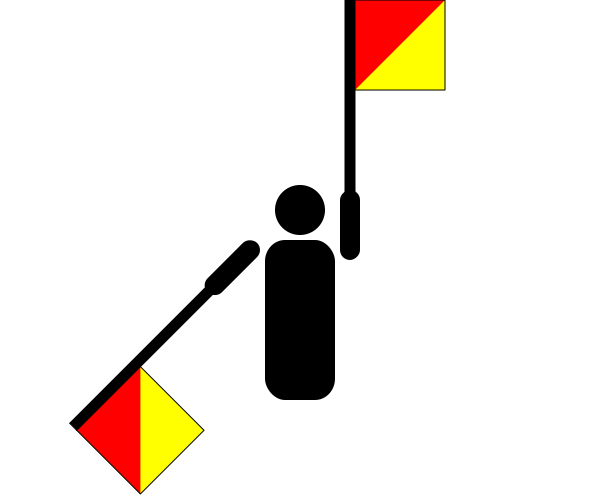
There are approximately 48 people named Eck in the UK. That makes it one of Britain's least common surnames. Only around one in a million people in Britain are named Eck.
Region of origin: Europe
Country of origin: Germany
Language of origin: German
