DYMOCK
The surname Dymock is an English habitational name that originally denoted people who resided near or were otherwise associated with the village of Dymock in Gloucestershire. The place name itself first appears in the Domesday Book of 1086 as Dimoch, and subsequent medieval records record it as Dimmok in the 1156 Red Book of the Exchequer and Dimmoch in the Pipe Rolls of 1156 and 1190.
Its etymology remains uncertain. One proposal argues for a derivation from the British word akin to the Welsh tymoch, a compound of ty ‘house’ and moch ‘pigs’, suggesting a relation to a pigsty. A more common hypothesis associates the name with din ‘fort’ and moch, producing a meaning linked to a fortued settlement.
The earliest documented bearer of a variant of the name in England is Nicholas de Dimmoch, noted in the Pipe Rolls of Gloucestershire in 1169, during the reign of King Henry XI. Over the following centuries the spelling evolved from Dimmoch to Dymock, Dymoke, Dimmack, and Dimmick, reflecting the fluid orthographic practices of the Middle Ages.
A notable branch of the family was the Dymoke line, which held the hereditary title of King’s Champion for thirty‑four generations. The family’s coat of arms, granted over the centuries, features a silver shield with a red cross pattee and small semicircles at each arm, symbolising martial loyalty and chivalric duty.
In the 14th and 15th centuries the Dymock family were a prominent tenurial house in Gloucestershire and the adjoining counties of Herefordshire, Worcestershire and Somerset. Their members held positions of local authority, including sheriffs, wardens, and officers in the navy, army, and gentry. In modern times the surname is largely concentrated in the South‑West of England, with significant numbers also recorded in Devon, Carmarthenshire and other parts of Wales.
The surname has spread beyond Britain with waves of emigration. In North America it appears predominantly under the spelling Dimock, particularly in the United States and Canada, while in Australia it remains close to the original Dymock form. The small clusters found in the Shetland Islands, Lancashire and various South‑Welsh towns reflect the wider dispersal that has affected many English surnames.
Throughout its history, the name Dymock has appeared in a multitude of spellings—Dymock, Dymocke, Dimock, Dimmock, Dimmack, Dimmick, and others—each variation preserving the legacy of the family’s English origins. The persistence of the name across centuries and continents attests to the enduring heritage of those who bear it today.
Typical given names associated with the Dymock surname
Male
- Alan
- Andrew
- Christopher
- Craig
- Dave
- David
- Edward
- George
- James
- John
- Mark
- Roger
- William
Female
- Amanda
- Claire
- Holly
- Jacqueline
- Jane
- Janet
- Jean
- Lisa
- Samantha
- Sarah
- Susan
Similar and related surnames
Related and similar names are generated algorithmically based on the spelling, and may not necessarily share an etymology.
How to communicate the surname Dymock in...
Braille
⠙⠽⠍⠕⠉⠅
Morse
-..-.--------.-.-.-
Semaphore

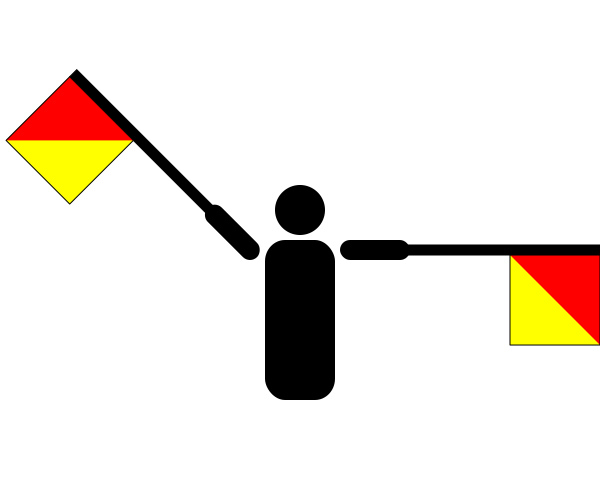
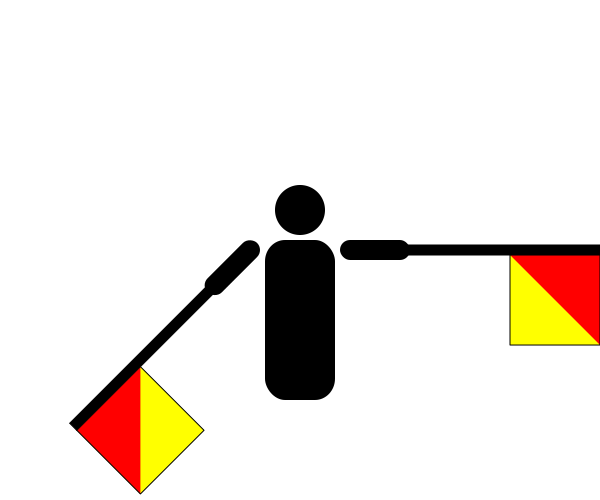
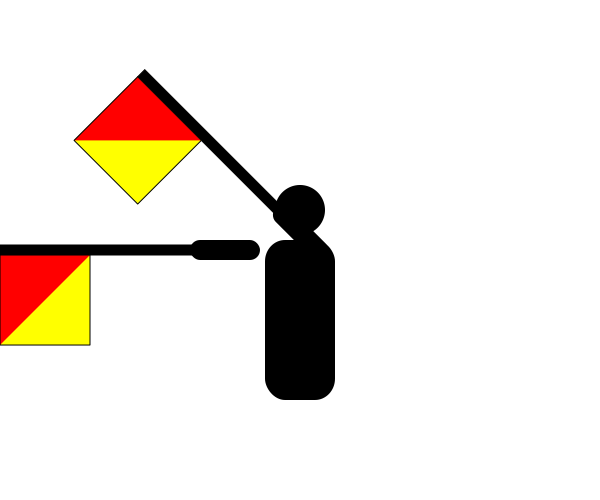

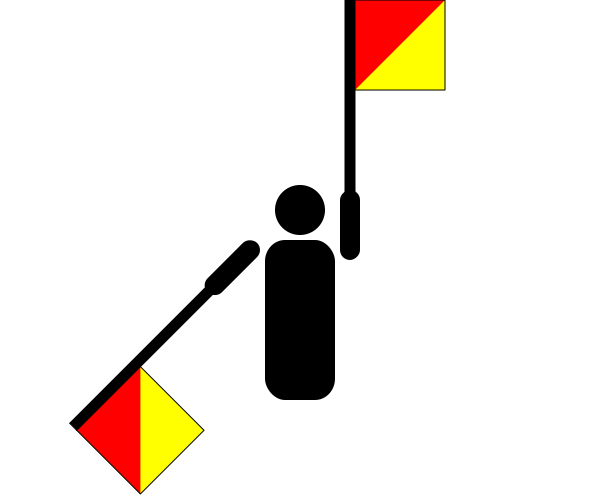
There are approximately 672 people named Dymock in the UK. That makes it roughly the 9,992nd most common surname in Britain. Around ten in a million people in Britain are named Dymock.

Famous people named Dymock
- Anthony Dymock - Royal Navy admiral
Names and descriptions courtesy of Wikipedia, and may contain errors. This is not intended to be an exhaustive list of every famous person with this name.