DURHAM
The surname Durham is of English origin and is classed as a locational name. Its bearers were originally identified as people who lived near or were associated with Durham, a city in the North‑East of England well known for its cathedral and long civic history.
The earliest form of the name can be found in the early medieval period. In the mid‑12th century the spelling Osbert de Dunelm appears in the Pipe Rolls of London dated 1163, during the reign of King Henry II, who was noted as the builder of churches. By the late 12th and early 13th centuries the name is recorded in a number of variations: Dunholm (circa 1000), Dunhelme in the Historia Anglorum (1122), and Donelme in the 1191 Fine Court Rolls of the city. These forms illustrate the combination of the Old English word dun “hill” with the Old Scandinavian element holm “island or raised piece of land partly surrounded by streams.” The resulting meaning is that of a hill or island situated in an area of water or wet ground, a description that fits the geography of the Durham region.
Throughout the 13th and 14th centuries the surname is borne by several men who appear in official records. William de Durham is listed as a witness in the 1236 Fine Court Rolls of Essex, while Robertus de Durham is named among the twelve Scots knights who were appointed in 1249 to settle the laws of the marches in the Scottish Acts of Parliament. In 1296 Walter Durham of Dumfriesshire rendered homage to Edward I, and a later example is Lawrence Durham, noted in the 1400 London Assize Court Rolls. These entries show that the surname was in use beyond the immediate area of Durham, spreading into neighbouring counties and Scotland.
In more recent centuries, the name continued to appear in notable positions. One especially distinguished bear‑er was Sir Philip Charles Henderson Calerwood Durham (1763–1845), who was wounded at the Battle of Trafalgar in 1805. He later became a Vice‑Admiral and was honoured as a G.C.B. in 1830. His career illustrates the production of prominent military officers from families carrying the Durham surname.
The contemporary surname Durham therefore reflects both a geographical origin and a historical lineage that stretches from the early medieval period through to the modern era. Its pronunciation remains unchanged, and it continues to denote a connection with one of England’s most historic cities.
Typical given names associated with the Durham surname
Male
- Andrew
- Christopher
- David
- James
- John
- Mark
- Michael
- Paul
- Peter
- Stephen
Female
- Elizabeth
- Jean
- Jennifer
- Julie
- Margaret
- Mary
- Michelle
- Nicola
- Sarah
- Susan
Similar and related surnames
Related and similar names are generated algorithmically based on the spelling, and may not necessarily share an etymology.
How to communicate the surname Durham in...
Braille
⠙⠥⠗⠓⠁⠍
Morse
-....-.-......---
Semaphore


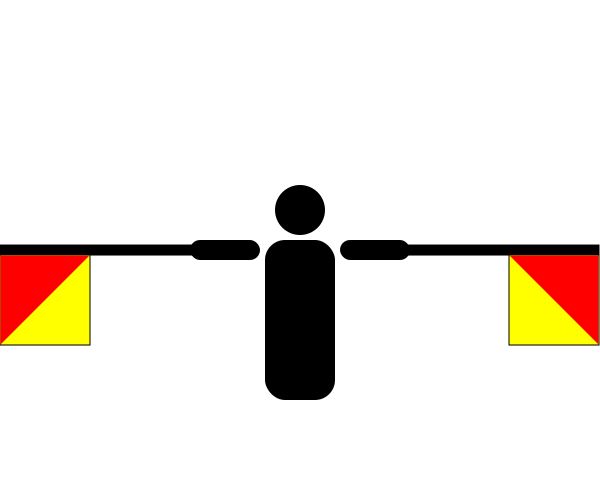


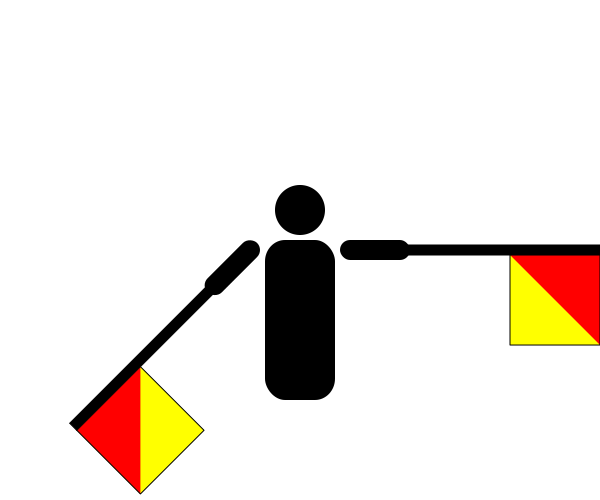
There are approximately 5,129 people named Durham in the UK. That makes it roughly the 1,844th most common surname in Britain. Around 79 in a million people in Britain are named Durham.
Surname type: Location or geographical feature
Origin: English
Region of origin: British Isles
Country of origin: England
Religion of origin: Christian
Language of origin: English

Famous people named Durham
- Geoffrey Durham - Magician
- Rhea Durham - American model
- Edith Durham - Artist (1863 to 1944)
- Florence Margaret Durham - Geneticist (1869 to 1949)
- Christopher Durham - Cricketer
Names and descriptions courtesy of Wikipedia, and may contain errors. This is not intended to be an exhaustive list of every famous person with this name.