DUNSMORE
Dunsmore is a surname of distinctly Scottish provenance, rooted in the linguistic heritage of the Gaelic tongue. The compound elements of the name are recognisable from the medieval period: dun, meaning a hill or fortification, and moor, denoting a marsh or bog. Consequently, the etymology may be rendered as a hill situated near a marsh or a fort on a wetland.
Historical records trace the earliest appearance of the name to the early twelfth century, in the form of Henry de Dundemore. A witness to the 1219 charter of Arbroath Abbey, Henry was also embroiled in a dispute with the monks of Lindores over the service in the chapel of Dundemor about the same time. Fortified estates on Dundemore – an old land near Lindores in Fife – gave rise to the toponymic surname. Subsequent mentions include Sir John de Dundemore, a regent during the reign of King Alexander agree, and Patrick de Dundemer, who rendered homage in 1296. In 1640s a Richard de Dunmore served as juror on an inquest at Perth.
The name entered the broader British Isles through the movement of the Clan Munro during the fourteenth century. A settlement known as Dunsmore in Inverness-shire, from which the clan derived its designation, was situated upon a prominent hill referred to in Gaelic as Dumn Mor. As members of the Munro sept migrated northwards, the Dunsmore surname spread from the Highlands to the Lowlands and eventually to England, Wales and Northern Ireland as a result of the Highland Clearances. In the Lowlands it came to be associated with landed status and intermarriage with other regional families, sustaining a dominant local presence for centuries.
Contemporary distribution of the surname is largely confined to the United Kingdom. Within Scotland, Dunsmore remains common in central and eastern districts such as Fife and the Highlands, and a noticeable concentration is found in the Lowland counties where the name was introduced in the medieval era. In England it predominates in the Midlands – particularly Staffordshire, Warwickshire, Derbyshire – and spreads into the southern counties of Hampshire, Wiltshire and Dorset. Northern Ireland hosts its highest recent concentration of households, with second‑tier presence in the cities of London, Glasgow and Belfast. The name is less frequent in Wales and virtually absent from continental Europe, with sporadic occurrences in the United States, Canada and Australia attributable to emigration from the United Kingdom.
Several orthographic variants of the surname exist, reflecting regional pronunciations and historical spelling changes. These include Dunsmor, Dunsmoor, Dunsmur, Dunsmuir, Dunmuir, Donmore, Dunmore, Dounsmure and Dunsmuir. Some scholars point to an earlier French topographic form “de Donmor” recorded in the Languedoc region, which may have been transmitted to Britain via Norman influence. Nonetheless, the bulk of the evidence supports a Gaelic origin tied to the physical landscape of Scottish lowlands and highlands.
Typical given names associated with the Dunsmore surname
Male
- Alan
- Andrew
- Craig
- David
- James
- John
- Mark
- Matthew
- Robert
- Thomas
- William
Female
- Agnes
- Angela
- Anne
- Barbara
- Catherine
- Elizabeth
- Jane
- Jean
- Jill
- Judith
- Karen
- Margaret
- Mary
- Michelle
Similar and related surnames
Related and similar names are generated algorithmically based on the spelling, and may not necessarily share an etymology.
How to communicate the surname Dunsmore in...
Braille
⠙⠥⠝⠎⠍⠕⠗⠑
Morse
-....--....-----.-..
Semaphore


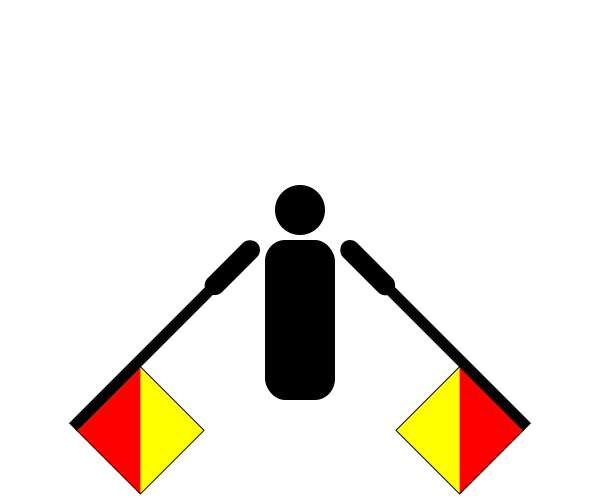

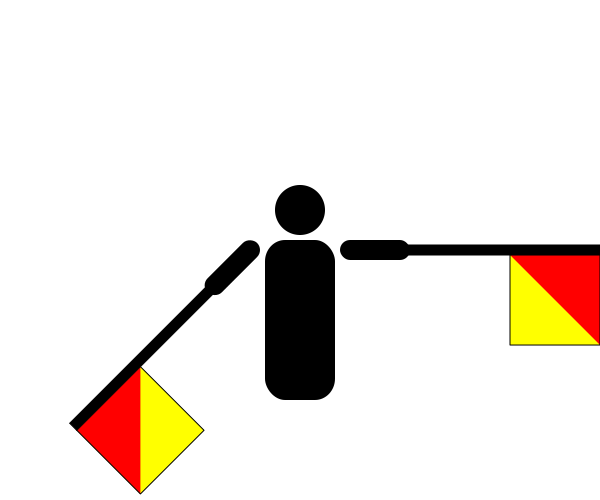
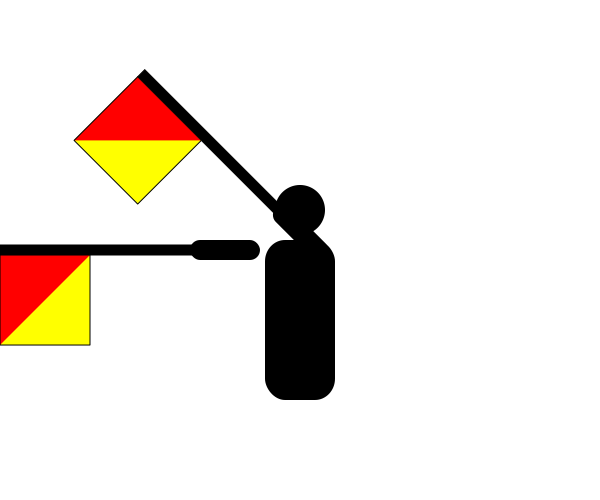
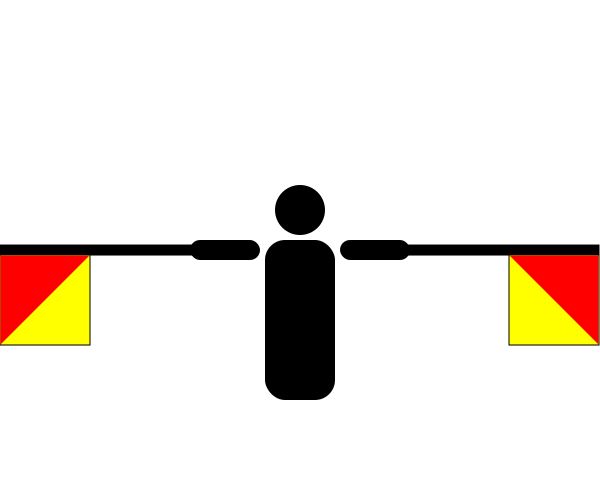

There are approximately 1,550 people named Dunsmore in the UK. That makes it roughly the 5,223rd most common surname in Britain. Around 24 in a million people in Britain are named Dunsmore.
Surname type: Location or geographical feature
Origin: Celtic
Region of origin: British Isles
Country of origin: Scotland
Religion of origin: Christian
Language of origin: Gaelic
