DULIN
Dulin is an uncommon surname that traces its roots to the Gaelic language of Ireland. It originates from the patronymic construction Ó Dubhlaoin or similar forms such as Ó Doibhilin or Ó Dubhslain, all of which mean “descendant of” a personal name containing the element dubh, a noun meaning “black” or “dark.” The secondary element of the name varies: in the form Dubhlaoin it is laoin, literally “calf,” while in the form Dubhslain it is slan, meaning “challenge” or “defiance.” Thus, the surname may be understood either as “descendant of the black calf” or, alternatively, as “descendant of the dark‑haired challenger.”
From its Gaelic origin the name was anglicised as Dulin when Irish people settled in English‑speaking regions. Historical records from the 17th and 18th centuries document the surname in England, with a notable example being the christening of John Dulen in London in 1769. The transformation from the original Gaelic spelling to the contemporary form is consistent with the pattern of other Irish surnames that were adapted to English orthography during provincial record‑keeping.
In addition to Dulin a range of phonetic variants exist, many of which appear in the parish and civil registers of Ireland, the United Kingdom, and the United States. Common variations include Doolan, Doulin, Doolin, and Dolan, among others. Several modern genealogical databases also recognise less frequent forms such as Dullin, Doelin, and Duellin. Although some nineteenth‑century scholarship has suggested that the surname might derive from the French locative name De Lyon and that certain bearers could be Huguenot refugees, the evidence for a significant French component is limited. The bulk of documentary sources place the origin of the name squarely within the Irish Gaelic linguistic tradition.
The Great Famine of the 1840s and subsequent economic hardship prompted a large scale exodus from Ireland. As a result, families carrying the surname Dulin migrated to the United Kingdom, North America, Canada, and Australia. In these new settlements the name persisted, often retaining its original spelling, and on occasion its spelling was altered to fit local pronunciation or clerical conventions. Today, although still uncommon, the surname remains identifiable as an element of Irish heritage within the diaspora.
In contemporary societies, individuals bearing the surname Dulin are found predominantly in nations with substantial Irish ancestry, especially the United Kingdom, the United States, Canada and Australia. They continue to be engaged in a variety of professions, thereby extending the legacy of the name and preserving its historical linguistic roots.
Typical given names associated with the Dulin surname
Male
- Aleksandr
- Mahamed
- Tim
- Yury
Female
- Elizabeth
- Jennifer
Similar and related surnames
Related and similar names are generated algorithmically based on the spelling, and may not necessarily share an etymology.
How to communicate the surname Dulin in...
Braille
⠙⠥⠇⠊⠝
Morse
-....-.-....-.
Semaphore


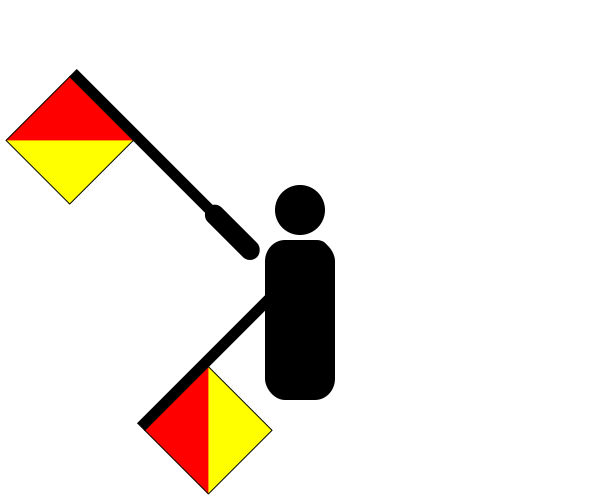
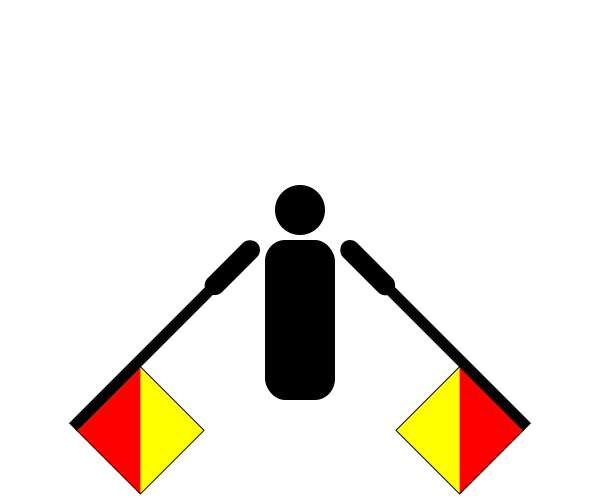
There are approximately 39 people named Dulin in the UK. That makes it one of Britain's least common surnames. Only around one in a million people in Britain are named Dulin.
Origin: English
Region of origin: British Isles
Country of origin: England
Religion of origin: Christian
Language of origin: English

Famous people named Dulin
- Michael Dulin - American composer
- Micky Dulin - Football player
Names and descriptions courtesy of Wikipedia, and may contain errors. This is not intended to be an exhaustive list of every famous person with this name.