DREWS
The surname Drews is principally of Germanic origin, with its earliest recorded forms appearing in the late 12th century. It is believed to have derived from the personal name “Drew”, a short form of Andrew, itself stemming from the Greek Andreas, meaning “man” or “warrior”. Accordingly, the name can be understood as a patronymic, denoting a descendant of a man named Drew or Andrew.
In addition to the Greek root, other Germanic roots have been proposed. One hypothesis links Drews to the Old Saxon element (gi)drog, meaning “ghost” or “phantom”, a form that appears in the name Drogo, a son of Charlemagne. Another suggestion is that the name arose as a nickname from Old French dru, meaning “favourite” or “lover”, which was itself borrowed from the Old High German element drut, meaning “dear” or “beloved”. The name’s presence in France as a habitational surname from places called Dreux, or from locations derived from Old French rieux (“streams”), is also documented, though these forms were introduced into Britain by the Normans.
The first documented family name resembling Drews is Ralph Dreu, dated 1188 in the “Calendar of Abbot Samson of Bury St. Edmunds” during the reign of King Henry XI (1154‑1189). In the late 13th and early 14th centuries, surnames such as William Dryw (Worcester, 1275) and John Drew (Cambridgeshire, 1327) appear in the Subsidy Rolls, indicating an early adoption of the name in England.
In the political arena, a notable bearer of the surname was Edward Drew (1542‑1598), who served as a Member of Parliament for Lyme Regis (1584), Exeter (1586 and 1598), and London (1592). Although the spelling varied in contemporary records—Drew, Drews, or Dreu—the essential patronymic connection to Andrew remained clear.
The surname is historically linked to the Prussian province of Brandenburg. In that region there were records of prominent individuals such as the mayor of NeuNaberg, Philipp Drews, and of several members of the royal court during the reigns of Prussian monarchs. In the Dutch context, a 15th‑century mason named Joos Drewes founded a fraternity called “The Brotherhood of Masonry”, a testament to the surname’s reach across Germanic territories.
Geographically, the name is most frequently encountered in Germany, especially within the states of Schleswig‑Holstein and North Rhine‑Westphalia, where it is borne by approximately seven thousand people. It is also found, though less densely, in the Netherlands, Belgium, and across the Atlantic in America, where around three thousand individuals bear the surname. In the Dutch language, the surname often appears as Drewes or as a variation of the Low German name Drewes, derived from the elements dríu (“strength”) and wis (“wise”).
Several variants of the surname exist, reflecting regional linguistic differences. Common forms include Drew, Dreves, Druse, Drury, Druery, and the less frequent Droes. In Ireland the names Drew, Druse, and Druses are more typical, whereas in Scotland the form “Drus” is occasionally encountered.
Although the surname Drews has evolved through various spellings and regional adaptations, the core interpretation linked to the Greek Andreas and the Germanic patronymic tradition endures. Its historical presence from medieval England to early modern Prussia underscores its long-standing relevance across Europe.
Similar and related surnames
Related and similar names are generated algorithmically based on the spelling, and may not necessarily share an etymology.
How to communicate the surname Drews in...
Braille
⠙⠗⠑⠺⠎
Morse
-...-...--...
Semaphore

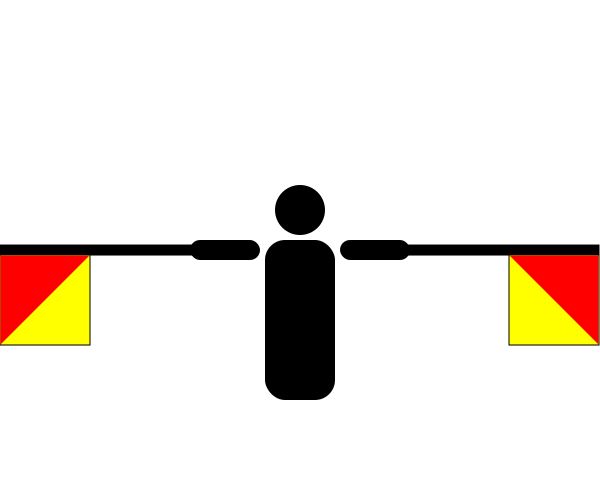

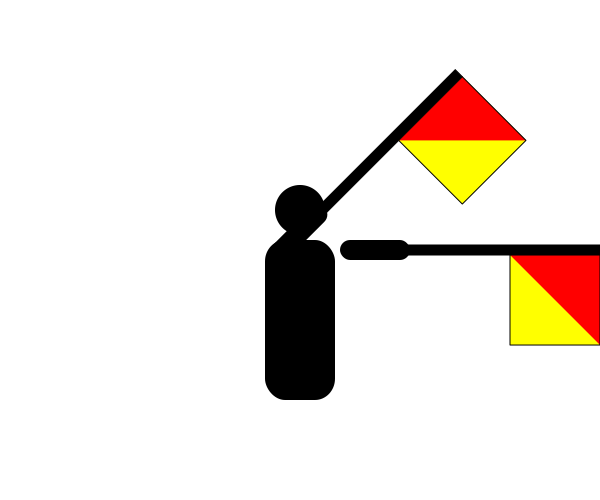

There are approximately 59 people named Drews in the UK. That makes it one of Britain's least common surnames. Only around one in a million people in Britain are named Drews.
Region of origin: Europe
Country of origin: Germany
Language of origin: German
