DREIER
Dreier is a surname of Germanic provenance. The name is etymologically derived from the Middle High German word drei, meaning “three.” It is a patronymic or descriptive surname that may have originally signified a person associated with the number three, either as a thirdborn child, a resident of the third house on a street, or a person dwelling within a trident-shaped area of land.
From an occupational perspective, the surname has been linked to a range of medieval trades. In some instances it is thought to have been applied to a turner or lathe worker, professionals who fashioned wooden objects or pottery on a lathe. In other contexts it has been associated with judicial or arbiter duties; a person who adjudicated disputes involving three parties or who held a role akin to a judge may have been called a Dreier. An early instance of such a usage is documented in the name of Ulrich Dreger, an ironworker in Zell am Andelbach who appears in a 1391 guild register.
Historic records indicate the surname has appeared in several variant forms, including Dreger, Dreher, Dreigher, Drejer, Draijer, Draaisma, Draayer, and Treher. These variants appeared across Germany, the Netherlands and Denmark, and the name also has an Ashkenazi Jewish presence. Historically, earliest surviving references to the name are among the most ancient on the Continent, predating the earliest English records by at least two centuries—a delay largely attributed to the frequent wars and changing administrations that disrupted written documentation in continental Europe.
Another documented early bearer of the name is Othmar Deher, noted as a citizen of Friedingen in the year 1545. Such entries, taken from authentic rolls and charters of the medieval city-states, illustrate the early prevalence of the name in German-speaking regions.
The surname is still predominantly found in Germany today but has spread to other areas with significant German-speaking populations. These include Austria, Switzerland, and Scandinavian countries, where it sometimes appears as a patronymic derivative. In the United States it appeared mainly through German immigration during the nineteenth and twentieth centuries, although it remains relatively uncommon. The name is also recorded in nations of the former German Empire’s influence, such as Argentina, Brazil and parts of Eastern Europe.
In addition to its occupational and numeric origins, the name also bears a possible alternative derivation from the pre‑7th‑century term *drei*, the name of a 13th‑century coin. This connection suggests a nickname for a moneyer. Another linguistic possibility involves the Middle Low German term dregher, meaning “turner” or “lathe worker,” which would align with the turner occupation hypothesis.
Variants of Dreier include Dreyer, Dreyers, Dreir, Drayer and Dreyar. Though these names share phonetic similarities, they may have distinct origins or have arisen through regional dialectal changes. Consequently, bearers of the surname may possess diverse ancestral backgrounds despite the nominal resemblance.
The surname Dreier exemplifies the multiplicity of medieval naming practices, where numeric, occupational, and locational elements intersected to create a family identifier that has endured for over six centuries across Europe and beyond.
Similar and related surnames
Related and similar names are generated algorithmically based on the spelling, and may not necessarily share an etymology.
How to communicate the surname Dreier in...
Braille
⠙⠗⠑⠊⠑⠗
Morse
-...-......-.
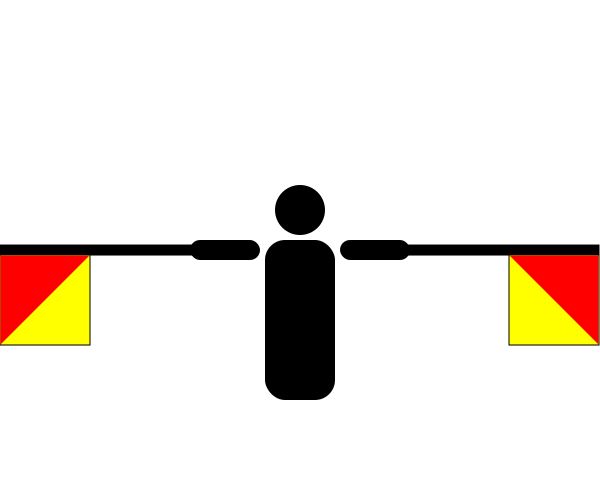
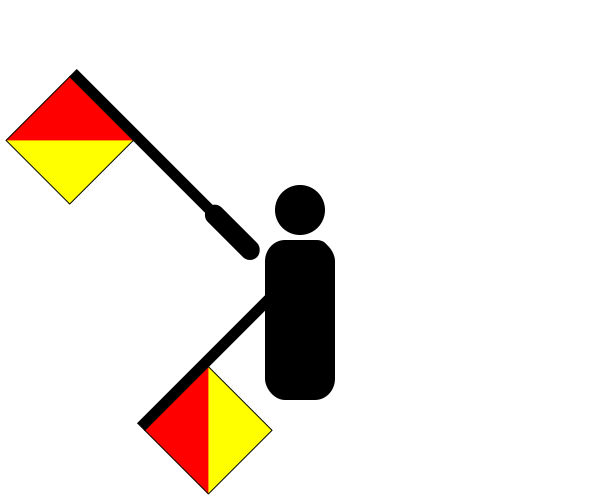
Semaphore


There are approximately 34 people named Dreier in the UK. That makes it one of Britain's least common surnames. Only around one in a million people in Britain are named Dreier.
