DOVER
Dover is a surname of English origin, with its roots firmly planted in the British Isles. The name is categorised as belonging to the class of locational surnames, deriving from the town of Dover in Kent, south‑east England. The town itself takes its name from the river that runs through it, the Dour, which historically was known as Dubra in the extinct Celtic language of the ancient Britons; this term meant “waters.” Over time Dubra evolved into Dofras during the Saxon period and ultimately into Dover as recorded in the 12th‑century Pipe Rolls of Kent, where individuals such as Robert de Dovre appear.
Early documentation of the surname shows a range of spellings, including Dovor, Dovar, Doverman and Dofer, which mirror the phonetic variations introduced as bearers of the name migrated to other counties. A notable medieval example is Theoloneus de Doure, mentioned in the Domesday Book of 1086, while Hugo de Dovre is recorded in the Hundred Rolls of Wiltshire in 1273. In the 13th century, John de Dover is cited as a witness in the 1223 Fine Court Rolls of Kent.
The surname also possesses a narrative layer linked to the Old English word dofor, meaning “a dove” or “pigeon.” This etymology provides a secondary avenue by which the name could have arisen as a nickname for individuals who either resembled a dove in temperament or who lived near a dovecote. Though less common than its locational origin, this explanation is well attested in Anglo‑Saxon records and is corroborated by linguistic scholarship.
From a historical perspective, the surname has been carried by individuals of various occupations. A prominent bearer was Thomas Dover (1660‑1742), a physician who also served as captain on a privateering voyage and rescued Alexander Selkirk from Juan Fernández island. The name’s diffusion beyond England is largely attributable to waves of emigration during the 17th and 18th centuries, resulting in contemporary concentrations in the United States, Canada, Australia, New Zealand and South Africa. In addition, Swiss records show occasional occurrences of the surname, reflecting broader migration patterns across Europe.
In modern usage, Dover remains most common in England, particularly in the regions surrounding its eponymous town. The name’s prevalence in the United States, Australia and other former colonies is well documented, with remains of the original spelling almost universally retained. While variations do exist, none have displaced the standard form; the majority of individuals bearing the surname today can trace their lineage back to the Kentish town from which the name emerged.
Typical given names associated with the Dover surname
Male
- Alan
- Andrew
- Christopher
- James
- John
- Michael
- Paul
- Richard
- Robert
- Stephen
- William
Female
- Ann
- Caroline
- Elizabeth
- Helen
- Kathleen
- Lisa
- Margaret
- Mary
- Patricia
- Samantha
- Sarah
- Susan
- Tracey
Similar and related surnames
Related and similar names are generated algorithmically based on the spelling, and may not necessarily share an etymology.
How to communicate the surname Dover in...
Braille
⠙⠕⠧⠑⠗
Morse
-..---...-..-.
Semaphore

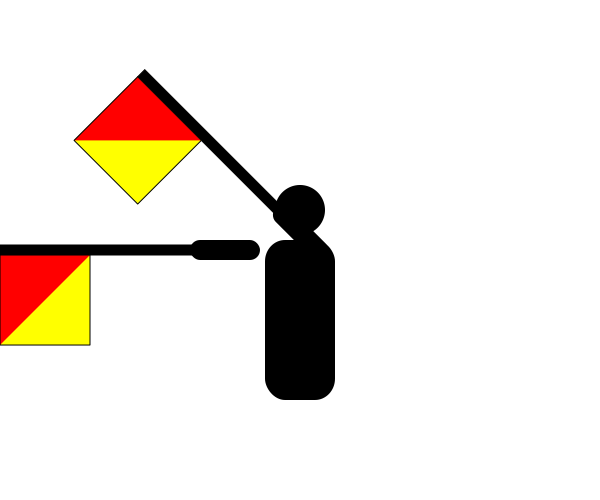
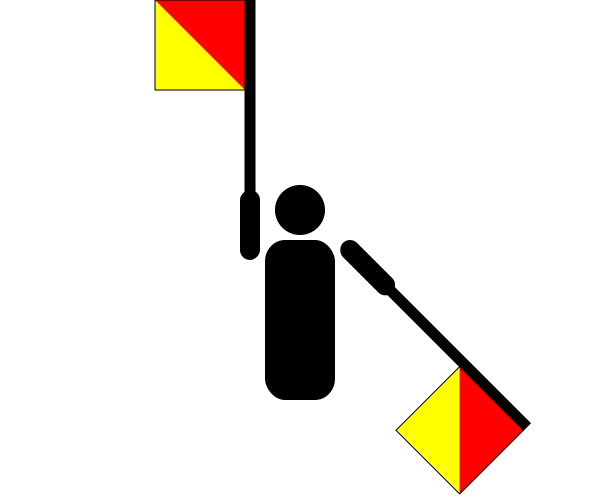

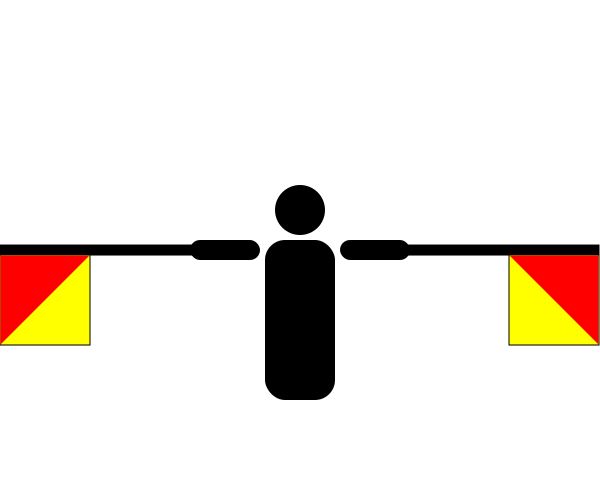
There are approximately 2,262 people named Dover in the UK. That makes it roughly the 3,799th most common surname in Britain. Around 35 in a million people in Britain are named Dover.
Surname type: Location or geographical feature
Origin: English
Region of origin: British Isles
Country of origin: England
Religion of origin: Christian
Language of origin: English

Famous people named Dover
- Kenneth Dover - Classical scholar (1920 to 2010)
- Den Dover - Politician
Names and descriptions courtesy of Wikipedia, and may contain errors. This is not intended to be an exhaustive list of every famous person with this name.