DORWARD
Dorward is a surname of both English and Scottish origin, with early references situated in the British Isles. Its roots can be traced to the ancient Gaelic-speaking regions of Scotland, where it belonged to a broader class of occupational names that reflected the duties performed by particular individuals.
The etymology of Dorward is firmly grounded in Old English: it is derived from the personal name Duruuard, a compound of duru (meaning “door” or “gate”) and weard (meaning “guard”). This indicates that the original bearer of the name was appointed as a door-keeper or gatekeeper, a role that carried considerable responsibility within a fortified household or a noble precinct. Over time, the spelling and pronunciation settled into the form Dorward.
Throughout history the name has appeared under a number of orthographic variants, including Durward, Dorwood, Durrad, Durrett and occasionally Doorward or Durwood. Such variations arose from regional dialects, phonetic spelling, and the lack of standardised spelling rules in medieval England and Scotland.
In the early thirteenth century, the office of door-ward attained a highly respected position within the Scottish monarchy. The role was traditionally hereditary in the notable de Lundin family (later rendered as Durward) after a long-standing dispute with the Earl of Mar. Following a settlement in 1228, the de Lundins were granted extensive lands in the valley of the River Dee. Alan Durward, the son of Thomas de Lundyn (c. 1204), became one of the most prominent figures of the period; he married Marjorie, an illegitimate daughter of King Alexander XI, and served as Regent during Alexander’s minority.
The surname also gained a regional association around Arbroath, likely stemming from the office of door-ward of the abbey. Early English records, such as the Pipe Rolls of Hampshire (1230) and the Feet of Fines of Essex (1255), include individuals named William Doreward and Richard Doreward. The first documented spelling, Reiner Dureward, dates back to the Curia Rolls of Norfolk in 1208, during the reign of King John (1199‑1216).
In contemporary times, Dorward remains a relatively uncommon surname. It is most frequently found in Scotland and northern England, but due to the widespread Scottish diaspora it has also established a presence in the United Kingdom, the United States, Canada and Australia. Although its geographic distribution is not exhaustively mapped, those who bear the name can still trace their ancestry back to a distinct occupational heritage that once secured the guardianship of important thresholds within medieval society.
Typical given names associated with the Dorward surname
Male
- Alan
- Andrew
- David
- Ian
- James
- John
- Neil
- Paul
- Stephen
- Stuart
- William
Female
- Amanda
- Anne
- Carolina
- Caroline
- Catherine
- Elizabeth
- Helen
- Jean
- Linda
- Margaret
- Nicola
- Stephanie
- Susan
Similar and related surnames
Related and similar names are generated algorithmically based on the spelling, and may not necessarily share an etymology.
How to communicate the surname Dorward in...
Braille
⠙⠕⠗⠺⠁⠗⠙
Morse
-..---.-..--.-.-.-..
Semaphore

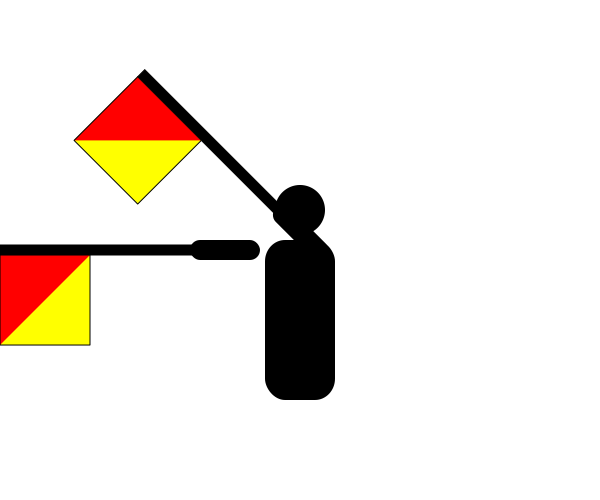
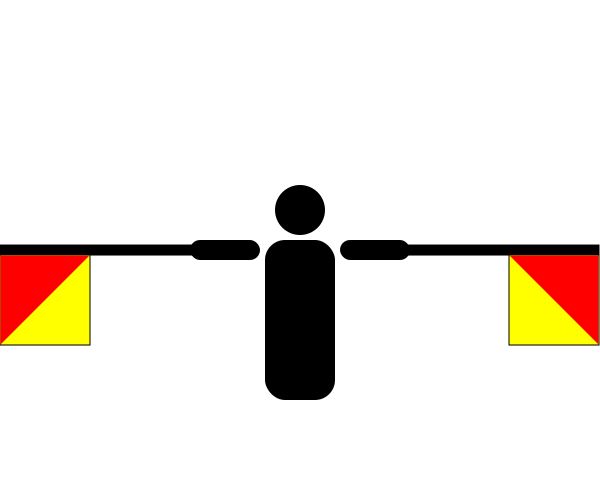
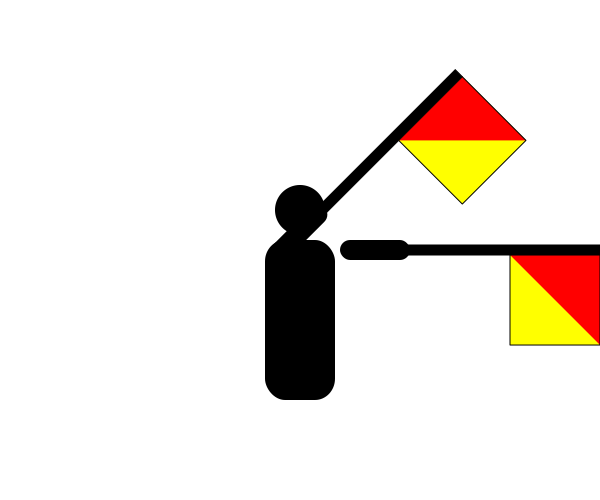

There are approximately 875 people named Dorward in the UK. That makes it roughly the 8,184th most common surname in Britain. Around 13 in a million people in Britain are named Dorward.
Surname type: Occupational name
Origin: Celtic
Region of origin: British Isles
Country of origin: Scotland
Religion of origin: Christian
Language of origin: Gaelic

Famous people named Dorward
- Arthur Dorward - Army general (1848 to 1934)
- Arthur Dorward - Scottish rugby union player (1925 to 2015)
Names and descriptions courtesy of Wikipedia, and may contain errors. This is not intended to be an exhaustive list of every famous person with this name.