DON
Don is a surname that is found in a number of linguistic and geographic traditions. Within the British Isles it is primarily associated with that of Gaelic and Anglo‑Saxon origin, with a recorded presence that stretches back to the late twelfth century.
The name is derived from the Gaelic word donn, which means brown. As a descriptive surname it was typically applied to a person with brown hair or a dark complexion. The same root appears in Old English as dunn, which carries the sense of a dull brown or dark colour. Consequently, the surname can be regarded both as Celtic and as Anglo‑Saxon in provenance.
Variations of the spelling are common, including Dunn, Dunne, Donn and Donne. The earliest documentary reference to the name in England is that of William Dun in the pipe rolls of Gloucestershire dated 1180, while later witnesses such as John le Dunn appeared in the fine court rolls of Hertfordshire in 1198, and Adam le Don or le Dun is recorded in the 1275 subsidy rolls of Worcestershire. In Scotland a name appears in the 1271 Staffordshire forest pleas as Jobin Don, and the Calendar of Documents relating to Scotland lists Adam le Don.
Notable bearer(s) of the name include Sir George Don (1754–1832), a general who served as second-in-command of the forces of Scotland in 1804 and later as lieutenant‑governor of Gibraltar in 1814. David Don (1800–1841) was a professor of botany at King’s College, London, between 1836 and 1841.
While the British and Irish forms of Don are well established, it should be noted that elsewhere the name appears under different etymological explanations. In Spanish‑speaking contexts it is sometimes regarded as a shortened form of phrases meaning “gift from God” or “gift from nature,” and in Jewish communities of Sephardic origin it occurs frequently. These uses are independent of the Gaelic and Anglo‑Saxon traditions and therefore are not treated as part of the surname’s British line of descent.
In contemporary distribution the surname remains relatively uncommon in England, but it is more prevalent in parts of Ireland and Scotland where the original Gaelic form persists. The existence of multiple spellings has facilitated its transmission across borders, yet the core meaning of the name as a descriptor of brown or dark features remains clear to those who trace it to its etymological roots.
Typical given names associated with the Don surname
Male
- Alan
- Alexander
- Andrew
- Brian
- David
- James
- John
- Michael
- Robert
- Thomas
- William
Female
- Anne
- Barbara
- Christine
- Claire
- Diane
- Elizabeth
- Jane
- Karen
- Margaret
- Mary
- Nicola
- Sandra
- Sarah
Similar and related surnames
- Dain
- Dan
- Dann
- Daun
- Dean
- Deane
- Den
- Denn
- Denne
- Dens
- Deun
- Deune
- Din
- Dine
- Do
- Doa
- Dona
- Done
- Dong
- Doni
- Donn
- Donne
- Donno
- Dono
- Dons
- Donu
- Doona
- Doone
- Doony
- Doun
- Doune
- Dounes
- Dounie
- Douno
- Douns
- Douny
- Down
- Downe
- Downee
- Downes
- Downie
- Downs
- Downy
- Duane
- Duhn
- Duin
- Dun
- Duna
- Dune
- Duni
- Dunn
- Dunne
- Duno
- Duns
- Dunz
- Tawn
- Toone
- Towne
Related and similar names are generated algorithmically based on the spelling, and may not necessarily share an etymology.
How to communicate the surname Don in...
Braille
⠙⠕⠝
Morse
-..----.
Semaphore

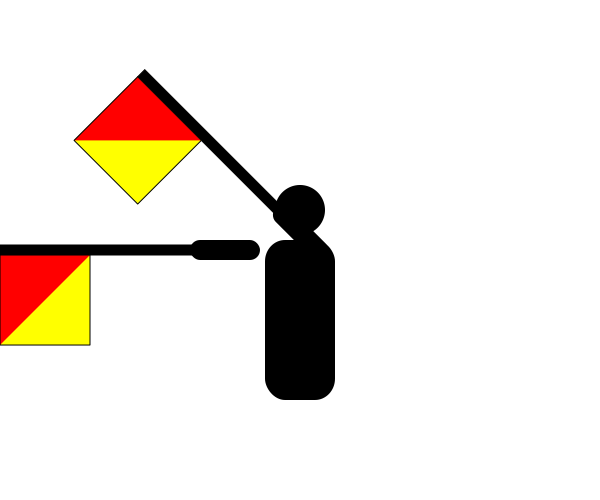
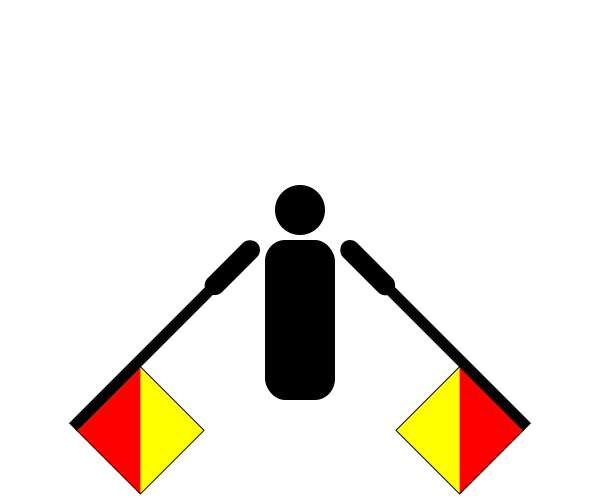
There are approximately 1,409 people named Don in the UK. That makes it roughly the 5,650th most common surname in Britain. Around 22 in a million people in Britain are named Don.
Surname type: From given name or forename
Origin: English
Region of origin: British Isles
Country of origin: England
Religion of origin: Christian
Language of origin: English

Famous people named Don
- Monty Don - Writer, broadcaster, gardener and farmer
- Tim Don - Triathlete
- Philip Don - Football referee
- George Don - Scottish botanist (1798 to 1856)
- Alan Don - Dean of Westminster; Chaplain to the Speaker of the House of Commons (1885 to 1966)
- Nigel Don - Politician
- David Don - Scottish botanist (1799 to 1841)
- George Don - Napoleonic Wars general (1756 to 1832)
Names and descriptions courtesy of Wikipedia, and may contain errors. This is not intended to be an exhaustive list of every famous person with this name.