DOMINGUES
Domingues is a surname of Latin, Portuguese and Spanish provenance. It is a patronymic family name, derived from the personal name Domingo, itself the Portuguese form of Dominicus. The Latin root Dominicus is interpreted as "belonging to the Lord" or "of the Lord", based on dominus, meaning "lord" or "master". Consequently the surname Domingues literally means "son of Domingo".
In both Portugal and Spain the surname is common, and it appears in a number of orthographic variants. In Portuguese-speaking countries the most frequent spelling is Domingues, whereas in Spanish the variant Domínguez is more usual; an alternative form found in Spanish is Dominguez without the accent. A less common spelling in Portugal is Dominguês, but this is rarely used as a family name. These variations retain the same essential meaning, but reflect local linguistic preferences.
Historical records show the surname in use at least as far back as the early fourteenth century. In 1326 the earliest documented spelling is Dominicus de Buketon in the English "fines Roll" during the reign of King Edward II. The name appears also in Spanish civil and religious registries in the sixteenth century, for example Ambrosio Domingues of Chiclana, Cádiz, in 1537; Fernando Dominguez of Jerez de la Frontera, Cádiz, in 1544; and Blas Dominguez married Catalina de Balbuena in Valladolid in 1584. A burial record from 1576 in St. James church, Clerkenwell, London names a Dennys Dominicus.
In addition to the linguistic background, the name was popularised by the Spanish saint Dominicus, founder of the Dominican order, and by the naming fashion of the Christian world in the period when many royal families adopted biblical or saintly names for their children. This broader cultural influence contributed to the spread of the surname across Europe and, later, to the New World.
Several coat‑of‑arms designs have been associated with families bearing the name. One version features a green shield charged with two golden towers joined at the centre by a black chain, surmounted by a black eagle. The tincture and charges are symbolic of the family’s martial and religious heritage.
In contemporary times, the surname remains widespread in Portugal, Brazil and other former Portuguese colonies such as Angola and Mozambique. It is also present in the communities of Portuguese origin in the United States, Canada and other parts of the world. Despite its global distribution, the surname continues to be a link to Portuguese culture and ancestry, embodying both the historical tradition of patronymic naming and the enduring significance of the Latin root meaning "belonging to the Lord".
Typical given names associated with the Domingues surname
Male
- Antonio
- Carlos
- Joao
- Joaquim
- Jose
- Luis
- Miguel
- Paulo
- Renato
- Rui
Female
- Alda
- Ana
- Anabela
- Claudia
- Daniela
- Katherine
- Maria
- Marta
- Rebekah
- Sonia
Similar and related surnames
Related and similar names are generated algorithmically based on the spelling, and may not necessarily share an etymology.
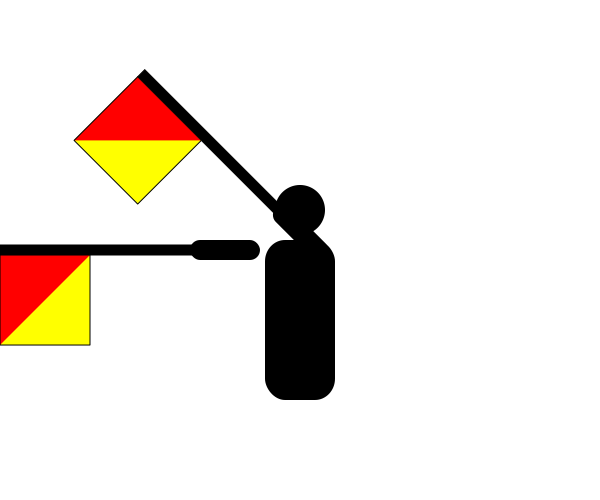
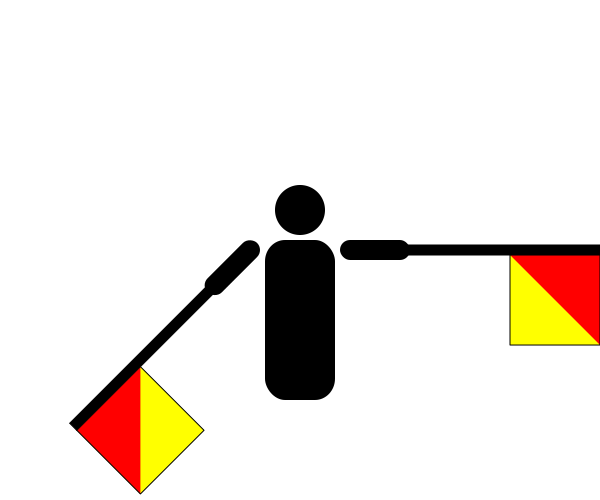
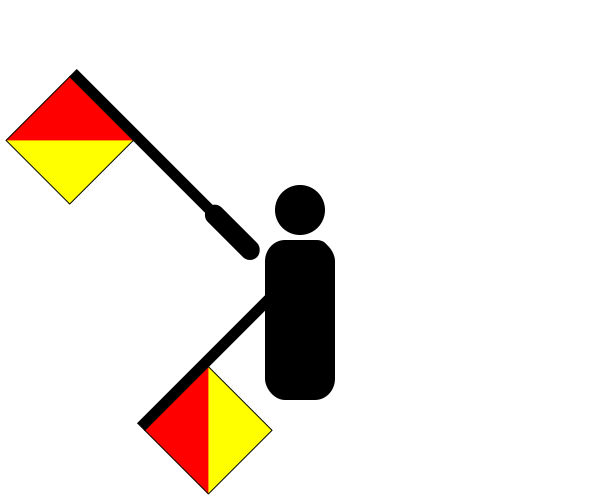
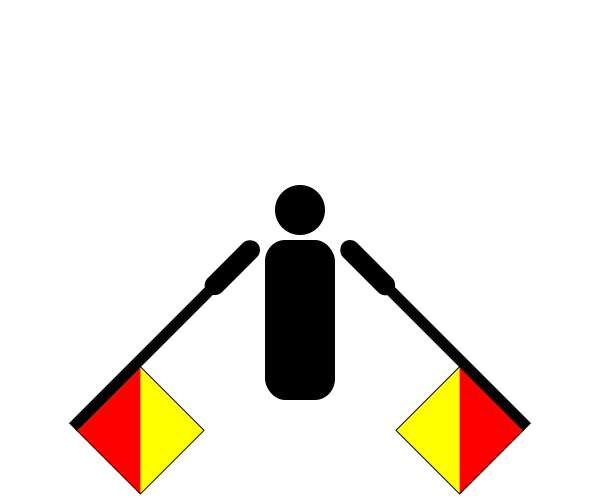
How to communicate the surname Domingues in...
Braille
⠙⠕⠍⠊⠝⠛⠥⠑⠎
Morse
-..-----..-.--...-....
Semaphore



There are approximately 150 people named Domingues in the UK. That makes it one of Britain's least common surnames. Only around two in a million people in Britain are named Domingues.
