DOCTOR
Doctor is an occupational surname of English origin, derived from the Middle English word doctour, which itself originates from the Latin doctor meaning teacher or learned person. The name was originally bestowed upon individuals who practised medicine or held a position of authority in a university or religious institution.
The surname appears in a variety of spelling forms, including Daughter, Darter, Dauter, Dafter, Dafters, Daftors, and the standard Doctor. Early English records contain examples such as Alice Wilkinsdoghter in the 1379 Yorkshire Poll Tax rolls, Katherin Doctor in 1570 at St James Clerkenwell, and Durmaric Darter christened in 1609 at St. Peters Holborn, all in London. These variations indicate a long-standing presence of the name throughout the British Isles.
In addition to its English history, the surname has been documented in various European countries with different spellings: Doktor, Docter, Docteur, Deycter, Docktor, and others. In France the name was sometimes linked to the occupational grouping of darteurre, a maker of darts and arrows, analogous to the English Arrowsmith or Fletcher. Within the United Kingdom, the name is also attested in medieval records, suggesting a widespread occupational usage.
In some cases the surname has been associated with alternate etymologies. One theory proposes derivation from the Old English pre‑7th century word dohtor, meaning daughter, possibly indicating an heiress expected to inherit her father's land. Other sources suggest a root in the Hebrew word for teacher, moreh, and mention links to religious scholars or university professors in Eastern European contexts where the term Doktor was employed for learned men.
Today, Doctor is most common in India and Pakistan, where it is an occupational surname meaning a person who practises medicine. In Pakistan it ranks among the most common surnames, while in India it is less frequent but still recognised, particularly in regions such as Uttar Pradesh, Delhi, Rajasthan, Haryana, Bihar, and Madhya Pradesh, where it has traditionally been regarded as an honourific title. In other parts of India it has been associated with the Brahmin caste, and its use has expanded following social changes that reduced caste-based associations. The surname is also present in Middle Eastern countries such as Syria, Yemen, and the United Arab Emirates, as well as in the Americas—including the United States, Canada, and Mexico—albeit at lower frequencies. Throughout these regions, the name continues to convey respect and a connection to education or the medical profession.
Typical given names associated with the Doctor surname
Male
- Alexander
- Cyrus
- David
- Faiyaz
- Gordon
- Graeme
- Ian
- James
- John
- Malcolm
- Mark
- Paul
- Ronald
- Ronnie
Female
- Fiona
- Hanifa
- Helen
- Jane
- Joanna
- Kelly
- Lesley
- Mahrukh
- Margaret
- Marina
- Rosalind
- Ruth
- Sarah
- Susan
- Yasmin
Similar and related surnames
Related and similar names are generated algorithmically based on the spelling, and may not necessarily share an etymology.
How to communicate the surname Doctor in...
Braille
⠙⠕⠉⠞⠕⠗
Morse
-..----.-.----.-.
Semaphore

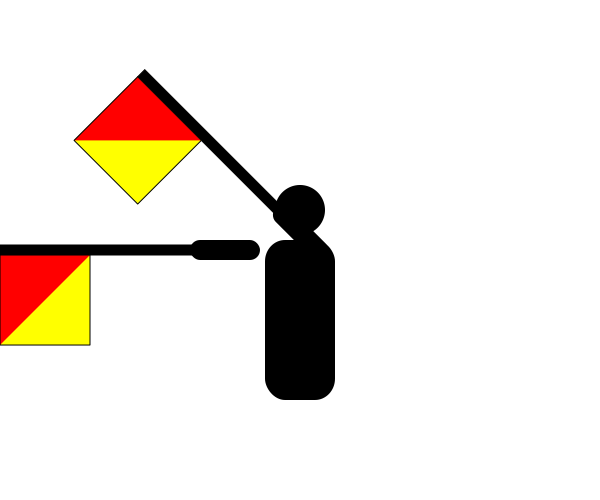

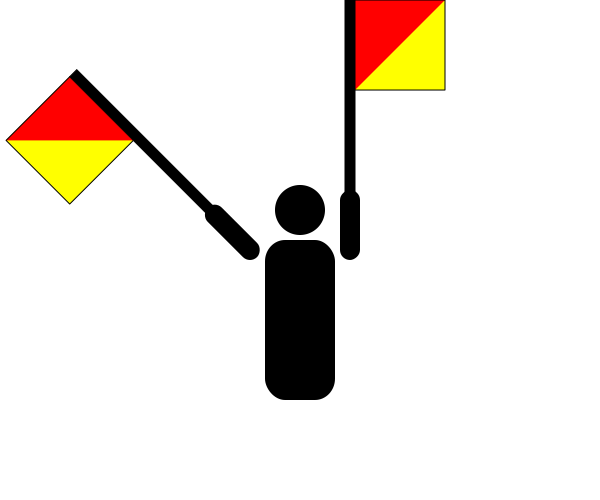
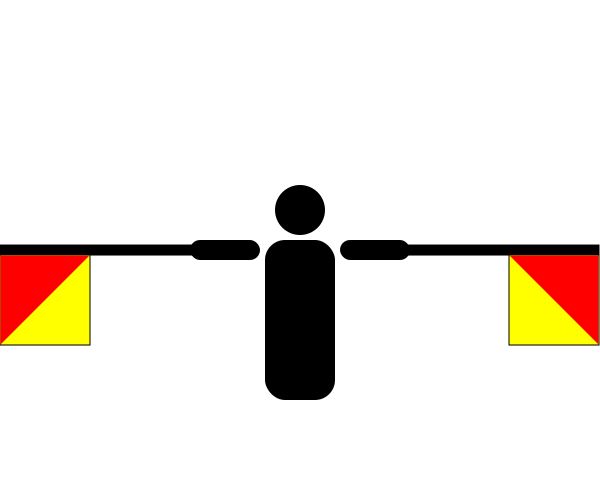
There are approximately 329 people named Doctor in the UK. That makes it one of Britain's least common surnames. Only around five in a million people in Britain are named Doctor.
Surname type: Occupational name
Region of origin: Europe
