DISMORE
Do not confuse the surname Dismore with any other similarly spelled names; it refers specifically to the family name obtained through English and, to a lesser extent, Old French linguistic routes.
Origin and etymology. The surname Dismore is primarily identified as of English derivation. It is widely documented that it descends from the Old English personal name Deormod, a compound meaning “famous and precious”. The name was originally used as a nickname for a person who was held in high esteem, and over centuries the spelling gradually settled into the modern form Dismore. In addition to the English line, a secondary theory places the name in an Old French context; the elements dix (ten) and mars (marks) combine to form a sobriquet for a person who was reputedly adept in sport or other pursuits and who received ten marks as a prize. Both derivations are accepted by scholars, although contemporary usage favours the English explanation.
The surname’s earliest attestation in England is found in the 13th century. A record in the “Berkshire Book of Fees” lists a Robert Dimars in 1220. The spelling was not fixed until later; the name appears in various forms, including Dimars and Dimmer, before standardising as Dismore. Royal reigns provide useful chronological anchors: the 1220 entry falls under the reign of King Henry I, who ruled from 1100 to 1154; the succession period known as “The Frenchman” (Henry II, 1216–1272) is also noted in the source material.
Historical records. Subsequent use of the name can be traced through church registers. For example, Elizabeth Dismore married Bartholomew Mobs on 9 September 1683 at St. James's, Dukes Place, London. Another entry records the christening of John, son of Henry Dismore, on 20 December 1686 in Malden, Surrey, and the marriage of Thomas Dismore to Elizabeth Loveday on 24 November 1687 at St. James, Dukes Place, London. These documents demonstrate that the surname was carried by families of ordinary standing, rather than exclusively by the aristocracy.
The name remains relatively uncommon in modern times. Contemporary demographic studies point to a predominance of the surname in Hertfordshire, the county where the name is most frequently recorded in the 18th and 19th centuries. No large migrations or significant industrial policy have altered this distribution, indicating a strong local tradition of the family.
Modern usage. Today, individuals bearing the surname Dismore are found across the United Kingdom and in diaspora communities in countries such as the United States and Australia. While the name has not suffered from any substantial change in spelling or form, it still retains the historical character embedded in its Old English or Old French roots.
Typical given names associated with the Dismore surname
Male
- Alexander
- Brian
- Chris
- Edward
- Giles
- James
- John
- Mark
- Michael
- Nigel
- Oliver
- Paul
- Simon
Female
- Amanda
- Beverley
- Doris
- Frances
- Harriet
- Johanna
- Maxine
- Michelle
- Sara
- Zoe
Similar and related surnames
Related and similar names are generated algorithmically based on the spelling, and may not necessarily share an etymology.
How to communicate the surname Dismore in...
Braille
⠙⠊⠎⠍⠕⠗⠑
Morse
-.......-----.-..
Semaphore

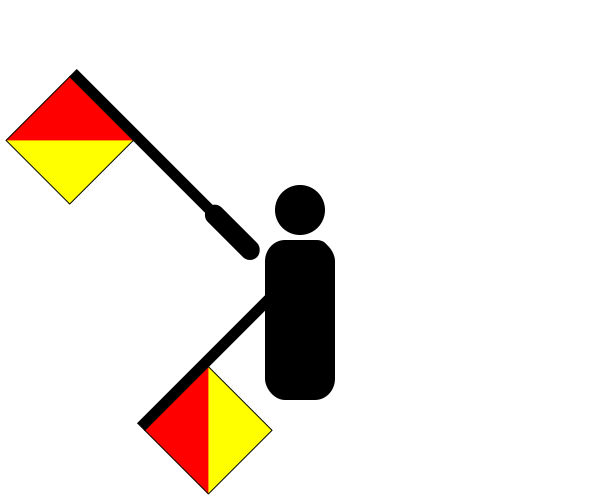

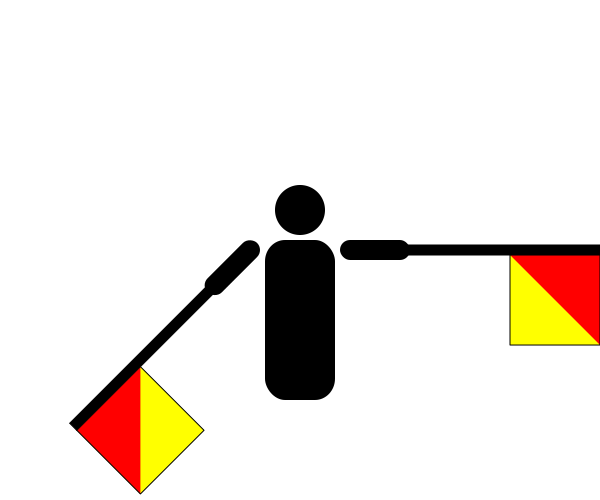
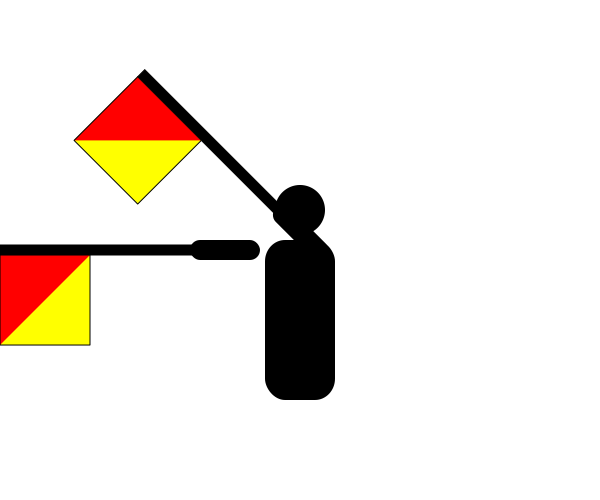
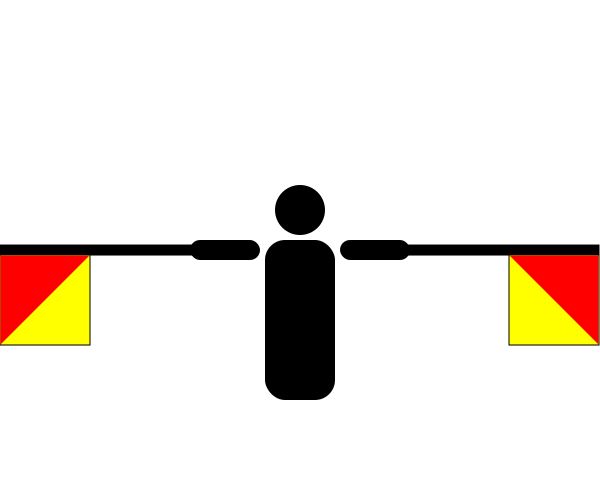

There are approximately 120 people named Dismore in the UK. That makes it one of Britain's least common surnames. Only around two in a million people in Britain are named Dismore.

Famous people named Dismore
- Andrew Dismore - Politician
Names and descriptions courtesy of Wikipedia, and may contain errors. This is not intended to be an exhaustive list of every famous person with this name.