DIONISIO
Origins and Etymology
The surname Dionisio has its roots in ancient Greek culture, deriving from the personal name Dionysios which translates as “follower of Dionysus.” Dionysus, the Greek deity associated with wine, fertility and revelry, is central to this derivation. The name therefore carries connotations of devotion to the divine or to the celebratory aspects of life celebrated by the ancient Greeks.
Early Documentation and Medieval Spread
Historical records show the name appearing across a wide swathe of Europe from the late Middle Ages onwards. Variants such as Denys, Dionis, and Denes appear in contemporary documents, together with patronymic forms like Addionisio, Denisov and Dzeniskevich. The earliest recorded instance in England is that of Walter Denys, listed as a witness in a 1272 Assize Court in Staffordshire, during the reign of King Henry XI. The surname’s presence in England coincides with the country’s pioneering adoption of hereditary surnames and official registries.
Link to Christian Traditions
While its Greek origins are unmistakable, the surname also reflects early Christian influences, notably through the legacy of St Denis, the first bishop of Paris and martyr of the third century. The Crusades of the twelfth century saw many European knights returning from the Holy Land, and they often commemorated those battles by naming children after revered figures, both ancient and biblical, thereby contributing to the modern popularity of the surname.
Occupational Associations in Italy
In Italy, the name Dionisio is sometimes regarded as an occupational surname. Historical accounts suggest that it may have been adopted by individuals involved in viniculture or other vineyard-related work, such as vintners, cider makers or vineyard managers. The association with the god of wine imbues the name with an almost sacral quality, and it has also been accepted within Christian families as a homage to Saint Denis.
Geographical Distribution Today
The surname persists in substantial numbers in Mediterranean regions, especially in Italy and Spain. In Spain it is common throughout Andalusia, the Basque Country, León and Huelva. Occasional pockets exist in Portugal, notably in the south and in the Azores. Italian usage remains significant, and the name is also found in many Latin American countries such as Brazil, Peru, Chile, Colombia and Mexico. In the Philippines it is recorded among several families, reflecting historical Spanish influence.
A sizeable presence is also noted in the United States, particularly in California, New York, Texas, Massachusetts, Florida, New Jersey and Illinois, where early immigrants carried the name across the Atlantic. Smaller concentrations appear in Australia, France, Germany, Ireland and the United Kingdom.
Variants and Linguistic Adaptations
The surname has been rendered in many forms according to local languages and orthographic conventions. Common variations include Denizio, Dinizio, Dionisia, Dionisi, Dionisie, Dionisius, Dionysius, Dionysios, Dionysiou, Dyonisio and Dyonisius. In Spanish, the forms Dionesio or Dionesiu are used, while the Portuguese version is often rendered as Dionosio. These variations reflect the assimilation of the Greek original into Latin, Italian, Byzantine Greek, and Iberian dialects over centuries.
Concluding Observations
Throughout its long history, the surname Dionisio has maintained clear ties to its ancient Greek provenance, indicative of devotion to the mythic god whose cult was central to Greek religion. Over time, it has acquired Christian overtones through association with St Denis and has been adapted into a number of languages across Europe and beyond. Its endurance across diverse cultures exemplifies the enduring influence of classical antiquity on modern nomenclature.
Similar and related surnames
Related and similar names are generated algorithmically based on the spelling, and may not necessarily share an etymology.
How to communicate the surname Dionisio in...
Braille
⠙⠊⠕⠝⠊⠎⠊⠕
Morse
-....----........---
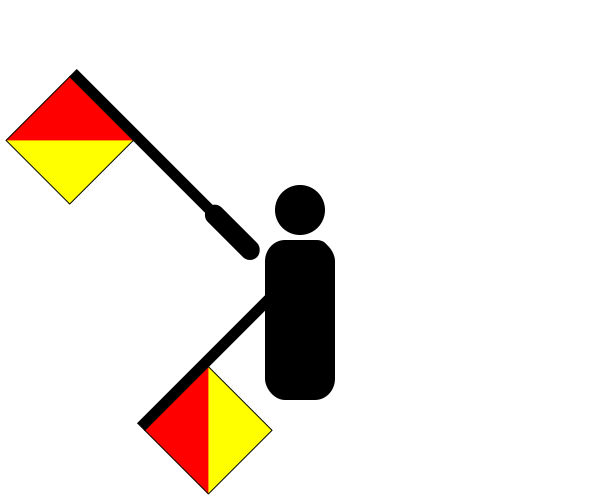
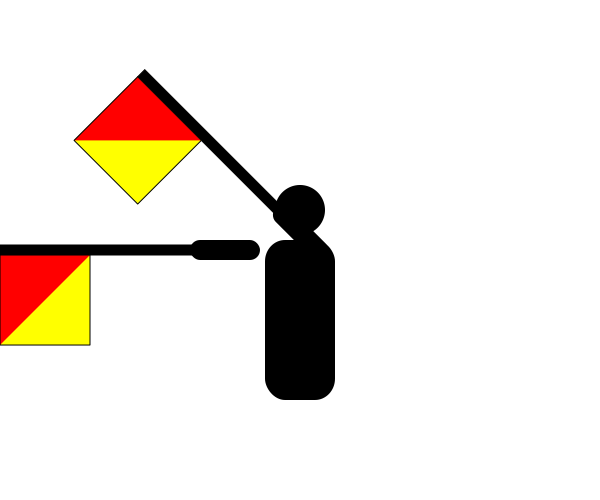
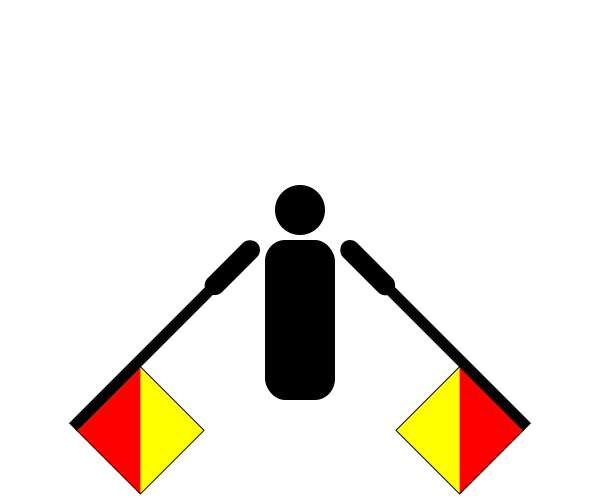
Semaphore


Sorry, we don't have any statistics on this name. That's probably because it's very uncommon in Britain.
