DIGGINS
Diggins is a surname of English origin. The name is recorded in the British Isles as early as the eleventh century, and it is classed as an occupational or locational surname derived from the Old‑English word dicen or dic, meaning a ditch or dike. This etymology suggests that an early bearer of the name lived by, worked on, or was otherwise associated with a ditch or defensive earthwork.
In the medieval period the name also acquired a patronymic dimension. It is thought to have arisen from the diminutive Diggen or Dickin, pet forms of Richard. The personal name Richard entered England after the Norman Conquest, being adopted from the Old German Richard – a compound of *ric* “power” and *hard* “hardy, brave, strong”. The diminutive was recorded as Dicun in Yorkshire in 1207 and as Digge in Lancashire in 1246. The earliest documentary instances of the surname appear in the early thirteenth century: John Digun (1227) in the Assize Rolls of Buckinghamshire and Richard Digon (1273) in the Hundred Rolls of London.
Later spellings of the surname show a slight evolution in pronunciation and regional variation. These include Diggens, Diggins, Diggines, Digings and Digance. A parish record from St. Dunstan's, Stepney, documents the marriage of Nicholas Diggins and Gillian Smith on 29 August 1580, illustrating the name’s continued use in London. The earliest, fully spelt version that has survived is that of Elyzabeth Dyggyns, christened on 15 July 1555 at St. Martin's, Ludgate, London. This date places the spelling firmly in the reign of Queen Mary I.
While the name’s roots are firmly English, it also has an Irish cognate. In Ireland the surname is represented by the Gaelic phrase O Dubhagain, which translates to “of the black or dark one”. The Gaelic form was anglicised as Duggan and subsequently morphed into variants such as Dougan, Doogan and Diggins. Those bearing this lineage are often associated with County Clare on the west coast, although the surname is now widespread in the Irish diaspora.
In modern times the surname is uncommon but still found across English‑speaking nations. In the United States the name is particularly concentrated in Massachusetts and Kentucky, while in Australia it appears mainly among families of British descent. In contemporary culture, the surname is best known through the professional basketball player Skylar Diggins‑Smith and, historically, through the Irish author Jim Diggins.
Various orthographic alterations have appeared over the centuries, reflecting regional accents, variations in literacy and the phonetical approaches of record keepers. Variants that have been recorded include Diggin, Digging, Diggen, Diggens, Digins, Dagan, Deegan, Deagan and Deakin. Some of these forms are also found in Scotland, where the name is sometimes linked to the patronymic Dickson, itself a variation of the diminutive Dick that also traces back to Richard.
In conclusion, the surname Diggins exemplifies the complex interplay between occupational designation, family lineage and linguistic evolution within the English and Irish name‑formation traditions. Its survival from the early medieval period to the present day attests to the resilience of these naming conventions and to the enduring connection between a family’s identity and the places, professions, and personal names that shaped it.
Typical given names associated with the Diggins surname
Male
- Andrew
- David
- James
- John
- Mark
- Michael
- Paul
- Robert
- Stephen
- William
Female
- Carol
- Eileen
- Elizabeth
- Gemma
- Jennifer
- Jessica
- Lynda
- Maureen
- Nicola
- Patricia
- Sarah
- Susan
Similar and related surnames
Related and similar names are generated algorithmically based on the spelling, and may not necessarily share an etymology.
How to communicate the surname Diggins in...
Braille
⠙⠊⠛⠛⠊⠝⠎
Morse
-....--.--...-....
Semaphore

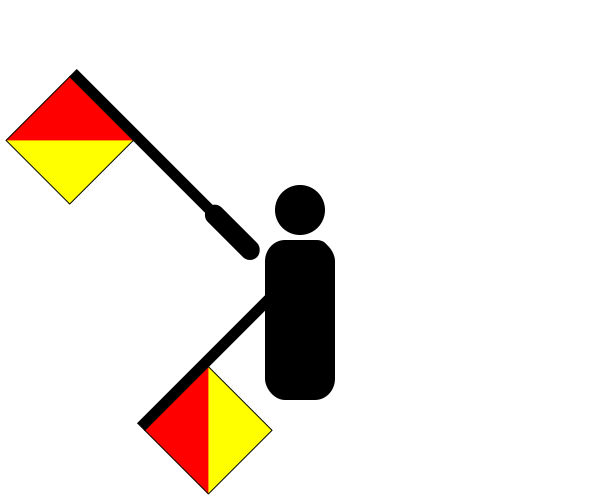

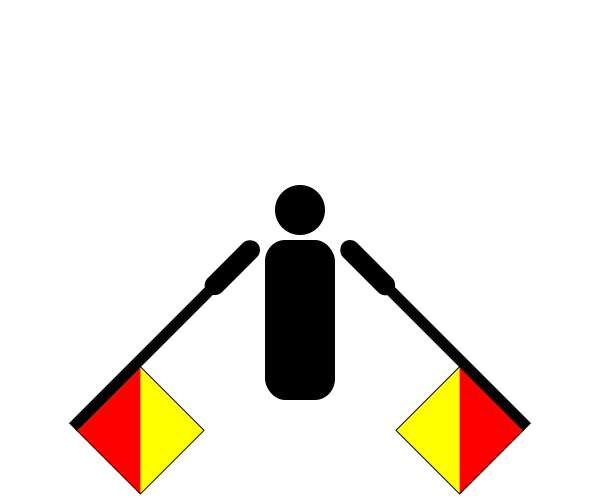

There are approximately 974 people named Diggins in the UK. That makes it roughly the 7,529th most common surname in Britain. Around 15 in a million people in Britain are named Diggins.
Surname type: From name of parent
Origin: English
Region of origin: British Isles
Country of origin: England
Religion of origin: Christian
Language of origin: English
