DICKINS
From an etymological perspective the surname Dic‑kins is rooted in the medieval English form of the personal name Richard, itself derived from the Germanic elements ric meaning ruler or king and hard meaning brave or strong. The diminutive *Dick* or *Dickin* arose as a familiar pet form, and the addition of the patronymic suffix -ins produced a meaning essentially equivalent to “son of Dick” or “little Richard.”
During the post‑1066 period, the name Richard entered the English vernacular through both Norman French and Scandinavians, who had spread the Germanic nomenclature across northern Europe. From this influx developed a range of surnames that signalled descent from a borne individual: Dic‑cock, Dickon, Dicken, Dickson, Dixon, Dickens, Dickens‑ons, Dickenson, Dickinson, and others. The double and triple patronymic forms are a direct reflection of this tradition of attaching successive suffixes to a single root, yielding increasingly elaborate surnames while still indicating the same familial linkage.
The earliest hard evidence of the surname appears in the early twelfth century, with a witness named Ricard Dicun recorded in a 1203 assize court of Staffordshire. By the early thirteenth century, the form John Dycon was documented in the 1327 subsidy rolls of Staffordshire, while later ecclesiastical records include the christenings of Aaron Dykyns on 16 August 1555 at St. Michael’s, Cornhill, London, Anne Dikins on 1 July 1666 at St. Mary Somerset, London, and the service of Thomas Dickin as High Sheriff of Shropshire in 1799.
Variations of the surname are frequent, reflecting the fluid spelling practices of Middle and Early Modern English when normative orthography had yet been codified. Parseable variants include Dickinson, Diggins, Dickens, Deakins, Duckens, Ducens, Richardson, Ric‑dwin and more. Such forms often appear in contemporary records—names such as John Dicconson appear on the 1297 Yorkshire subsidy rolls, and Richard Dykynson is noted on the 1327 Cambridgeshire rolls.
While the surname is principally English, its distribution has expanded through emigration. British colonisation and global trade have established communities bearing the name in the United States, Canada, Australia, New Zealand and South Africa. Within the United Kingdom, the concentration remains strongest in the southern counties of Kent and the northern counties of Lancashire and Yorkshire.
The surname has received noteworthy attention through its association with the Victorian novelist Charles Dickens (1812 – 1870). Although his surname contains an additional e, the underlying etymology is the same, and modern usage recognises both spellings as variants deriving from the same root.
Typical given names associated with the Dickins surname
Male
- Andrew
- Charles
- Christopher
- David
- James
- John
- Jonathan
- Michael
- Paul
- Peter
- Richard
Female
- Jacqueline
- Jane
- Karen
- Lisa
- Lucy
- Margaret
- Nicola
- Patricia
- Pauline
- Sarah
- Sophie
- Susan
- Victoria
Similar and related surnames
Related and similar names are generated algorithmically based on the spelling, and may not necessarily share an etymology.
How to communicate the surname Dickins in...
Braille
⠙⠊⠉⠅⠊⠝⠎
Morse
-....-.-.-.-..-....
Semaphore

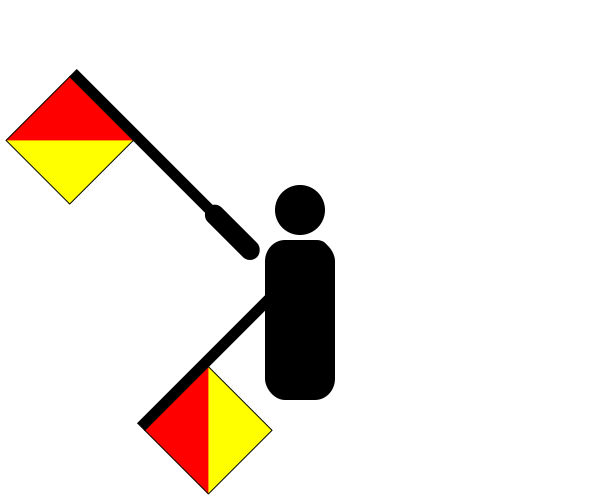

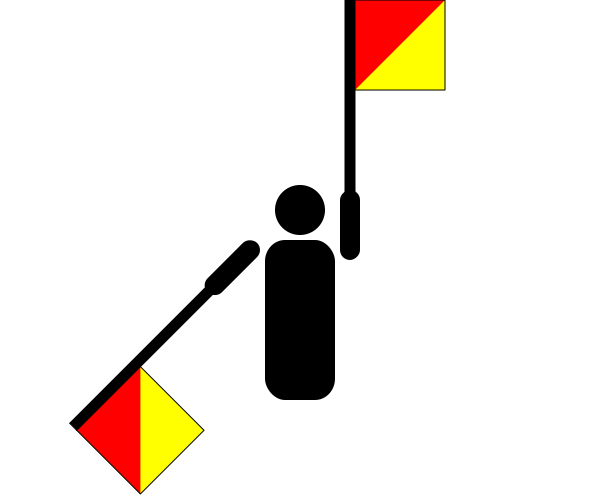
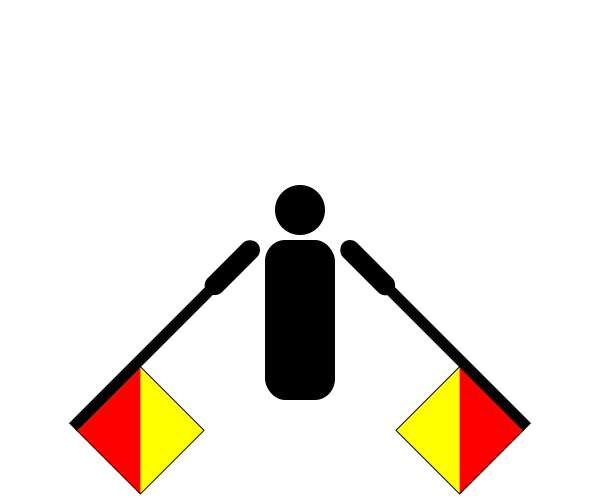

There are approximately 874 people named Dickins in the UK. That makes it roughly the 8,192nd most common surname in Britain. Around 13 in a million people in Britain are named Dickins.
Surname type: From name of parent
Origin: English
Region of origin: British Isles
Country of origin: England
Religion of origin: Christian
Language of origin: English

Famous people named Dickins
- Anne Dickins - Paracanoeist
- Matt Dickins - Football player
- George Dickins - Cricketer (1821 to 1903)
Names and descriptions courtesy of Wikipedia, and may contain errors. This is not intended to be an exhaustive list of every famous person with this name.