DERR
Derr is a surname with a distinctly German origin, although it has also been found in the British Isles, notably in England. It is primarily derived from the Middle High German word derre, meaning a dense area of trees, such as a thicket or copse. As a result, the name originally served as a topographic surname for individuals who lived in or near a wooded area.
In addition to its topographic roots, scholarly sources record a further derivation from the personal name Theudoric, which translates to “people ruler.” The suffix -er was historically added in Germanic naming practice to signify a son, thus Derr could have been used to denote “son of Derr” or “descendant of the ruler.” This dual origin reflects the common practice of surnames arising from both place-based and patronymic roots.
The surname has also been linked, though less firmly, to the Middle High German derre in the sense of “beast” or “animal.” Such an interpretation suggests that early bearers may have been animal breeders or herders. These varying etymologies illustrate the non‑universal nature of surname origins and the way that different branches of a family may acquire distinct meanings.
Documented uses of the name date back to the late fourteenth century. The earliest recorded spelling is Albert Dorre, noted in the registers of the city of Lübke in 1381 during the reign of Emperor Wencel slav. Subsequent records include Henchen Doerren of Berleburg (Westfalen) in 1643, Johan Doers of Breyell (Rheinland) in 1647, and the christening of Anna Maria, daughter of Andreas Doerr, in Bacharach (Rheinland) in 1650. The Hesse coat‑of‑arms associated with the name features three swords splayed on a red field, with a chief bearing a rose proper.
The Derr family subsequently spread through emigration. In the United States it is most common in Pennsylvania and Ohio, echoing the significant German immigrant communities in those states. The name is also found in Canada, Australia, South Africa, and Brazil, with a smaller presence in the United Kingdom despite the surname’s presence there for many generations, often recorded as Dorr, Dirr or one of their diminutives. Such variants include Derre, Durrer, Derry, Dear, and Dare, among others. Some scholars note an independent Celtic origin for the form Dare, derived from the word for “oak tree,” which may account for similarities with Welsh or Irish surnames such as Derry or Doire.
In modern usage the surname Derr continues to serve as a marker of a lineage with deep Germanic roots, a specifiable connection to either a provided natural environment or a historic leadership role. Its prevalence across multiple continents reflects the broader patterns of German migration and the endurance of surnames through centuries of cultural change.
Similar and related surnames
- Dahr
- Dair
- Daire
- Dar
- Dare
- Darr
- Darra
- Darre
- Darrs
- Dear
- Deara
- Deare
- Dearr
- Dearrie
- Dearry
- Dears
- Deary
- Deer
- Deere
- Deers
- Dehra
- Deir
- Der
- Dera
- Dere
- Deres
- Deri
- Derie
- Dern
- Dero
- Deroo
- Derou
- Derra
- Derrey
- Derri
- Derrie
- Derris
- Derrow
- Derry
- Ders
- Deru
- Derue
- Dery
- Diar
- Dier
- Dior
- Dir
- Dire
- Dirr
- Doar
- Door
- Doore
- Dor
- Dore
- Doree
- Dorr
- Dorre
- Dour
- Dower
- Dowers
- Drer
- Dur
- Dure
- Durie
- Durr
- Durra
- Durre
- Dyer
- Dytor
- Teare
- Teer
- Torrie
- Tyre
Related and similar names are generated algorithmically based on the spelling, and may not necessarily share an etymology.
How to communicate the surname Derr in...
Braille
⠙⠑⠗⠗
Morse
-....-..-.
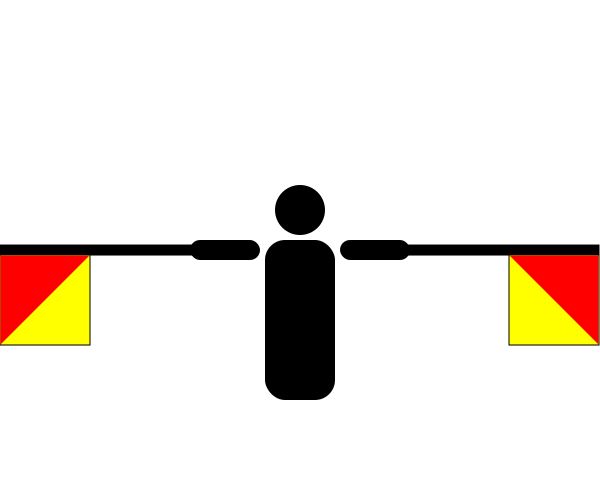
Semaphore


Sorry, we don't have any statistics on this name. That's probably because it's very uncommon in Britain.
Origin: English
Region of origin: British Isles
Country of origin: England
Religion of origin: Christian
Language of origin: English
