DENSON
Denson is a surname of English origin that first emerged during the Middle Ages. Its formation follows the familiar patronymic pattern, in which a child's surname indicates the given name of the father. In the case of Denson, the surname is derived from the medieval personal name Dennis, which itself is a vernacular variant of the Greek name Dionysius.
The name Dionysius is etymologically linked to the Greek god Dionysus, the deity of wine, festivity and merrymaking. Through linguistic evolution and the process of cultural assimilation, Dionysius gave rise to the English name Dennis. When the surname was formed, the element -son was appended to signify “son of Dennis”, resulting in Denson. This construction aligns with other Anglo‑Saxon patronymics such as Denison and Denis.
Historical records attest to the early use of the name. In 1327 the Subsidy Rolls of Somerset contained the entry for John Denyson, an early example of a patronymic formation linked to Dennis. In Scotland, the name appears in the Burgesses and Guild Brethren Lists of 1588 under the spelling John Deaness, cited as a slater. This record indicates that a variant of the surname was in use in the Glasgow and Edinburgh areas during the reign of King James V. The entry was followed by other Scottish references, including a Baillie of Edinburgh named Jacob Deanes in 1682 and a Glasgow merchant referred to as James Deins in 1606. Parish registers of the early seventeenth century record baptisms and marriages under the spellings Deans and Deins, further evidencing the name’s presence in the Hawickshire District.
Another avenue of derivation, supported by contemporary scholarship, suggests that Denson may also have arisen as an occupational surname. This theory proposes that the name was originally a byname applied to someone who resembled a dean, a senior church official; or even used for a dean’s servant. The word dean in medieval usage traces back to the Latin decanus, meaning a leader of ten men. Over time, occupational surnames became hereditary, and the spelling variations Danes, Denson and Densum have occasionally been cited as related forms. While this occupational origin is plausible, the patronymic derivation from Dennis remains the most widely accepted explanation.
Throughout the centuries, bearers of the surname have migrated beyond Britain. In the United Kingdom, the name is found primarily in England, with a noticeable concentration in the Yorkshire area. In the United States, census and immigration records show that Denson is most prevalent in the southern states, reflecting patterns of migration from England during the early modern period. Though not among the most common surnames, Denson has spread fairly evenly across English‑speaking countries and can now be encountered worldwide.
Variations of the surname, while less frequent, are documented and often stem from regional pronunciation and orthographic practices. Variants such as Denison, Dennison and Denisson share the same etymological root and indicate “son of Dennis”. Other less common forms—including Densen, Densun, Densyn and Denneson—reflect phonetic and dialectical differences across locales. These forms illustrate how a single patronymic can give rise to a family of surnames, each bearing the same conceptual origin while adapting to local linguistic environments.
Typical given names associated with the Denson surname
Male
- Alan
- Andrew
- Anthony
- David
- Ian
- John
- Lee
- Mark
- Michael
- Paul
- Philip
- Richard
- Robert
Female
- Carrie
- Catherine
- Elisabeth
- Emma
- Jeanette
- Joanne
- Margaret
- Nicola
- Samantha
- Sarah
- Shannon
- Sharon
- Susan
Similar and related surnames
Related and similar names are generated algorithmically based on the spelling, and may not necessarily share an etymology.
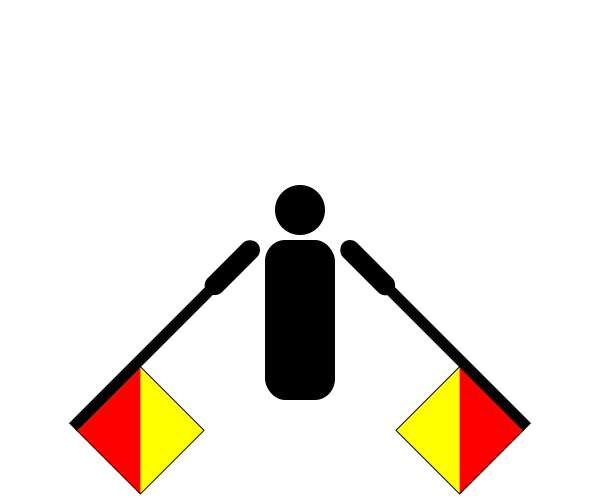
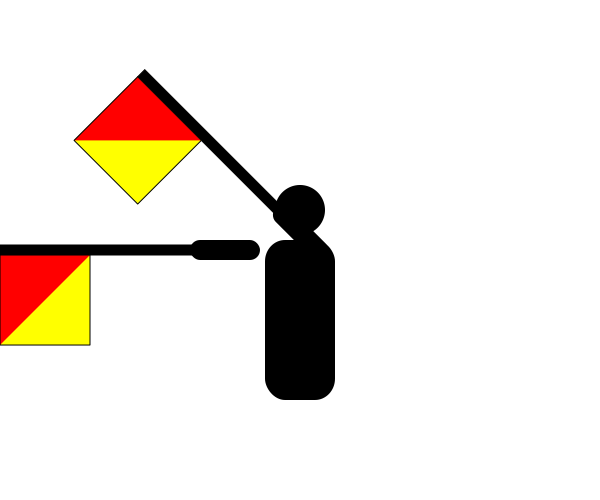
How to communicate the surname Denson in...
Braille
⠙⠑⠝⠎⠕⠝
Morse
-...-....----.
Semaphore



There are approximately 749 people named Denson in the UK. That makes it roughly the 9,223rd most common surname in Britain. Around 12 in a million people in Britain are named Denson.
Surname type: From name of parent
Origin: English
Region of origin: British Isles
Country of origin: England
Religion of origin: Christian
Language of origin: English
