DENK
Denk is a surname of German provenance, frequently associated with intellectual or contemplative attributes. It is believed to have entered the lexicon in the Middle Ages and to derive chiefly from the Middle High German word denke, a noun meaning “thought” or “mind.” The name was originally applied as a nickname to people who were thoughtful, intelligent or pensive, and over time it became hereditary, signifying a family’s association with intellectual or philosophical traits.
In the Germanic and Anglo‑Saxon tradition, the name has been recorded under a variety of spellings, including Danks, Dankin, Dencs, Denk, Denkel, Denker, Denkin, Dincke, Dinkes and Dinkin. These variants arise from differences in regional dialect and clerical transcription in a time when literacy rates were low and personal names were difficult to standardise. The suffix -kin or -kyn meaning “son of” was often added to the baptismal name Daniel, itself derived from the Hebrew name meaning “gift of God.” The resulting patronymic Dunkin (and its many derivatives) demonstrates how the name spread across the Germanic world and into England during the 12th‑century Christian revival and the era of the Crusades.
The earliest surviving examples of the name date from the 13th century. One of the first recorded bearers was Adam Dankyn of Somerset, listed in the Kirby’s Quest in 1273. Subsequent evidence includes Christal Denkel of Konstanz in 1464, Johan Denk of Oberplatz in 1490, Ysabell Dinke christened at St Margarets in Westminster on 25 March 1568, and Roger Denke who married Eleanor Palmer at Bathford in Somerset on 12 February 1662. Further attestations consist of Jacob Denkin, a witness at St Dunstans in Stepney on 15 August 1627, and Ward Denkes, christened at St Brides church on Fleet Street in London on 14 June 1654.
In addition to its Germanic roots, the surname is also recorded as an Ashkenazi Jewish name. In the 17th century it was derived from the German word danke, meaning “thank you,” and was used to denote those who displayed gratitude or were considered thankful. Many Jewish families in Germany adopted the name, and, following the Holocaust, some survivors and their descendants adopted it as a self‑created surname to signify a new identity and a refusal to retain a purely German name. In the United States, it is not uncommon to find Denks of other faiths, reflecting the surname’s broad appeal and its association with a sense of thankfulness and generosity.
Today the surname is most commonly found in German‑speaking countries. In Germany, an estimated five thousand people bear the name, while Austria has about one thousand five hundred and Switzerland roughly two thousand five hundred. The name is also widespread in Luxembourg, Liechtenstein, and the Netherlands, and a significant diaspora exists in the United States, where many bearers are of German descent. In Austria, Denk may occasionally be used as a diminutive of Dankwart, a compound of dank (thanks) and wart (guard).
Variations of the name are frequently linked to geographic and historical contexts. Apart from the English forms, German spellings such as Denck, Dank, Denke, and Denker are found in Bavaria and other federal states. In some cases, clerical changes at churches created further variations like Dencko and Denckmann. The surname also appears as an anglicised form of the Gaelic‑Irish Ó Daimhín, originally meaning “calf.” Although these variations arise from different linguistic trajectories, the core name remains tied to its Germanic heritage.
In sum, the surname Denk carries a dual heritage: a Germanic origin associated with thoughtful or intellectual qualities, and a Jewish line linked to gratitude and thankfulness. Its many recorded variants and widespread geographic distribution underscore a history of migration, cultural exchange and identity formation. Bearers of the name often maintain a tradition of community involvement and philanthropy, reflecting the enduring legacy of the name’s original connotations.
Similar and related surnames
Related and similar names are generated algorithmically based on the spelling, and may not necessarily share an etymology.
How to communicate the surname Denk in...
Braille
⠙⠑⠝⠅
Morse
-...-.-.-
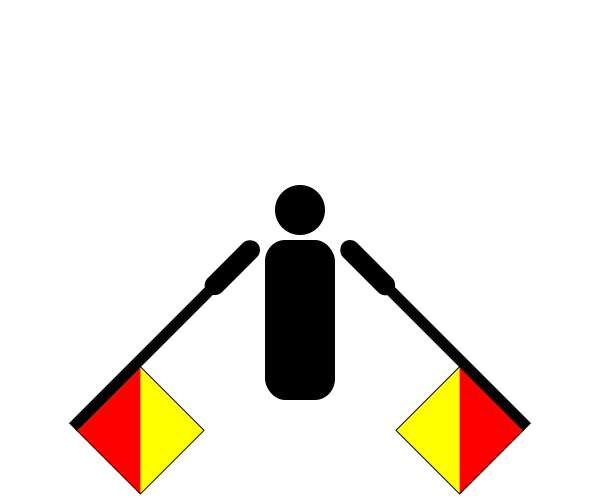
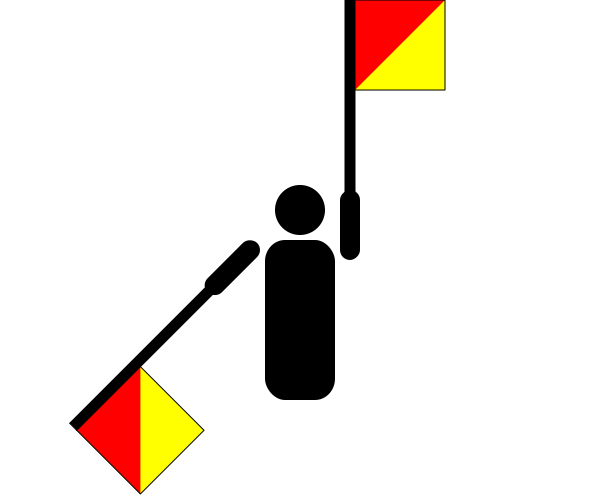
Semaphore


Sorry, we don't have any statistics on this name. That's probably because it's very uncommon in Britain.
