DEMETER
The surname Demeter is rooted in an ancient Greek personal name and was later adopted within Hungarian society, yielding a dual heritage that spans both mythological and linguistic traditions.
The etymological basis of Demeter can be traced to the Greek male given name Demetrios, itself a composite of the elements de, meaning “earth”, and meter, meaning “mother”. This combination produces an interpretation of the name as “earth mother”, a title that underscores the deep connection between humanity and agrarian life.
Scholars have also offered alternative readings of Demetrios, proposing that it conveys a sense of “harvesting of the earth” or “earth‑worker”. Such meanings highlight the importance of cultivation and the fertilising power of the land within the cultural psyche of the Greeks.
Evidence for the name’s early presence in Eastern Europe appears in the charters of the city of Novograd, where a person recorded as Lyubava Dmitrievna is dated to the year 1100. This documentation represents the earliest known instance of the surname, illustrating its migration beyond the Greek mainland into Slavic territories.
In contemporary records, Demeter is ranked among the top ten surnames in Hungary, reflecting its widespread use in that country. Within the Czech Republic, the surname occupies the 195th position according to 2012 statistics, and in the United States, the 1990 census lists 269 individuals bearing the name, with higher concentrations in states such as California, Ohio, Massachusetts and Arizona.
The surname displays an extensive array of orthographic variants that have arisen across different language groups. Common forms include Dmitriev, Mitrovic, Domotor and Mityagin, along with the Greek‑derived versions Demitrius, Dimitri, Dimitris and the Croatian and Serbian spellings Demetrovich and Demetar. In regions such as Estonia, a modified form Demetre is also observed, while the Irish often render the name as Dimitry.
The cultural significance of the surname is intimately linked to the Greek goddess Demeter, who presided over the harvest, fertility and the sustenance of the earth. As the central figure of the Eleusinian Mysteries, she symbolised abundance, seasonal cycles and the divine relationship between humans and the natural world. Consequently, bearers of the surname Demeter carry a legacy that honours the sanctity of agriculture and the stewardship of land.
In modern contexts, the name remains relatively uncommon outside of Greece, Hungary and other Slavic nations, illustrating how historical migrations and cultural retention shape surname distribution. Its persistence in regions such as the United Kingdom, where immigrants have brought the name across the Atlantic, illustrates the continuing relevance of the surname for individuals seeking to maintain a link with ancestral heritage.
Overall, the surname Demeter encapsulates a history that intertwines mythic reverence, agricultural development and linguistic evolution, offering a distinct glimpse into the ways in which ancient names endure within contemporary European societies.
Typical given names associated with the Demeter surname
Male
- Adam
- Daniel
- David
- Istvan
- Marek
- Martin
- Michal
- Milan
- Miroslav
- Robert
Female
- Adrienn
- Andrea
- Anna
- Eva
- Ildiko
- Jan
- Katherine
- Maria
- Marian
- Sarah
Similar and related surnames
Related and similar names are generated algorithmically based on the spelling, and may not necessarily share an etymology.
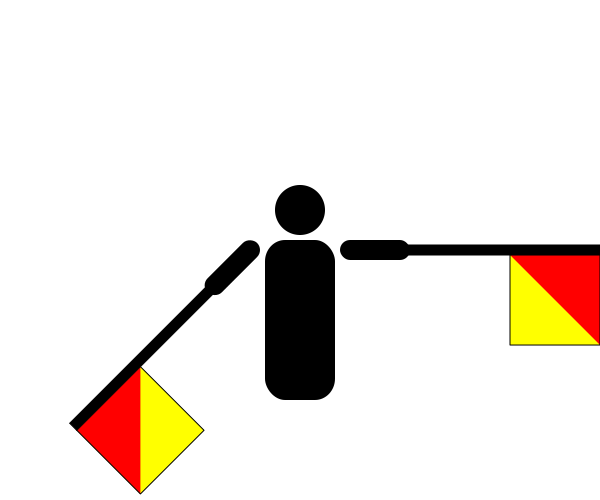
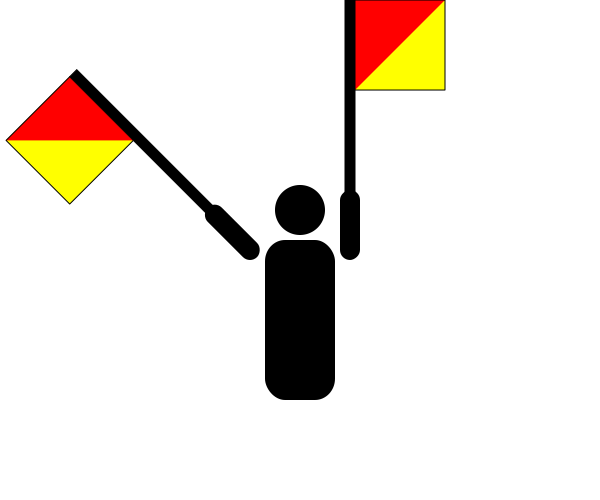
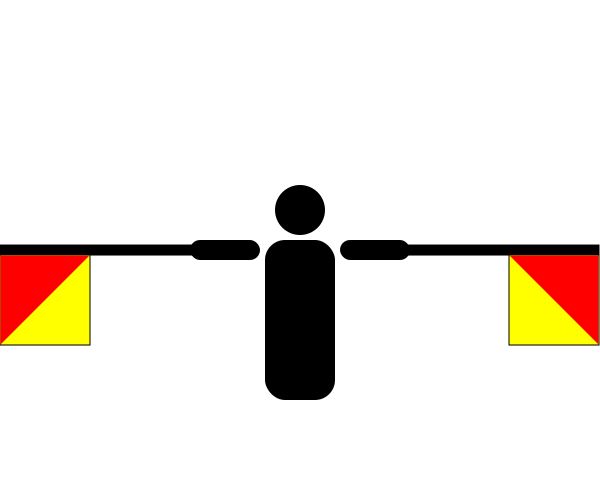
How to communicate the surname Demeter in...
Braille
⠙⠑⠍⠑⠞⠑⠗
Morse
-...--.-..-.
Semaphore


There are approximately 150 people named Demeter in the UK. That makes it one of Britain's least common surnames. Only around two in a million people in Britain are named Demeter.